
Garmin Approach R10: Is It Worth It in 2026?

On this page8
- 01What does the Garmin Approach R10 actually measure?
- 02How accurate is the Garmin R10, and where does it fall short?
- 03Indoor or outdoor: does it need real turf?
- 04Garmin R10 vs Rapsodo MLM2PRO vs SkyTrak ST MAX: how do they compare?
- 05What software actually works with the Garmin R10?
- 06How much does the Garmin R10 actually cost, all in?
- 07Who is the Garmin R10 actually good for?
- 08The bottom line on the Garmin Approach R10
Yes, the Garmin Approach R10 is worth it for most golfers, at $599.99 MSRP (regularly discounted to $499-549), it is the cheapest way to get real Doppler-radar ball data and a simulator at home. The catch is spin: the R10 calculates it instead of measuring it directly, so shot-shape accuracy drops indoors unless you add Titleist RCT balls. If you want trustworthy curvature data out of the box, or you’re building a serious sim room, that single limitation is worth knowing before you buy.
What does the Garmin Approach R10 actually measure?
The R10 directly measures four things off its Doppler radar: club head speed, ball speed, launch angle, and launch direction. From those four numbers it calculates another ten, including spin rate, spin axis, angle of attack, smash factor, apex height, carry distance, total distance, and deviation, for 14 metrics total, per Garmin’s own product page.
That distinction between “measured” and “calculated” matters more than the spec sheet suggests. Club speed, ball speed, and launch numbers are genuinely solid: PlayBetter’s testing put distance accuracy within 1-2 yards on mid-irons, widening to 8-10 yards on drivers, with a shot-detection miss rate under 3%. Spin is where the radar has to guess, and that guess is the single most common complaint you’ll find in golf forums about this unit.
How accurate is the Garmin R10, and where does it fall short?
Garmin publishes tolerance figures of roughly ±3 mph on club speed, ±1 mph on ball speed, and ±1 degree on launch angle and direction. Those numbers hold up in independent testing for full-swing shots on a mat or on grass. MyGolfSpy’s lab testing, which ran 13 launch monitors through 50 hours of side-by-side sessions, scored the R10 87.5 out of 100 overall and 85 out of 100 specifically for accuracy, with the same conclusion: it performs better outdoors than in, and spin is the recurring weak spot at this price.
Spin is a different story. Because the R10 calculates spin axis mathematically instead of tracking the ball’s rotation, curvature and deviation numbers can be off by 10-15 yards without help, according to Home Performance Lab’s comparison testing. Pair the R10 with a Titleist RCT ball, which embeds a chip the radar can read directly, and spin rate tightens to within roughly 100 rpm of a Bushnell Launch Pro. Without an RCT ball, especially indoors, treat every draw or fade number as a rough estimate, not a fact.
Indoor or outdoor: does it need real turf?
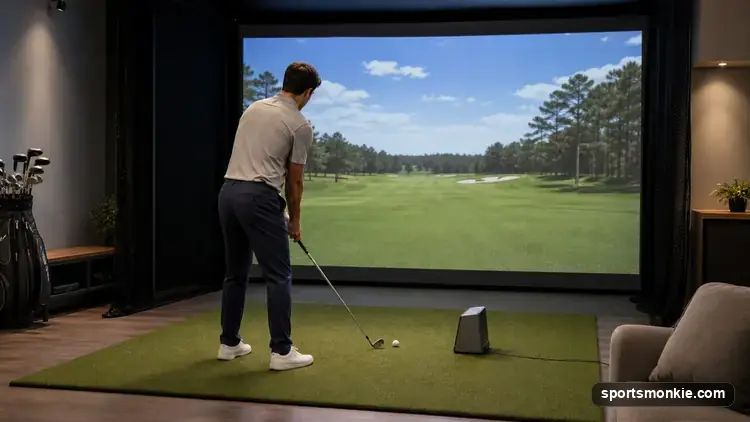
Both, and the R10 is genuinely built to travel between them. Outdoors, it works off real ball flight the same way any radar unit does. Indoors, it needs actual room: 6-8 feet behind the ball and a minimum of about 13-14 feet from ball to net or screen, with accuracy improving out to roughly 21 feet of total depth. Go shorter than that minimum and the numbers get noisy fast.
That space requirement rules the R10 out for a lot of tight home setups. If your hitting bay is under 14 feet deep, a camera-based unit like the SkyTrak ST MAX (the successor to the SkyTrak+, using the same side-mounted photometric system) fits better, since it only needs about 10 feet of depth, though you’ll pay several times more for the privilege.
Garmin R10 vs Rapsodo MLM2PRO vs SkyTrak ST MAX: how do they compare?
| Garmin Approach R10 | Rapsodo MLM2PRO | SkyTrak ST MAX | |
|---|---|---|---|
| Price | $599.99 MSRP (often $499-549) | $699.99, or $899 with 1-year membership | $2,995 ($1,995 during current promo) |
| Spin measurement | Calculated (radar); needs RCT balls for accuracy | Directly measured (dual camera + radar) | Directly measured (camera) |
| Space needed indoors | ~13-14 ft minimum, 21 ft ideal | ~14-16 ft | ~10 ft (works beside the ball) |
| Subscription | Free tier + $9.99/mo or $99/yr for Home Tee Hero | 45-day trial, then $199/yr or $499 lifetime | $300-$600/yr for full simulator access |
| Best for | Budget-conscious buyers with 14+ ft of room | Golfers who want measured spin without SkyTrak money | Compact spaces, most polished native app |
The pattern: the R10 wins on upfront and ongoing cost, the MLM2PRO wins on spin accuracy for a few hundred dollars more, and SkyTrak ST MAX wins on space efficiency and app polish if your budget has real room in it. Rapsodo’s own listing confirms the MLM2PRO captures 15 metrics per shot including directly measured spin rate, spin axis, and club path, which is the exact gap the R10 papers over with math.
What software actually works with the Garmin R10?
The R10 pairs with the Garmin Golf app for range sessions, shot dispersion charts, and swing video, and it plugs into Garmin’s own Home Tee Hero simulator mode. Home Tee Hero now covers more than 43,000 real courses, but full access sits behind a subscription, per Garmin’s own support documentation: $9.99 a month or $99 a year after a 30-day free trial, on top of the hardware price. A handful of E6 Connect courses come free with the unit if you’d rather skip the subscription entirely.
Beyond Garmin’s own software, the R10 also feeds into third-party simulators including E6 Connect, Awesome Golf, and Golf Club 2019, which is more open compatibility than most launch monitors in this price bracket offer.
How much does the Garmin R10 actually cost, all in?
Sticker price undersells the real number. Budget for the $599.99 MSRP hardware (realistically closer to $499-549 with a sale, which happens often around Memorial Day, Father’s Day, Prime Day, and Black Friday), then decide whether you want Home Tee Hero at $99 a year, and whether you’ll add a sleeve of Titleist RCT balls for indoor spin accuracy. A golfer who buys outdoors-only and skips the subscription can be in and out for under $550. Add the software and balls and you’re closer to $650-700 in year one, which starts to close the gap on the MLM2PRO.
Who is the Garmin R10 actually good for?
The R10 is the right buy for a golfer who wants a home range setup or an occasional simulator round, has at least 14 feet of usable depth indoors, and doesn’t need tournament-grade shot-shape data to improve. It’s especially strong for anyone tracking their golf handicap over a season, since consistent carry distances and clean strike data matter more for that than perfect spin numbers.
Spend more if you coach for a living, you’re building a permanent sim room and can afford the deeper subscription costs, or you specifically need trustworthy draw/fade numbers without buying specialty balls. In that case, the MLM2PRO or a camera-based unit like the SkyTrak ST MAX earns its higher price. For most weekend and mid-handicap players working on ball-striking rather than tour-level shot shaping, though, the R10 gives you 90% of the useful data for a third of the cost of the units above it.
The bottom line on the Garmin Approach R10
Buy the R10 if you want real practice data at home without a four-figure commitment, and accept that indoor spin needs a $2-3 RCT ball to be trustworthy. Skip it only if precise shot-shape numbers, not distance and strike quality, are the whole point of your purchase. For most golfers improving their scoring, whether in casual match play or stroke play rounds, the R10 answers the two questions that actually move a handicap: how far did that go, and how solid was the strike. For more gear breakdowns and everything else shaping the men’s and women’s professional game, visit our golf hub.
Frequently asked questions
Is the Garmin Approach R10 accurate enough to trust?+
For club speed, ball speed, launch angle, and carry distance, yes, within about 1-2 yards on mid-irons according to independent testing. Spin is the weak point: the R10 calculates spin axis from radar rather than measuring it directly, so curvature reads can be off by 10-15 yards unless you use Titleist RCT golf balls.
Do I need special golf balls for the Garmin R10?+
Not to get a carry distance, but yes if you want trustworthy spin and shot-shape data indoors. The R10 pairs with Titleist RCT (Radar Capture Technology) balls to read spin directly. Without them, indoors especially, deviation and curvature numbers are rough estimates rather than measurements.
Can I use the Garmin R10 indoors in a small room?+
You need real space, not a closet. Garmin and independent testers recommend 6-8 feet behind the ball and roughly 13-14 feet minimum from ball to net, with accuracy improving out to about 21 feet of total depth. Below that, ball flight data gets noticeably less reliable.
What is Home Tee Hero and do I have to pay for it?+
Home Tee Hero is Garmin's own golf simulator mode, playable through the Garmin Golf app across more than 43,000 real courses. A limited set of courses is free with the R10; full access runs $9.99 a month or $99 a year, with a 30-day free trial per Garmin's support pages.
Garmin R10 vs Rapsodo MLM2PRO: which should I buy?+
Buy the R10 for simulator range and lower total cost; buy the MLM2PRO if trustworthy spin data matters more than price. The MLM2PRO uses dual cameras plus radar to measure spin directly and ships with RCT-style balls, but its $699.99 launch price and required membership push the real cost higher than the R10's.
How long does the Garmin R10 battery last?+
Garmin rates the Approach R10 for up to 10 hours of continuous use on a full charge, which covers a full range session or several simulator rounds before you need to plug it back in. The unit charges over USB-C, the same cable most current phones use.
Sources
- Garmin – Approach R10 Portable Golf Launch Monitor (specs, price)
- Garmin Support – Membership and subscription fees for Garmin Golf products
- MyGolfSpy – Garmin R10 Golf Launch Monitor Review
- PlayBetter – Garmin Approach R10 Review: Best Golf Launch Monitor Under $1,000?
- Home Performance Lab – Garmin R10 vs Mevo+ vs SkyTrak+ Comparison (space/accuracy data)
- Rapsodo – MLM2PRO Mobile Launch Monitor + Golf Simulator
Play & tools
Free browser games and tools — no account, no download.
- Play today's Sports Connections — Today's Sports Connections — daily hints, answers, and play the grid.
- Play Guess the NFL Player — A new mystery NFL player every day. Eight guesses, with a clue on each — plus free unlimited mode.
- Explore all our games →
Related golf guides
View all →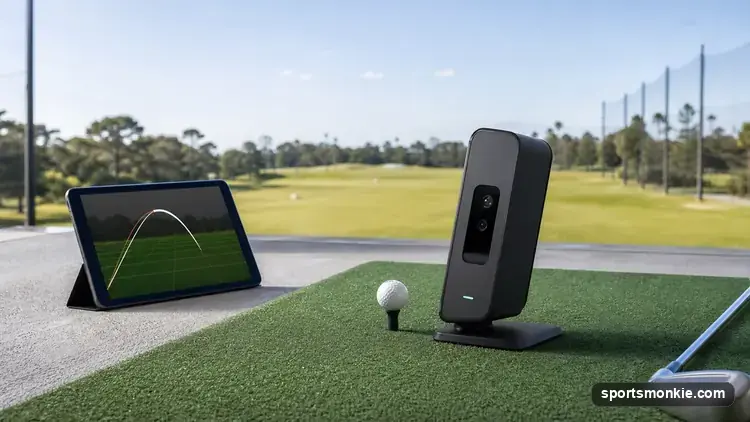
Portable Golf Launch Monitors: What Actually Matters
What a portable golf launch monitor really measures, 2026 prices from $200 to $2,500, and which metrics are marketing fluff versus real data.
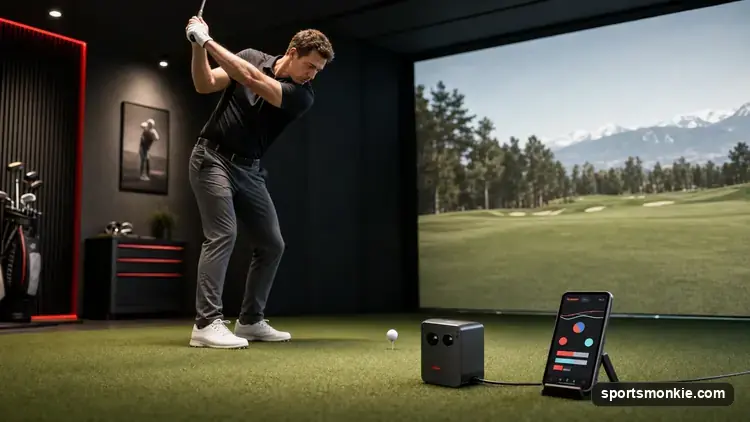
Rapsodo MLM2PRO Review: Is It Worth It in 2026?
Rapsodo MLM2PRO price, subscription cost, accuracy, and E6 Connect compatibility, tested against the Garmin R10 to answer whether it is worth buying in 2026.
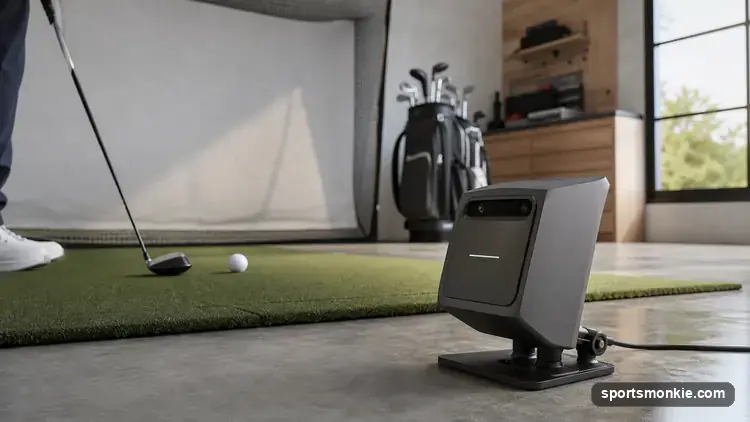
Shot Scope LM1 Review: Is It Worth It in 2026?
The Shot Scope LM1 golf launch monitor costs $199.99 and tracks 5 swing metrics with no subscription. Here's the accuracy, limits, and who should buy it.
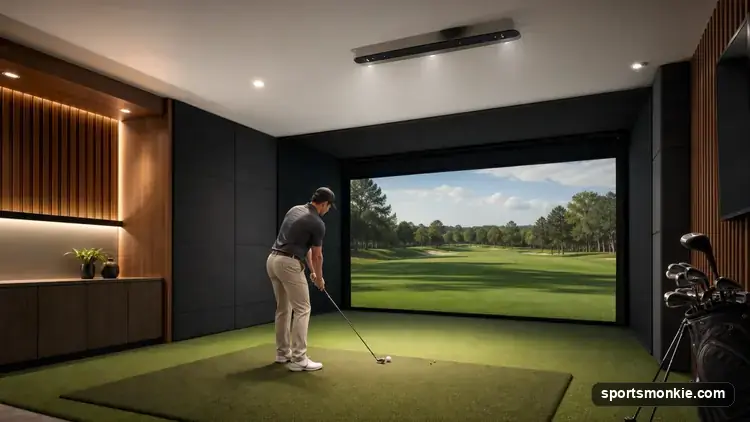
Overhead & Ceiling-Mounted Golf Launch Monitors: Worth It?
Overhead golf launch monitors mount to the ceiling, safe from mis-hits. What they cost, the ceiling height needed, and who should skip it for a floor unit.
Best Launch Monitor for a Golf Simulator (2026 Guide)
A launch monitor for a golf simulator lives or dies on software compatibility, not specs. What actually works with GSPro, E6 Connect, and your room size.

McIlroy Says Yes to LIV Players Coming Back to the PGA Tour
Rory McIlroy, LIV's loudest critic since 2022, told a New Delhi forum he would vote to welcome its players back, called LIV half a good idea and said the threat is over.