
Lacrosse vs Hockey: Similarities, Differences and Crossover Skills

On this page6
Lacrosse and hockey are close cousins, not the same sport. Both are stick games built on goals, quick passing, and hard body contact, but lacrosse is played with a rubber ball on a grass or turf field by ten players a side, while ice hockey uses a puck on ice with six a side. They share so much physical and tactical DNA that thousands of athletes, including Wayne Gretzky, grew up playing both. Below is exactly where they line up and where they split.
Lacrosse vs hockey: the core differences
The fastest way to see the relationship is side by side. The figures for lacrosse come from World Lacrosse and USA Lacrosse; the hockey figures follow the NHL’s official rules.
| Feature | Field lacrosse | Ice hockey |
|---|---|---|
| Surface | Grass or artificial turf field | Sheet of ice inside a boarded rink |
| Object played | Solid rubber ball (~5 oz, ~8 in around) | Vulcanized rubber puck (~6 oz, frozen) |
| Players on the field/ice | 10 per team (incl. goalie) | 6 per team (5 skaters + goalie) |
| Contact | Body checking and stick checking (men’s) | Body checking and stick contact |
| Goal size | 6 ft by 6 ft | 6 ft wide by 4 ft tall |
| Typical scoring | High, often 10-plus goals a team | Lower, often 2 to 5 goals a team |
| Movement | Running | Skating |
The single cleanest divider is the last two rows: you skate in hockey and run in lacrosse, and lacrosse games run up far bigger scores because the net is larger and the ball moves faster into open space.
Is hockey the same as lacrosse?
No, and the confusion usually comes from box lacrosse rather than the field game. Box lacrosse is played indoors in a converted hockey rink, with six players a side behind the same boards, and it looks enough like hockey without skates that the two blur together on video. But even there the object is a ball in a netted stick, not a puck on a blade.
Field lacrosse, the version most Americans and Australians grow up with, spreads ten players across a field roughly 110 yards long. Ice hockey compresses six players onto a 200-foot ice sheet where the boards keep the puck alive. Same instinct, different container. The tactics rhyme, the equipment does not.
Is lacrosse played with a puck or ball?
A ball, every time. The lacrosse ball is solid rubber, about five ounces, and just under eight inches in circumference, carried in the mesh pocket of the stick and thrown or shot from there. Ice hockey’s puck is a flat disc of vulcanized rubber, frozen before play so it slides cleanly and does not bounce.
That difference drives everything else. A ball in a pocket has to be cradled, a constant rocking motion that keeps it seated while you run and get hit. A puck sits on the ice and is pushed, pulled, and snapped with the blade. Learning to cradle is the skill new lacrosse players wrestle with most, much as edge work is the wall new skaters hit. If you want the fuller breakdown of that learning curve, see our guide to whether lacrosse is hard to learn.
Is hockey harder than lacrosse?
They are hard in different places, so the honest answer depends on where your athleticism already sits. Hockey front-loads its difficulty: until you can skate confidently, you cannot do anything else, and that keeps a lot of beginners off the ice for a season or more. Lacrosse lets you start running on day one, then buries its difficulty in stickwork, the cradle, the off-hand pass, the quick-stick shot, that takes months to feel natural.
Physically, field lacrosse asks for more sustained running because the field is large and the ball changes ends fast. Hockey shifts are short, explosive, and repeated, closer to interval sprints on a slick surface. A converted athlete usually finds the hockey learning curve steeper at the very start and the lacrosse one steeper in the middle. Neither sport is soft; both feature real collisions, and men’s lacrosse permits cross-checking within defined rules that surprises players coming from other field sports.
What did Wayne Gretzky say about lacrosse?
Gretzky is lacrosse’s most quoted hockey advocate, and his point was about playing more than one sport, not choosing between them. In his own recollection he “played lacrosse, baseball, hockey, soccer, track and field,” and was “a big believer that you played hockey in the winter and when the season was over you hung up your skates and you played something else.” He has repeatedly tied that off-season lacrosse to the hand-eye coordination that shaped his hockey.
It is not a lone-genius quirk. Generations of Canadian hockey players used summer lacrosse to keep their hands sharp while their legs rested from skating, and the pipeline still runs both directions today.
Crossover skills: why the two sports feed each other
The reason athletes stack these two sports is that the transferable skills are unusually direct:
- Hand-eye coordination. Catching and releasing a small object on a stick under pressure is the same nervous-system task whether it is a ball or a puck.
- Spatial awareness. Reading a give-and-go, screening a goalie, and timing an off-ball cut translate almost cleanly between rink and field.
- Physical toughness. Both sports normalize contact, so a player used to protecting the puck along the boards already knows how to shield a ball while getting checked.
- Shooting instinct. The wind-up differs, but the read, find the corner the goalie has left open, is shared, which is why lacrosse “top corner” shooters often become natural hockey snipers.
Speed and agility round it out. Change-of-direction footwork on turf builds the same hips that hockey’s crossovers demand once skates are on.
If you are choosing a first stick sport for a child, a fair rule of thumb is this: start with lacrosse if you want to be playing games within weeks, and hockey if your family already lives near ice and you want the skating base early. Many players simply refuse to choose, and the crossover data suggests they are right to. For a related field-sport comparison, our breakdown of lacrosse vs field hockey shows how the “hockey” name gets shared across very different games. Pick one, learn its stick, and the second sport will come to you faster than you expect.
Frequently asked questions
Is hockey harder than lacrosse?+
Neither is clearly harder; they tax you differently. Ice hockey adds skating, so balance and edge control raise the barrier to entry. Lacrosse removes skating but demands more running and a deeper skill of cradling and passing a small ball at speed. Hockey punishes beginners faster, while lacrosse rewards endurance over a full field.
Is hockey the same as lacrosse?+
No. Both use sticks, goals, and heavy body contact, but hockey is played with a puck on ice by six players a side, and field lacrosse uses a rubber ball on grass or turf with ten players a side. The overlap is real in physicality and tactics, not in the playing surface or equipment.
What did Wayne Gretzky say about lacrosse?+
Gretzky credited a multi-sport childhood, saying he played lacrosse, baseball, hockey, soccer, and track and field, and believed young athletes should hang up their skates in the off-season and play something else. He has long argued lacrosse sharpens hand-eye coordination that carries directly onto the ice.
Is lacrosse played with a puck or ball?+
Lacrosse is played with a solid rubber ball, roughly five ounces and about eight inches around, carried and thrown in a stick's netted pocket. The puck belongs to ice hockey, a flat vulcanized-rubber disc that slides along the ice. This is the clearest single line dividing the two sports.
Sources
Play & tools
Free browser games and tools — no account, no download.
- Play today's Sports Connections — Today's Sports Connections — daily hints, answers, and play the grid.
- Play Guess the NFL Player — A new mystery NFL player every day. Eight guesses, with a clue on each — plus free unlimited mode.
- Explore all our games →
Related guides
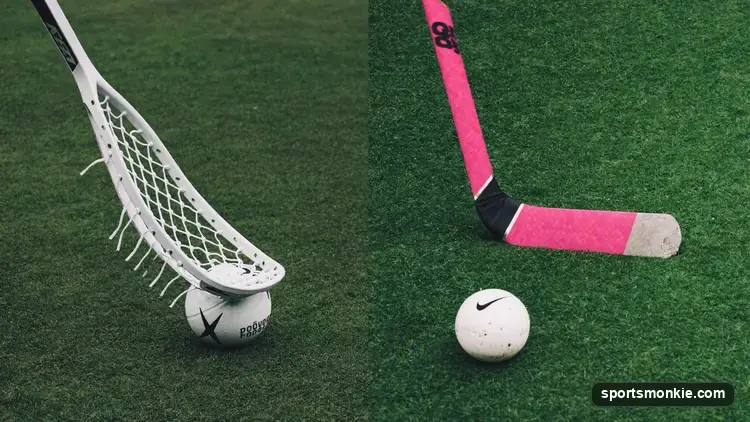
Lacrosse vs Field Hockey: Key Differences Explained
Lacrosse vs field hockey: one throws a ball through the air with a netted stick, the other pushes it along the ground. Compare rules, gear, and contact.

Box Lacrosse vs Field Lacrosse
Box lacrosse is a fast 5-on-5 indoor game; field lacrosse is a 10-on-10 outdoor sport. Rules, field, gear and physicality compared.

The 8-Meter Arc in Women's Lacrosse: Free Position Shots
The 8-meter arc in women's lacrosse is the fan in front of goal where a major defensive foul gives the attacker a free position shot. Rules and procedure inside.
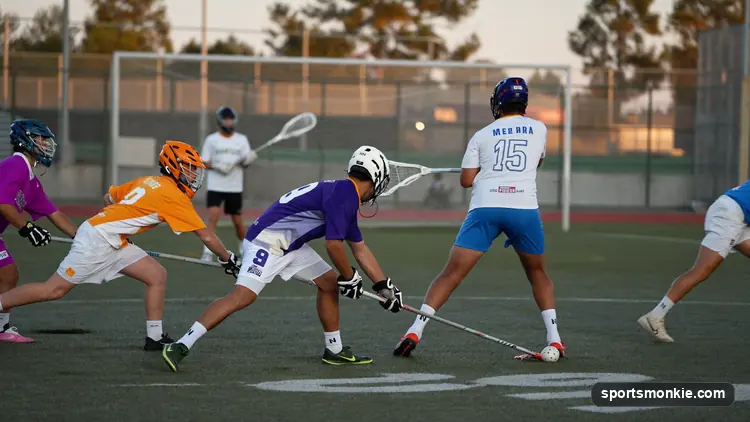
Adult Lacrosse Leagues: How to Find One and What They Cost
Adult lacrosse leagues run roughly $100-250 a season. Here is how to find one near you, what the divisions mean, and whether it's too late to start.

Can You Kick the Ball in Lacrosse? The Rule Explained
Yes, you can kick the ball in men's lacrosse, and you can even score by kicking it. The women's game restricts it more. Here is exactly what the rules allow.

The Fastest Lacrosse Shot Ever (And Average Speeds by Level)
The fastest lacrosse shot ever officially recorded is 119.9 mph by Patrick Luehrsen. See the record, plus average lacrosse shot speed by level.