
Biggest Match-Fixing Scandals in Cricket History, Ranked
On this page13
- 01At a Glance: The Biggest Cricket Fixing Scandals
- 021. The Hansie Cronje Affair (South Africa, 2000)
- 032. The 2000 Indian Match-Fixing Investigation
- 043. Salim Malik’s Life Ban (Pakistan)
- 054. Pakistan’s Lord’s Spot-Fixing Scandal (2010)
- 065. The IPL 2013 Spot-Fixing Scandal (India)
- 076. Pakistan Super League Spot-Fixing (2017)
- 087. Marlon Samuels’ Repeated Bans (West Indies)
- 098. Maurice Odumbe’s Bribery Ban (Kenya, 2004)
- 109. Mervyn Westfield’s County Cricket Fix (England, 2012)
- 1110. Shakib Al Hasan’s Failure-to-Report Ban (Bangladesh, 2019)
- 12How We Ranked These Scandals
- 13Cricket’s Anti-Corruption Response in 2026
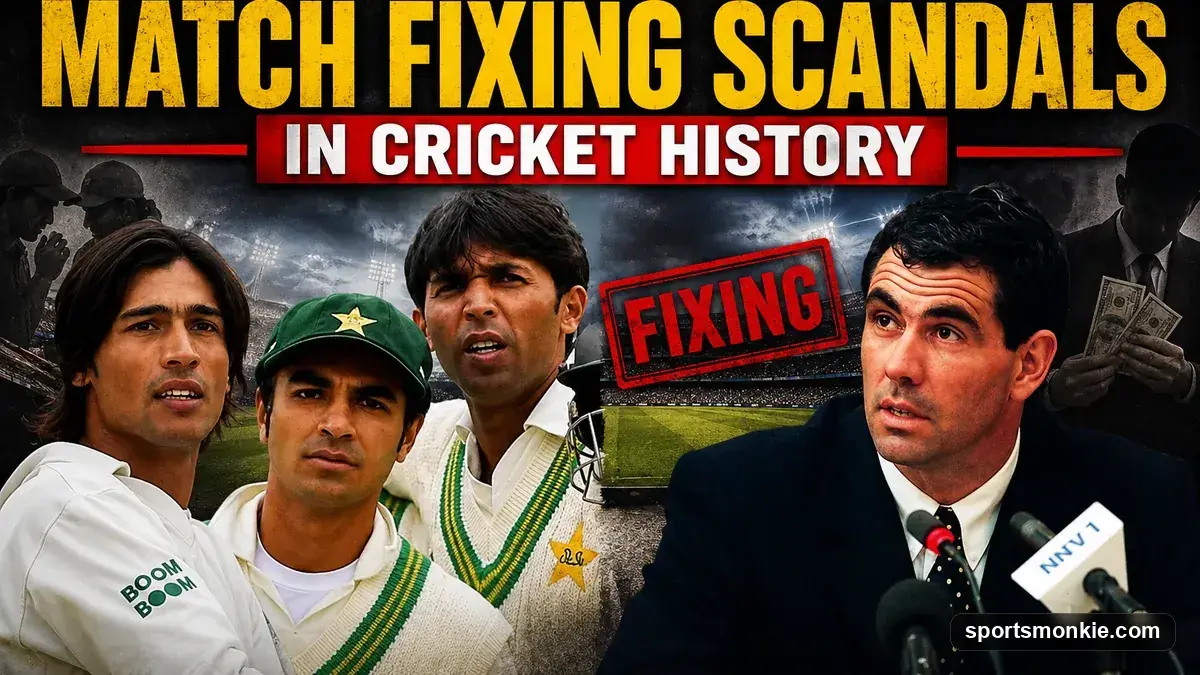
Cricket’s biggest match-fixing scandal broke in April 2000, when a South African wiretap caught captain Hansie Cronje discussing cash with a bookmaker — a confession that exposed corruption at the sport’s highest level. A decade later, the 2010 Lord’s spot-fixing case put three Pakistan internationals in a British prison for arranging no-balls on demand. Between those two poles sits a longer list: Indian captains, Kenyan and West Indian internationals, county pros, and IPL franchise players, all caught, charged, and banned. Here are cricket’s 10 biggest fixing scandals, ranked and verified.
At a Glance: The Biggest Cricket Fixing Scandals
| Rank | Scandal | Nation(s) | Key Figure | Why It Ranks Here |
|---|---|---|---|---|
| 1 | Hansie Cronje affair | South Africa | Hansie Cronje | Captain’s confession created the ICC ACU |
| 2 | 2000 Indian fixing probe | India | Mohammad Azharuddin | Life bans for a captain and teammate |
| 3 | Salim Malik ban | Pakistan | Salim Malik | First captain to orchestrate fixes from within |
| 4 | Lord’s spot-fixing | Pakistan | Butt, Asif, Amir | Only scandal to jail active internationals |
| 5 | IPL 2013 spot-fixing | India | S. Sreesanth | First T20-league arrests; two franchises suspended |
| 6 | PSL 2017 spot-fixing | Pakistan | Sharjeel Khan, Khalid Latif | Six players sanctioned in one season |
| 7 | Marlon Samuels bans | West Indies | Marlon Samuels | Banned twice, 15 years apart |
| 8 | Maurice Odumbe ban | Kenya | Maurice Odumbe | Ended an associate-nation captain’s career |
| 9 | Mervyn Westfield case | England | Mervyn Westfield | First county player jailed for fixing |
| 10 | Shakib Al Hasan ban | Bangladesh | Shakib Al Hasan | Non-reporting alone proved bannable |
1. The Hansie Cronje Affair (South Africa, 2000)
Cronje was South Africa’s captain, publicly devout and widely trusted, which made his April 2000 confession land even harder. A wiretap caught him discussing payments with bookmaker Sanjay Chawla; he later admitted to South Africa’s King Commission he had taken money for information and, at times, for influence over outcomes. He received a lifetime ban and died in a 2002 plane crash before any reinstatement bid. The case proved corruption reached cricket’s top and directly led the ICC to found its Anti-Corruption Unit that year.
2. The 2000 Indian Match-Fixing Investigation
While Cronje’s story broke, India’s Central Bureau of Investigation was running a parallel probe implicating the country’s biggest names. Former captain Mohammad Azharuddin got a life ban, set aside by the Andhra Pradesh High Court in 2012 on procedural grounds, though he never played internationally again. Ajay Sharma also received a permanent ban; Ajay Jadeja and Manoj Prabhakar, whose 1997 allegations triggered the inquiry, got five-year bans later reduced. The probe showed bookmaking networks had reached the national team’s dressing room directly.
3. Salim Malik’s Life Ban (Pakistan)
Salim Malik, Pakistan’s captain through the 1990s, was banned for life by the PCB in 2000 after a judicial inquiry led by Justice Malik Mohammad Qayyum found he had offered teammates money to underperform, including approaches to Australians Shane Warne and Mark Waugh. He was the first modern-era international captain found guilty of orchestrating fixes from inside his own team, rather than merely accepting payments. A Lahore court overturned the ban in 2008 on a technicality, but Malik never played for Pakistan again.
4. Pakistan’s Lord’s Spot-Fixing Scandal (2010)
During Pakistan’s August 2010 Test at Lord’s, a News of the World sting filmed agent Mazhar Majeed guaranteeing exactly when bowlers would deliver pre-arranged no-balls — and the deliveries landed precisely as predicted. The ICC banned captain Salman Butt for 10 years (five suspended), Mohammad Asif for seven (two suspended), and Mohammad Amir, then 18, for five. A London court convicted all three of conspiracy in November 2011, jailing Butt two and a half years, Asif one year, and Amir six months — the only cricket-fixing case to send active internationals to prison.
5. The IPL 2013 Spot-Fixing Scandal (India)
Delhi Police arrested three Rajasthan Royals bowlers, S. Sreesanth, Ankeet Chavan, and Ajit Chandila, in May 2013 on spot-fixing charges. The BCCI gave Sreesanth and Chavan life bans; the Supreme Court later reduced Sreesanth’s to seven years. A parallel probe exposed betting links through Chennai Super Kings and Rajasthan Royals, and both franchises were suspended from the IPL for two years from 2016 — the first fixing scandal to reach a major global T20 league.
6. Pakistan Super League Spot-Fixing (2017)
A sting by undercover British police, working through bookie Yousef Anwar, exposed a fixing ring around the PSL’s second season. Opener Sharjeel Khan was banned five years (two and a half suspended) for agreeing to play deliberate dot balls for payment; Khalid Latif got a matching five-year ban and a fine for recruiting teammates into the scheme. Mohammad Irfan, Shahzaib Hasan, Nasir Jamshed, and Mohammad Nawaz all received separate sanctions for failing to report approaches, with Jamshed’s later extended to 10 years plus a UK prison term. Six players were sanctioned from one league season.
7. Marlon Samuels’ Repeated Bans (West Indies)
Marlon Samuels is one of a handful of players banned twice for corruption, 15 years apart. In 2008, the West Indies board banned him two years after he passed team information to Indian businessman Mukesh Kochhar and accepted a hotel benefit from him. In 2023, an ICC tribunal handed him a separate six-year ban for a different breach of the anti-corruption code. The two cases, spanning most of his playing and post-playing career, make him a rare repeat offender in the ICC’s disciplinary record.
8. Maurice Odumbe’s Bribery Ban (Kenya, 2004)
Maurice Odumbe captained Kenya through its best-ever World Cup run, reaching the 2003 semifinal, before an ICC investigation found he had accepted money from a bookmaker. He was banned from all cricket for five years in 2004, ending the career of the most recognizable player Kenyan cricket had produced. The case showed fixing networks reaching well beyond the game’s traditional powers, into an associate nation with far less institutional oversight than India, Pakistan, or South Africa.
9. Mervyn Westfield’s County Cricket Fix (England, 2012)
Essex fast bowler Mervyn Westfield admitted spot-fixing a 2009 domestic match against Durham, conceding a pre-agreed number of runs for £6,000 arranged through teammate Danish Kaneria. He was jailed four months in 2012 and banned from cricket for life by the ECB — the first case proving fixing had spread into English county cricket, not just internationals and franchise T20s.
10. Shakib Al Hasan’s Failure-to-Report Ban (Bangladesh, 2019)
Bangladesh’s captain and all-time leading all-rounder, Shakib Al Hasan, was banned two years (one suspended) by the ICC in October 2019 — not for fixing anything himself, but for failing to report three corrupt approaches from Indian businessman Deepak Agarwal in 2018 and during an IPL match. Shakib accepted the charges and served his active suspension before returning in October 2020, the clearest example of the ICC treating silence about an approach as seriously as accepting one.
How We Ranked These Scandals
Rankings weigh four factors: the seniority of players involved (captains rank above squad players), whether the case reached criminal courts or disciplinary tribunals only, the length and permanence of the ban, and the scandal’s lasting impact on how cricket is governed. Cases that reshaped anti-corruption policy, like Cronje’s, outrank ones confined to a single domestic or league fixture, even with a similarly severe ban.
Cricket’s Anti-Corruption Response in 2026
The ICC’s Anti-Corruption Unit, formed directly because of the Cronje and CBI cases, now runs mandatory education for international and major-league players, restricts outsider access around teams, and requires players to report any corrupt approach or face sanction themselves, as Shakib Al Hasan learned. Franchise leagues including the IPL and PSL have added their own compliance officers on top of ICC oversight. As of 2026, no international team has produced a Cronje- or Malik-level captain-led scandal since 2010, though domestic and franchise cases, like the PSL’s 2017 sting, keep surfacing as fixers target competitions with less scrutiny than bilateral internationals.
Cricket’s corruption history sits alongside the sport’s greatest players of all time, several of whom played through the same era. For the format most targeted by fixers, see how IPL and other T20 leagues compare, and browse more explainers on the cricket hub for how the sport’s rules and records have evolved.
See also how this compares in What Is Strike Rate in Cricket? Batting & Bowling Explained.
Frequently asked questions
What was the biggest match-fixing scandal in cricket?+
The Hansie Cronje affair in 2000 is the biggest match-fixing scandal in cricket history. South Africa's captain admitted taking money from bookmakers for information and match influence, received a lifetime ban, and forced the ICC to build its Anti-Corruption Unit from scratch.
Which cricketers have received lifetime bans for match-fixing?+
Hansie Cronje (South Africa), Mohammad Azharuddin (India, later overturned by an Indian court in 2012), Ajay Sharma (India), and Salim Malik (Pakistan, ban later overturned by a Lahore court in 2008) are among the cricketers handed lifetime bans for corruption.
What happened in the 2010 Pakistan spot-fixing scandal?+
Captain Salman Butt and bowlers Mohammad Asif and Mohammad Amir arranged deliberate no-balls during the 2010 Lord's Test against England for a News of the World sting. The ICC banned them for 5–10 years and a UK court jailed all three in November 2011.
Which players were arrested in the 2013 IPL spot-fixing scandal?+
Rajasthan Royals bowlers S. Sreesanth, Ankeet Chavan, and Ajit Chandila were arrested by Delhi Police in May 2013. Sreesanth received a life ban from the BCCI, later reduced to seven years by the Supreme Court of India, while Chennai Super Kings and Rajasthan Royals were suspended for two years over related betting charges.
What is spot-fixing, and how is it different from match-fixing?+
Match-fixing manipulates a game's overall result. Spot-fixing manipulates one small, pre-agreed moment inside a match — a deliberate no-ball, a wide, or a specific number of runs in an over — while the outcome itself can still be genuine, which makes it far harder to detect.
How does the ICC try to stop match-fixing today?+
The ICC's Anti-Corruption Unit runs mandatory player education, monitors global betting markets for suspicious patterns, restricts phone and outsider access around teams, and requires players to report any corrupt approach. Failing to report an approach, as Shakib Al Hasan learned in 2019, is itself a bannable offence.
Has any banned cricketer successfully returned to international cricket?+
Yes. Mohammad Amir served his five-year ban and returned to Pakistan's international side in 2016. Mohammad Azharuddin's life ban was set aside by the Andhra Pradesh High Court in 2012, and Salim Malik's ban was overturned by a Lahore court in 2008, though neither played international cricket again.
Sources
Play & tools
Free browser games and tools — no account, no download.
- Play today's Sports Connections — Today's Sports Connections — daily hints, answers, and play the grid.
- Play Guess the NFL Player — A new mystery NFL player every day. Eight guesses, with a clue on each — plus free unlimited mode.
- Explore all our games →
Related cricket guides
View all →
Stefan Milicevic Banned for 24 Years After Running a Match-Fixing Network
Serbia's Stefan Milicevic, a former world No. 1,338, has been banned until 2050 and fined $70,000 after the ITIA found he fixed six matches and recruited other players.

Biggest Sports Scandals of All Time, Ranked
The 11 biggest sports scandals ever, ranked by scope, proof, and lasting fallout — from Lance Armstrong and the Black Sox to FIFA, Russia, and the Astros.
Biggest Sixes in Cricket History: The Longest Hits Ever Recorded
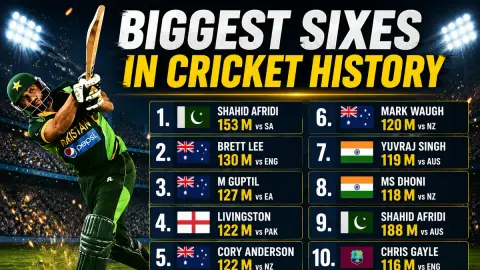
Shahid Afridi's 153m strike in Johannesburg tops most lists of the biggest sixes in cricket history. See the full leaderboard, the disputed measurements, and who's still chasing the record in 2026.
Most Test Centuries in Cricket History
Sachin Tendulkar holds the record with 51 Test centuries. The full leaderboard of the most hundreds in Test cricket, plus the active chasers, explained.
Most Test Runs in Cricket History
Sachin Tendulkar holds the record with 15,921 Test runs. The full top-10 leaderboard of the highest run-scorers in Test cricket, explained.
Most Test Wickets in Cricket History
Muttiah Muralitharan holds the record with 800 Test wickets. The full top-10 leaderboard of the leading wicket-takers in Test cricket, explained.