
Best Tennis Academies in the World: Where Champions Are Made
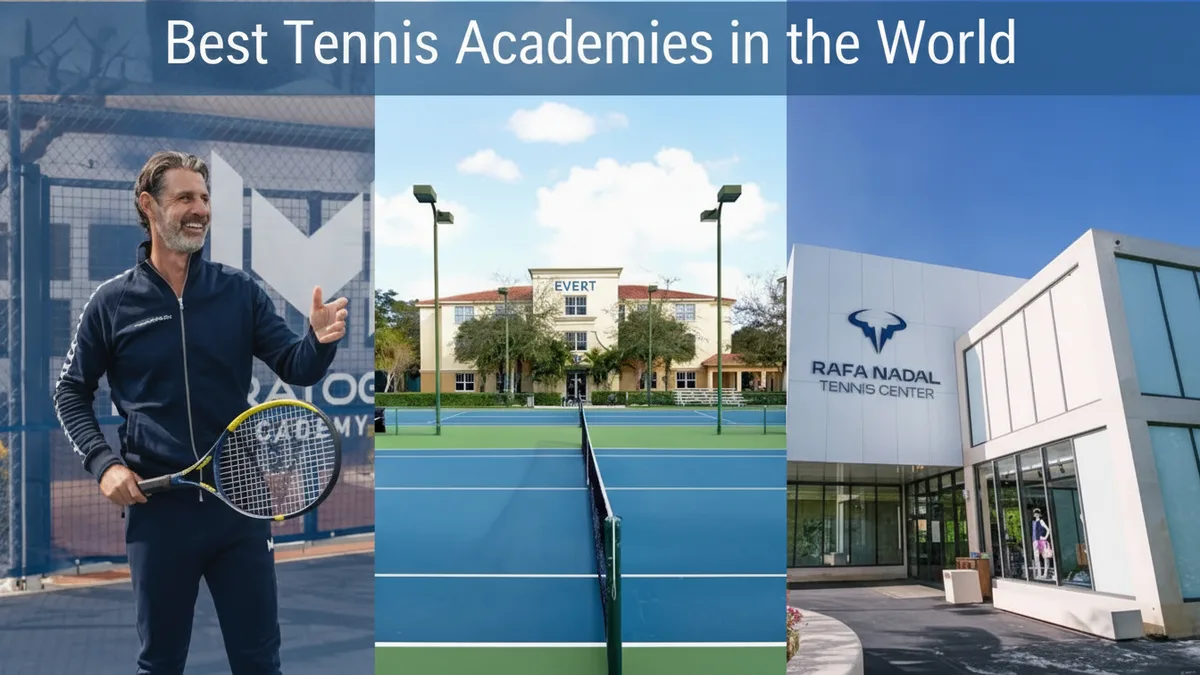
On this page11
- 01The best tennis academies at a glance
- 02IMG Academy — Bradenton, Florida
- 03Emilio Sánchez Academy — Barcelona, Spain
- 04Rafa Nadal Academy — Manacor, Mallorca
- 05Mouratoglou Academy — Biot, France
- 06Spartak Tennis Club — Moscow, Russia
- 07Evert Tennis Academy — Boca Raton, Florida
- 08How We Ranked These Academies
- 09What Elite Academies Actually Provide
- 10Academies at a Glance
- 11How to Choose the Right Academy
We ranked on proven tour alumni first, then coaching pedigree, court inventory and cost transparency — with an era adjustment so a 2016 academy isn't penalized for lacking a 30-year alumni list. Marketing copy and celebrity founders earned nothing on their own.
The best tennis academies at a glance
| Rank | Academy | Best fit or advantage |
|---|---|---|
| 1 | IMG Academy | Deepest Grand Slam alumni list; 56 courts |
| 2 | Emilio Sánchez Academy | Proven Spanish clay pathway |
| 3 | Rafa Nadal Academy | Modern residential campus; 45 courts |
| 4 | Mouratoglou Academy | Tour-level coaching and two campuses |
| 5 | Spartak Tennis Club | Historic champion-producing club model |
| 6 | Evert Tennis Academy | Focused junior and women's development |
- Most decorated
IMG Academy — Bradenton, Florida
No academy on this list matches IMG's champion output. Nick Bollettieri opened it in 1978, IMG bought it in 1987, and the roster that came through includes Andre Agassi, Monica Seles, Jim Courier and Maria Sharapova — four Grand Slam singles winners from one program. It ranks above the Rafa Nadal Academy because that track record is settled history, not projection.
It is also the only academy here that publishes a full rate card, and the campus is a 600-acre multi-sport operation with 35 outdoor hard, five indoor hard and 16 green-clay courts — surface variety no single-culture academy can match.
Founded: 1978 (as Nick Bollettieri Tennis Academy) · Alumni: Agassi, Seles, Courier, Sharapova, Nishikori · Courts: 56 total · Edge: only published rate card
- Clay pathway
Emilio Sánchez Academy — Barcelona, Spain
Andy Murray moved to Barcelona at 15 and built his defensive game here; Svetlana Kuznetsova and Grigor Dimitrov followed the same clay-first pathway. That is a deeper proven-tour alumni list than the Rafa Nadal Academy has yet produced, which is why it ranks a place higher despite thinner facilities and a lower profile.
Founded in 1998 by Emilio Sánchez Vicario and Sergio Casal, it built its reputation on the "Spanish drill" — relentless footwork and physical intensity. If you are searching for "Sánchez-Casal," that is the same institution under its current name, now with a second campus in Naples, Florida.
Founded: 1998 · Alumni: Murray, Kuznetsova, Dimitrov, Hantuchová · Method: Spanish clay drilling · Campuses: Barcelona + Naples, FL
- Modern flagship
Rafa Nadal Academy — Manacor, Mallorca
The published facilities list shows 45 tennis courts — 23 hard (four indoor) and 22 clay (seven semi-indoor) — plus 19 padel courts, and Nadal's own coaching team is involved day to day. It sits below IMG and Emilio Sánchez only because it opened in 2016 and hasn't yet had time to graduate a Grand Slam champion of its own.
Note what the court list is missing: no grass. Embedded in Spain's clay culture with an on-site international school, it fits a junior aiming at the European circuit far better than one chasing hard-court seasons. Fees aren't published; the residential tennis-and-school year was reported near €50,000 in 2025.
Founded: 2016 · Courts: 45 (23 hard, 22 clay, no grass) · Extras: on-site school, university partnership · Reported year: ~€50,000 (2025)
- Coaching method
Mouratoglou Academy — Biot, France
Patrick Mouratoglou coached Serena Williams through the late, still-dominant stretch of her career, and that tour-level pedigree is the draw. He founded the academy in 1996 with Bob Brett and moved it from the Paris region to Biot, in Sophia Antipolis between Nice and Cannes, in 2016.
It ranks below the three above because its reputation rests more on its head coach's résumé than on a long line of homegrown Grand Slam champions. The documented, repeatable methodology and hard performance culture are the substance; a US campus in Zephyrhills, Florida, extends the same program to North American juniors.
Founded: 1996 (with Bob Brett) · Founder: Patrick Mouratoglou, ex-coach of Serena Williams · Base: Biot, France · Second campus: Zephyrhills, FL
- Historic factory
Spartak Tennis Club — Moscow, Russia
Spartak's alumni argue for a higher spot — Yevgeny Kafelnikov, Marat Safin, Anastasia Myskina and Elena Dementieva all came through, a golden generation few programs can rival. It ranks fifth because it is a club rather than a full residential academy, and its 15 clay courts are outdoor-only, usable roughly four months a year.
That seasonal, no-frills setup is the opposite of IMG's year-round campus, and it explains why the model belongs to an earlier era of Russian tennis. As a proof of what disciplined coaching produces on limited facilities, though, its record stands.
Founded: 1979 · Alumni: Kafelnikov, Safin, Myskina, Dementieva, Kournikova · Courts: 15 clay, outdoor only · Model: club, not residential
- Women's specialist
Evert Tennis Academy — Boca Raton, Florida
Chris Evert, an 18-time Grand Slam singles champion, founded this Boca Raton academy in 1996 with her brother John and built it around developing women's tennis. That specialist focus is its identity and its reason to exist separate from the bigger Florida campuses.
It sits sixth because it is smaller and its alumni list is shorter than the names above, but the combination of Evert's own involvement, technical coaching and a heavy competitive schedule gives families a clear, narrow reason to choose it over a general multi-sport factory.
Founded: 1996 · Founders: Chris Evert (18 majors) and John Evert · Focus: women's development · Base: Boca Raton, FL
Reader interaction
Build your ranking
Drag the names into the order you think is right — or use the arrows — then submit to see how your list compares with everyone else's.
- IMG Academy — Bradenton, Florida
- Emilio Sánchez Academy — Barcelona, Spain
- Rafa Nadal Academy — Manacor, Mallorca
- Mouratoglou Academy — Biot, France
- Spartak Tennis Club — Moscow, Russia
- Evert Tennis Academy — Boca Raton, Florida
Audience ranking
How everyone ranked them
Built from reader rankings using position-based points.
A club pro can fix a junior’s forehand. What a club can’t replicate is daily match reps against players who are also being groomed for the tour, sports-science staff on call, and a tournament calendar built around a federation’s rankings. That is the gap residential academies fill, and it is why most players who reach the ATP or WTA passed through one on the way up.
Picking the wrong academy at 13 can cost a player years of development. The ranking above weighs proven results and coaching over facilities and founder fame — here is how that shakes out, and how to read it for your own situation.
How We Ranked These Academies
The order rewards four things, in priority:
- Proven tour alumni: how many players who trained on campus reached the top of the game — weighted most heavily
- Coaching pedigree: former tour players and coaches with genuine ATP/WTA track records on staff
- Court inventory and surface fit: number of courts, surface mix, and how well that matches a target circuit
- Cost transparency: whether the academy publishes real numbers or makes you chase a quote
We applied an era adjustment so a program that opened in 2016 is not penalized against one operating since 1978. Celebrity founders and marketing language earned nothing on their own — an academy has to point to players and staff, not a logo.
What Elite Academies Actually Provide
Beyond the ranking, the strongest programs share a working core: high-calibre coaching, high-volume court time across surfaces, integrated strength and conditioning, performance psychology built into daily training, and connections to ITF junior circuits and national federations. For younger players, accredited schooling on site is the difference between a development plan and a gamble — most juniors never turn pro, and their education has to survive the attempt.
Academies at a Glance
| Academy | Location | Founded | Surface emphasis | Cost signal |
|---|---|---|---|---|
| IMG Academy | Bradenton, Florida | 1978 | Hard + green clay, widest mix | Published: $75,400–$99,900 (2026-27) |
| Emilio Sánchez Academy | Barcelona, Spain + Naples, FL | 1998 | Clay-first | Quote on request |
| Rafa Nadal Academy | Manacor, Mallorca | 2016 | Hard + clay, no grass | Reported ~€50,000 (2025) |
| Mouratoglou Academy | Biot, France + Zephyrhills, FL | 1996 | Clay + hard | Quote on request |
| Spartak Tennis Club | Moscow, Russia | 1979 | Clay, outdoor only | Club membership model |
| Evert Tennis Academy | Boca Raton, Florida | 1996 | Hard | Quote on request |
How to Choose the Right Academy
Age, current ranking, preferred surface, location and budget all factor in, and no single academy is right for every player. Match the surface to the circuit the player is aiming at, and treat a big alumni list as a starting question, not an answer — ask who trains there now and who would actually coach your player. Visit in person if you can, talk to current students and coaches rather than only admissions staff, and get fees in writing, since only IMG publishes a full rate card.
For a closer look at a related topic, see Who Invented Tennis? The History and Origins of the Sport.
This connects to another question fans ask a lot: Why Are Tennis Balls Pressurized? The Science Explained.
A natural follow-up read is Why Do Tennis Players Grunt? The Science Behind It.
Frequently asked questions
Which tennis academy has produced the most Grand Slam champions?+
IMG Academy, and it is not especially close. Under Nick Bollettieri it developed Andre Agassi, Monica Seles, Jim Courier and Maria Sharapova, and served as a base for players including Kei Nishikori. Spartak in Moscow has a strong claim from a single generation — Kafelnikov, Safin and Myskina — but IMG's champion output spans decades and multiple eras of the game, which is why it tops this ranking.
How much does a top tennis academy cost per year?+
IMG Academy publishes rates: full-year tennis boarding tuition for 2026-27 runs $75,400 to $99,900 depending on age and program, plus a non-refundable enrollment deposit of $10,500 to $13,000. Most rivals quote case by case rather than posting a rate card. The Rafa Nadal Academy's residential tennis-and-school year was reported near €50,000 in 2025. Always confirm the current figure in writing before you budget, because programs and add-ons shift the total.
Does surface choice really matter when picking an academy?+
It matters more than families expect. A junior aiming at European clay events gains little from a year on Florida hard courts, and the reverse is equally true. The Rafa Nadal Academy and Emilio Sánchez run clay-heavy setups suited to that circuit; IMG offers the widest surface mix. None of the academies here trains on grass, so grass-court preparation happens elsewhere in the calendar.
At what age should a player join a residential academy?+
Many academies accept players from around age nine or ten, but the serious developmental window usually opens between 12 and 16. The Rafa Nadal Academy's tennis-and-school program is built for ages 12 to 18. Joining too early can be costly and disruptive; joining too late can leave a talented player behind peers who have logged years of structured match reps. The right entry point is individual, not universal.
Will attending a tennis academy make you a professional?+
No academy can guarantee a tour career. What a good one supplies is coaching, daily match reps against motivated peers, sports science and a tournament calendar — real advantages that improve a talented player's odds. But talent, physical development, mental toughness, funding and staying free of serious injury all matter too. Only a tiny fraction of juniors ever earn a living on the ATP or WTA tours, which is why on-site schooling is not optional.
How do I verify an academy's claims before enrolling?+
Visit in person if you can, and talk to current students and coaches rather than only admissions staff. Ask for fees in writing, confirm the exact court inventory and surface mix against the official facilities page, and check whether accredited schooling is genuinely integrated. Alumni names on a website can be years old or loosely connected, so ask specifically who trains on campus now and which staff would actually coach your player day to day.
Sources
Play & tools
Free browser games and tools — no account, no download.
- Play today's Sports Connections — Today's Sports Connections — daily hints, answers, and play the grid.
- Play Guess the NFL Player — A new mystery NFL player every day. Eight guesses, with a clue on each — plus free unlimited mode.
- Explore all our games →
Related tennis guides
View all →
10 Best Tennis Drills for Beginners to Learn Fast
The best tennis drills for beginners start with mini-tennis inside the service boxes, then add drop-feed rallies, target cones, and wall drills. Here are 10 drills ranked by what they build.
9 Best Tennis Footwork Drills to Move Faster and Hit Cleaner (Ranked)
Nine tennis footwork drills ranked by what they fix: split-step reaction, lateral coverage, explosive change of direction, and recovery. Move faster, hit cleaner.
Best Tennis Courts in the World: 10 Iconic Venues, Ranked
The 10 most iconic tennis courts on the planet, ranked — Centre Court, Philippe-Chatrier, Arthur Ashe, Rod Laver Arena and more, with capacities and surfaces.
Greatest Female Tennis Players of All Time: The Definitive List
Serena Williams, Steffi Graf, Martina Navratilova and Margaret Court ranked by majors, weeks at No. 1, and dominance — the women's tennis GOAT case settled.
Tallest Female Tennis Players: WTA Heights in 2026
See the tallest female tennis players and current WTA heights, including Rybakina at 6'0", Sabalenka at 5'11" and the 6'3" record holders.
Greatest Tennis Players of All Time (Men's)
A ranked look at the greatest men's tennis players ever, from the Big Three of Djokovic, Nadal and Federer to Laver, Sampras and Borg, updated for 2026.