
Best Tennis Courts in the World: 10 Iconic Venues, Ranked
On this page14
- 01The world's most iconic tennis courts at a glance
- 02Centre Court, Wimbledon (London, UK)
- 03Court Philippe-Chatrier, Roland Garros (Paris, France)
- 04Arthur Ashe Stadium, New York (USA)
- 05Rod Laver Arena, Melbourne Park (Australia)
- 06Louis Armstrong Stadium, New York (USA)
- 07Inalpi Arena, Turin (Italy)
- 08Stadium 1, Indian Wells Tennis Garden (California, USA)
- 09Campo Centrale, Foro Italico (Rome, Italy)
- 10Court Rainier III, Monte Carlo Country Club (Monaco)
- 11Andy Murray Arena, Queen's Club (London, UK)
- 12How We Ranked These Courts
- 13How the Surfaces Differ
- 14The Field at a Glance
Prestige and history come first — a court earns a high spot by hosting matches that matter, year after year. Atmosphere, surface character and capacity break ties, in that order, which is why the biggest bowl (Arthur Ashe) doesn't automatically rank first.
The world's most iconic tennis courts at a glance
| Rank | Court | Surface and distinction |
|---|---|---|
| 1 | Centre Court | Grass; Wimbledon final since 1877 |
| 2 | Court Philippe-Chatrier | Clay; Roland Garros show court |
| 3 | Arthur Ashe Stadium | Hard; largest tennis stadium |
| 4 | Rod Laver Arena | Hard; Australian Open show court |
| 5 | Louis Armstrong Stadium | Hard; intimate roofed US Open arena |
| 6 | Inalpi Arena | Indoor hard; ATP Finals host |
- The spiritual home
Centre Court, Wimbledon (London, UK)
Centre Court has staged the Wimbledon final every year since 1877, the longest unbroken run of any court in tennis. That is the single fact that puts it above Philippe-Chatrier: both seat roughly 15,000, both have modern roofs, but only Wimbledon carries 148 years of continuous championship history, the grass, the Royal Box and the all-white dress code.
A retractable roof arrived in 2009 and was first closed mid-match that year, so long rain suspensions are largely gone. The venue changed; the aura didn't. Ask players past or present to name the court they most want to win on and Centre Court still tops the list.
Event: Wimbledon · Surface: Grass · Capacity: ~14,979 · Roof: 2009 · Final hosted every year since 1877
- Clay at its most brutal
Court Philippe-Chatrier, Roland Garros (Paris, France)
This is the most demanding stage in clay-court tennis: a slow red surface that rewards heavy topspin and long rallies, and a Paris crowd that picks sides loudly. A stadium rebuild completed in early 2020 added a retractable roof made of 11 steel trusses without gutting the tradition around it.
It ranks below Centre Court only on history — at roughly 15,000 seats it's an near-exact match on scale, and the sliding footwork and sheer physicality on clay give it an atmosphere many players rate as the most alive in the sport.
Event: French Open · Surface: Clay · Capacity: ~15,000 · Roof: completed 2020
- The biggest bowl
Arthur Ashe Stadium, New York (USA)
Named for Arthur Ashe, this is the largest tennis-specific stadium on the planet at 23,771 seats — more than 7,500 bigger than any other court in the sport. Night sessions under the lights are the loudest in tennis, and a roof completed for the 2016 US Open ended the multi-hour rain stoppages that once plagued Flushing Meadows.
So why third and not first? Sheer size works against intimacy — the upper rows sit a long way from the baseline, and the venue lacks the century-plus of championship lineage that lifts Wimbledon and Roland Garros above it. It wins outright on spectacle and capacity.
Event: US Open · Surface: Hard · Capacity: 23,771 (largest in tennis) · Roof: 2016
- Best to play on
Rod Laver Arena, Melbourne Park (Australia)
Rod Laver Arena was the first tennis venue anywhere to install a retractable roof, which matters more than it sounds: it lets the Australian Open manage brutal late-January heat, and players routinely name it the most comfortable Grand Slam court to compete on.
It edges the US Open's number-two courts for this ranking because it's a Slam main stage, not a support court — a 14,820-seat arena with sharp acoustics and a Melbourne crowd that stays loud past midnight. It has hosted more post-midnight five-set marathons than any other major court.
Event: Australian Open · Surface: Hard (roof) · Capacity: ~14,820 · First roofed tennis arena
- The best second court
Louis Armstrong Stadium, New York (USA)
Rebuilt from scratch and reopened for the 2018 US Open, Louis Armstrong seats about 14,053 and is the largest number-two court at any Grand Slam. Its own retractable roof makes it a full weather backup to Arthur Ashe rather than a court that shuts down when the sky opens.
It ranks above the Masters 1000 venues below it because its sunken, steeply tiered bowl puts fans closer to the action than almost anywhere at Flushing Meadows — the intimacy Ashe can't offer, at nearly the same capacity as a Slam main court.
Event: US Open · Surface: Hard (roof) · Capacity: ~14,053 · Reopened: 2018
- Indoor season finale
Inalpi Arena, Turin (Italy)
Since 2021 the season-ending Nitto ATP Finals has been staged here, inside a venue originally built for the 2006 Winter Olympics. A revamp lifted capacity above 13,500 for the 2026 edition, and the steep seating around an indoor hard court produces a close, noisy atmosphere unlike the sprawl of a Slam bowl.
Turin is confirmed to host through 2027, with the event set to remain in Italy through 2030. It ranks here rather than higher because it stages one week a year, not a two-week major with a century of lineage.
Event: ATP Finals · Surface: Hard (indoor) · Capacity: ~13,500 · Host through 2027 (Italy to 2030)
- The 'fifth Slam'
Stadium 1, Indian Wells Tennis Garden (California, USA)
Home to the BNP Paribas Open, Stadium 1 seats about 16,100 — the second-largest outdoor tennis stadium in the world, behind only Arthur Ashe. That makes it bigger than every Grand Slam main court except one, despite hosting a Masters 1000 rather than a major.
Desert scenery, wide concourses and a fan experience that rivals the majors have earned Indian Wells its "fifth Slam" nickname. It sits below the ATP Finals here on event weight — a regular-season Masters versus the year-end championship of the tour's top eight.
Event: BNP Paribas Open · Surface: Hard · Capacity: ~16,100 · 2nd-largest outdoor tennis stadium
- Cinematic clay
Campo Centrale, Foro Italico (Rome, Italy)
The Italian Open's center court is a roughly 10,500-seat clay bowl set into a sunken hollow, ringed by pine trees and the marble statues of Mussolini-era architecture that make even a first-round match look like a film set.
It ranks above Monte Carlo because Rome is a combined ATP and WTA 1000 with a bigger draw and a rowdier, more invested crowd. The slow red clay and the amphitheater acoustics are a regular fixture near the top of players' favorite-venue lists.
Event: Italian Open · Surface: Clay · Capacity: ~10,500 · Setting: sunken marble bowl
- Best backdrop
Court Rainier III, Monte Carlo Country Club (Monaco)
Cut into a hillside above the Mediterranean, Court Rainier III has arguably the best view in tennis — the sea, the yachts and Monaco's cliffs are all visible from the roughly 10,000-seat stands. The Monte-Carlo Masters opens the European clay swing here every April.
Its clay plays a touch faster and truer than Rome's, and the setting draws one of the sport's most glamorous crowds. It ranks just below Rome on event size and atmosphere, but nothing on this list beats it for pure scenery.
Event: Monte-Carlo Masters · Surface: Clay · Capacity: ~10,000 · Setting: Mediterranean hillside
- Grass warm-up
Andy Murray Arena, Queen's Club (London, UK)
Queen's is where much of the top tier tunes up its grass game before Wimbledon. Its center court — renamed the Andy Murray Arena for the 2025 event, after the five-time champion — was expanded to seat more than 9,000, still the most intimate venue on this list.
It makes the ten on history and pedigree rather than scale: the club dates to 1886, the grass-court event runs back over a century, and its tight, clubby finals have often previewed the Wimbledon fortnight to come. See how its surface compares in our guide to tennis court surfaces.
Event: Queen's / HSBC Championships · Surface: Grass · Capacity: ~9,000+ · Renamed 2025
Reader interaction
Build your ranking
Drag the names into the order you think is right — or use the arrows — then submit to see how your list compares with everyone else's.
- Centre Court, Wimbledon (London, UK)
- Court Philippe-Chatrier, Roland Garros (Paris, France)
- Arthur Ashe Stadium, New York (USA)
- Rod Laver Arena, Melbourne Park (Australia)
- Louis Armstrong Stadium, New York (USA)
- Inalpi Arena, Turin (Italy)
- Stadium 1, Indian Wells Tennis Garden (California, USA)
- Campo Centrale, Foro Italico (Rome, Italy)
- Court Rainier III, Monte Carlo Country Club (Monaco)
- Andy Murray Arena, Queen's Club (London, UK)
Audience ranking
How everyone ranked them
Built from reader rankings using position-based points.
The ranking above is the heart of this guide. The sections below explain how we weighed the ten venues, how the surfaces actually differ, and how the courts compare at a glance.
How We Ranked These Courts
We weighed four things, in order. Prestige and history came first — how much a court has mattered, and for how long. That alone lifts the four Grand Slam main courts above everything else, and it’s why Wimbledon’s 148 unbroken years edge Roland Garros despite near-identical seating.
Atmosphere broke the next set of ties: crowd noise, night-session electricity, and how close fans sit to the play. Surface character counted too — a court known for a distinctive, demanding surface (Chatrier’s slow clay, Centre Court’s grass) scores higher than a generic hard court.
Capacity came last, not first. That’s the deliberate reason Arthur Ashe, the biggest stadium in the sport at 23,771 seats, ranks third rather than first: raw size doesn’t outweigh a century of lineage or the intimacy that smaller bowls offer.
How the Surfaces Differ
Three surfaces define this list, and each rewards a different style. Clay (Roland Garros, Rome, Monte Carlo) is the slowest, with a high bounce that drags out rallies and favors heavy topspin and patient defense. Grass (Wimbledon, Queen’s) is the fastest and lowest, rewarding big serves and short, aggressive points. Hard courts (Melbourne, New York, Turin, Indian Wells) sit in between and test an all-around game.
That spread is why the tour year moves through distinct “swings,” and why a player’s favorite venue often lines up with the surface that suits them. For the full breakdown, see our guide to tennis court surfaces, and for the standard dimensions every one of these courts shares, how big a tennis court actually is.
The Field at a Glance
| Rank | Court | Venue / Event | Surface | Capacity |
|---|---|---|---|---|
| 1 | Centre Court | Wimbledon, London | Grass | ~14,979 |
| 2 | Court Philippe-Chatrier | Roland Garros, Paris | Clay | ~15,000 |
| 3 | Arthur Ashe Stadium | US Open, New York | Hard | 23,771 |
| 4 | Rod Laver Arena | Australian Open, Melbourne | Hard (roof) | ~14,820 |
| 5 | Louis Armstrong Stadium | US Open, New York | Hard (roof) | ~14,053 |
| 6 | Inalpi Arena | ATP Finals, Turin | Hard (indoor) | ~13,500 |
| 7 | Stadium 1 | Indian Wells Tennis Garden | Hard | ~16,100 |
| 8 | Campo Centrale | Foro Italico, Rome | Clay | ~10,500 |
| 9 | Court Rainier III | Monte Carlo Country Club | Clay | ~10,000 |
| 10 | Andy Murray Arena | Queen’s Club, London | Grass | ~9,000+ |
Capacity and rank don’t track together on purpose — the column shows how little raw size decides this list. For more on the sport itself, browse our full ATP and WTA coverage.
Frequently asked questions
What is the best tennis court in the world?+
Centre Court at Wimbledon is the most widely cited answer, largely because it has hosted the championship final every year since 1877 — the longest unbroken run in tennis. Court Philippe-Chatrier at Roland Garros and Arthur Ashe Stadium at the US Open follow closely, with Rod Laver Arena in Melbourne usually completing the top four. Each is a Grand Slam showpiece with its own history, surface and atmosphere.
Which tennis court has the largest seating capacity?+
Arthur Ashe Stadium at the USTA Billie Jean King National Tennis Center in New York holds 23,771 spectators, making it the largest tennis-specific stadium in the world — more than 7,500 seats bigger than any other court in the sport. Stadium 1 at Indian Wells is next at around 16,100, followed by Court Philippe-Chatrier and Wimbledon's Centre Court, both near 15,000.
Where is the ATP Finals played now?+
As of 2026, the season-ending Nitto ATP Finals is held at the Inalpi Arena in Turin, Italy, which has hosted the event since 2021. The ATP has confirmed Turin as host through 2027, with the Finals set to remain in Italy through 2030. London's O2 Arena was the previous long-term home, from 2009 through 2020, before the event moved to Italy.
What's the biggest tennis stadium outside the Grand Slams?+
Stadium 1 at the Indian Wells Tennis Garden seats about 16,100, making it the largest non-Grand Slam tennis venue and the second-largest outdoor tennis stadium in the world after Arthur Ashe. Its scale, wide concourses and major-level fan experience are a big reason the BNP Paribas Open is nicknamed the 'fifth Slam,' even though it is officially a Masters 1000 and WTA 1000 event.
Does the court surface change how the same players perform?+
Substantially. On clay, the slow, high bounce favors patient baseliners who build points over long rallies. On grass, the fast, low skid rewards big serving and quick, aggressive net play. Hard courts sit between the two and test all-around games. That is why some players dominate one surface but struggle on another, and why sweeping majors across all three is so rare and so highly regarded.
Which of these courts have retractable roofs?+
Five of the ten do. All four Grand Slam main courts on this list are roofed — Wimbledon's Centre Court (2009), Rod Laver Arena, Arthur Ashe (2016) and Philippe-Chatrier (2020) — as is the US Open's Louis Armstrong Stadium. The Inalpi Arena is fully indoors, so it needs no roof. Rome, Monte Carlo and Queen's remain open-air, which is part of why their clay and grass events are more exposed to weather.
Sources
Play & tools
Free browser games and tools — no account, no download.
- Play today's Sports Connections — Today's Sports Connections — daily hints, answers, and play the grid.
- Play Guess the NFL Player — A new mystery NFL player every day. Eight guesses, with a clue on each — plus free unlimited mode.
- Explore all our games →
Related tennis guides
View all →
10 Best Tennis Drills for Beginners to Learn Fast
The best tennis drills for beginners start with mini-tennis inside the service boxes, then add drop-feed rallies, target cones, and wall drills. Here are 10 drills ranked by what they build.
9 Best Tennis Footwork Drills to Move Faster and Hit Cleaner (Ranked)
Nine tennis footwork drills ranked by what they fix: split-step reaction, lateral coverage, explosive change of direction, and recovery. Move faster, hit cleaner.
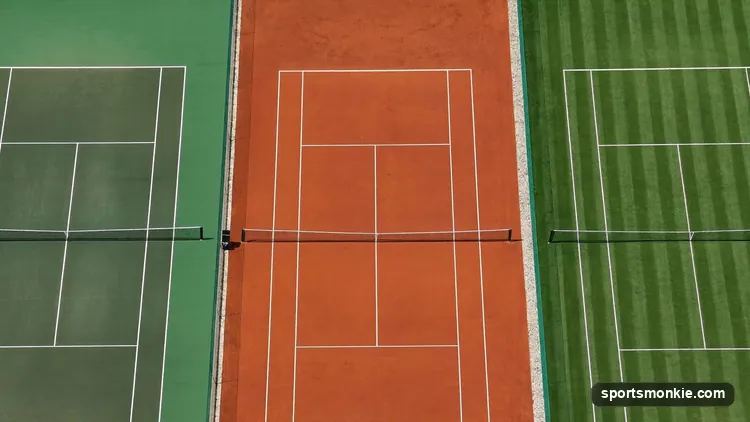
Types of Tennis Courts: Hard, Clay, Grass & Carpet Explained
The 4 types of tennis courts are hard, clay, grass, and carpet. See how each changes speed and bounce, and which surface every Grand Slam uses.
How Much Do Tennis Courts Cost to Build? (2023 Guide)
Building a private tennis court typically costs $25,000 to $100,000+ depending on surface, site prep, fencing, and lighting. Hard courts are the cheapest.

Best Tennis Academies in the World: Where Champions Are Made
The world's top tennis academies ranked on alumni, coaching and facilities — plus what a full year at IMG or the Rafa Nadal Academy actually costs to attend.

Greatest Female Tennis Players of All Time: The Definitive List
Serena Williams, Steffi Graf, Martina Navratilova and Margaret Court ranked by majors, weeks at No. 1, and dominance — the women's tennis GOAT case settled.