
How Long Are Tennis Matches? Average Duration Explained
On this page6
Tennis matches have no clock, so duration depends entirely on how the points play out. A typical best-of-three professional match runs roughly 90 minutes to 2 hours. Best-of-five Grand Slam matches average closer to 2.5–4 hours, though tiebreaks, long rallies, and closely contested sets can push any match well beyond those ranges.
Why tennis has no fixed match length
Unlike most team sports, tennis does not use a game clock. A match ends when one player wins enough sets — and each set ends only when a player wins enough games, with a margin of at least two. This means a dominant straight-sets win can be over in under an hour, while a five-set battle can last the better part of a day. The scoring format, not the stopwatch, decides when play stops.
Average durations by format
| Format | Sets required to win | Typical duration |
|---|---|---|
| Men’s Grand Slam singles | Best of 5 (win 3) | 2.5 – 4 hours |
| Women’s Grand Slam singles | Best of 3 (win 2) | 1.5 – 2.5 hours |
| ATP / WTA Tour (non-Slam) | Best of 3 (win 2) | 1 – 2 hours |
| Doubles (most events) | Best of 3, with match tiebreak | 1 – 1.5 hours |
| Junior & club matches | Best of 3 | 1 – 2 hours |
These are broad averages. Serve-dominant matches on fast grass courts tend to be shorter. Clay-court matches, where baseline rallies are longer, tend to run significantly longer.
Factors that affect match length
Tiebreaks. When a set reaches 6-6, most formats play a tiebreak to decide the set. As of 2026, all four Grand Slams use a 10-point tiebreak once the deciding set reaches 6-6 — a rule standardised across the majors in 2022 specifically to prevent the near-endless final sets that were once possible.
Surface. Clay slows the ball and produces a higher bounce, extending rallies and pushing matches longer. Grass and indoor hard courts favour faster points and shorter matches.
Playing styles. Big servers who win short rallies shorten matches. Defensive baseliners who grind out long exchanges extend them.
Weather and conditions. Heat breaks, rain delays, and low-light suspensions can stretch real-world match time over multiple days, even when the actual playing time is far less.
How the rules changed to cap match length
For decades, most Grand Slams played the deciding set as an “advantage set” — no tiebreak, so a player had to win by two games no matter how high the score climbed. That rule produced the sport’s most extreme marathons. In 2022 the Grand Slam Board standardised a 10-point final-set tiebreak at 6-6 across all four majors, replacing the patchwork of earlier rules. As a result, a modern Grand Slam singles match, however tight, now has a firm ceiling on how long its final set can run.
Notable long matches
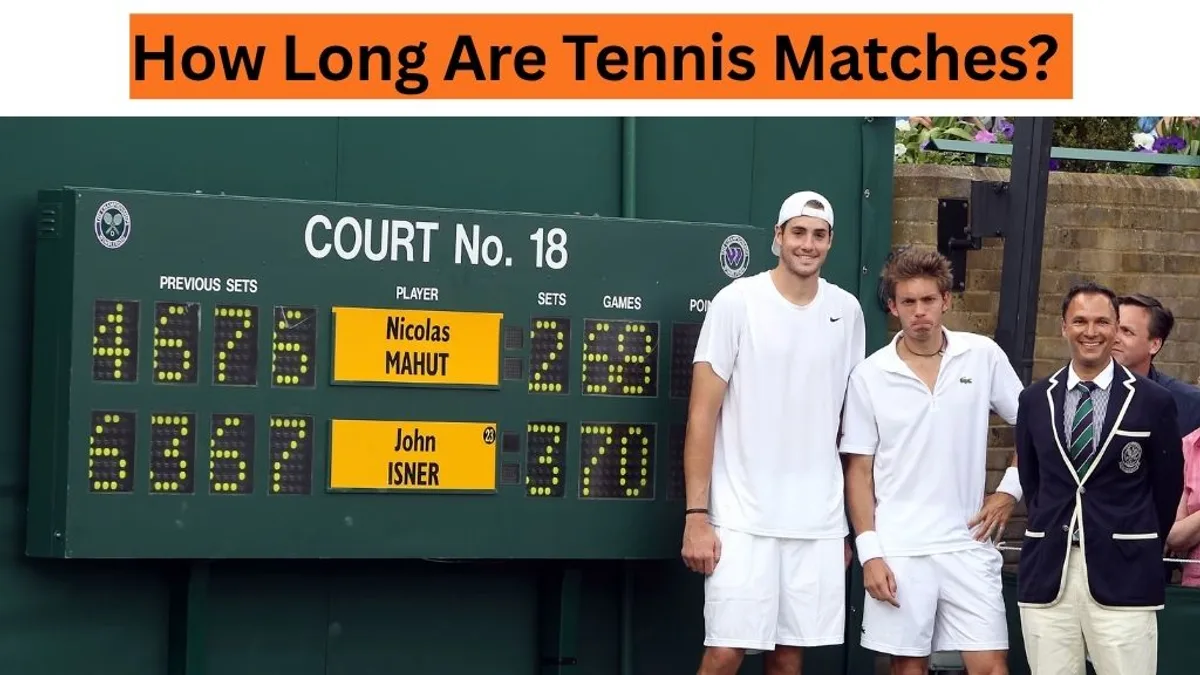
The Isner–Mahut match at Wimbledon 2010 is the most extreme example on record — 11 hours and 5 minutes of play spread across three days, finishing 70–68 in the fifth. The final set alone lasted 8 hours and 11 minutes, and the two players hit 113 and 103 aces respectively. Matches like this, played under the old advantage-set rule, are what prompted the majors to adopt final-set tiebreaks. Five-set Grand Slam finals still regularly top four or five hours when both players are closely matched, particularly on clay at Roland Garros.
What to expect when watching
For casual viewing, a two-hour window usually covers a best-of-three match at tour level with time to spare. For major finals or expected five-set clashes, block out at least three to four hours and expect possible overruns from tiebreaks, long rallies, or weather delays.
Frequently asked questions
How long does a tennis match last on average?+
Most professional best-of-three matches last between 90 minutes and 2 hours. Best-of-five Grand Slam matches typically run 2.5 to 4 hours. Because tennis has no clock, a dominant straight-sets result can finish in under an hour while a tight contest can run much longer.
What is the longest tennis match ever played?+
The longest professional match on record is the 2010 Wimbledon first-round match between John Isner and Nicolas Mahut, which lasted 11 hours and 5 minutes across three days. The final set alone ran 8 hours and 11 minutes and ended 70–68 in Isner's favour.
Do all Grand Slams use best-of-five sets for men?+
Yes. All four Grand Slams — the Australian Open, French Open, Wimbledon, and US Open — use best-of-five sets for men's singles. Women's singles at all four majors uses best-of-three, which is one reason women's matches average shorter than the men's.
How does the final-set tiebreak affect match length?+
Since 2022 all four Grand Slams use a 10-point tiebreak once the deciding set reaches 6-6, replacing the old advantage-set rules. This caps how long a final set can run and effectively makes marathons like Isner–Mahut impossible under current rules.
Why do clay-court matches take longer?+
Clay slows the ball down and produces a higher bounce, which extends rallies and rewards defensive baseline play. Longer points and more of them mean clay matches, such as those at the French Open, tend to run noticeably longer than grass or indoor hard-court matches.
How long is a best-of-three set tennis match?+
A best-of-three match — the standard for all WTA events and men's tour-level events outside the Grand Slams — usually lasts between 1 and 2.5 hours. The exact time depends on surface, how many games go to deuce, and whether sets reach a tiebreak.
Is there a time limit or shot clock in tennis?+
There is no limit on total match time, but a 25-second shot clock governs the time between points and players get limited time at changeovers. These rules control pace and reduce stalling, but they do not cap how long an overall match can last.
How long do doubles matches usually last?+
Most doubles matches run about 1 to 1.5 hours because many events use no-ad scoring and replace the deciding set with a 10-point match tiebreak. These shortened formats are designed to keep doubles compact and predictable for scheduling.
Sources
Play & tools
Free browser games and tools — no account, no download.
- Play today's Sports Connections — Today's Sports Connections — daily hints, answers, and play the grid.
- Play Guess the NFL Player — A new mystery NFL player every day. Eight guesses, with a clue on each — plus free unlimited mode.
- Explore all our games →
Related tennis guides
View all →
How Many Sets Are There in Tennis? A Complete Guide
Most pro tennis matches are best-of-three sets, so the first to win two sets wins. Grand Slam men's singles use best-of-five, needing three sets to win.
What Is Deuce in Tennis? Score, Advantage, and Tiebreaks
Deuce in tennis means both players have reached 40, so one player must win two straight points to take the game.
What Is Hawk-Eye in Tennis? How Electronic Line Calling Works
Hawk-Eye uses multiple cameras and ball-tracking software to judge whether a tennis shot landed in or out.
Walkover vs Retirement in Tennis: What Is the Difference?
A walkover happens before a match begins; a retirement happens after play starts. The distinction affects results, records and tournament administration.
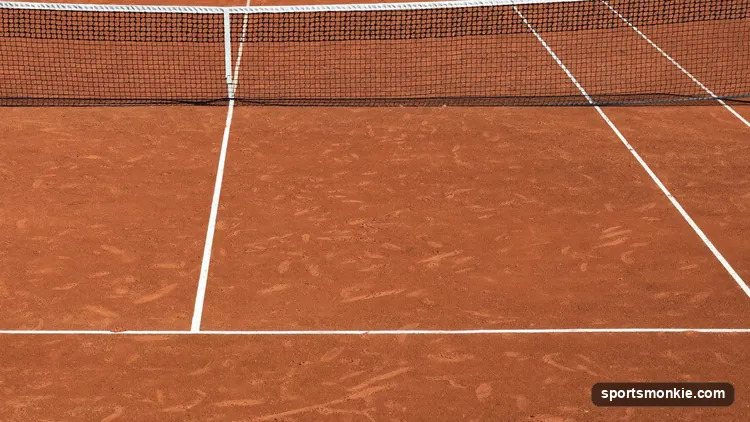
Clay Court Tennis: Surface, Rules, and Why It Plays So Slow
Clay court tennis is the slowest surface with the highest bounce. See red vs. green clay, sliding, ball marks, upkeep, and why Nadal owns it.
Grass Court Tennis: Why the Fastest Surface Plays So Different
Grass court tennis is the fastest, lowest-bouncing surface in the sport, per ITF's own pace rating. How Wimbledon's ryegrass shapes serve-and-volley play.