
Best Powerlifters of All Time
On this page6
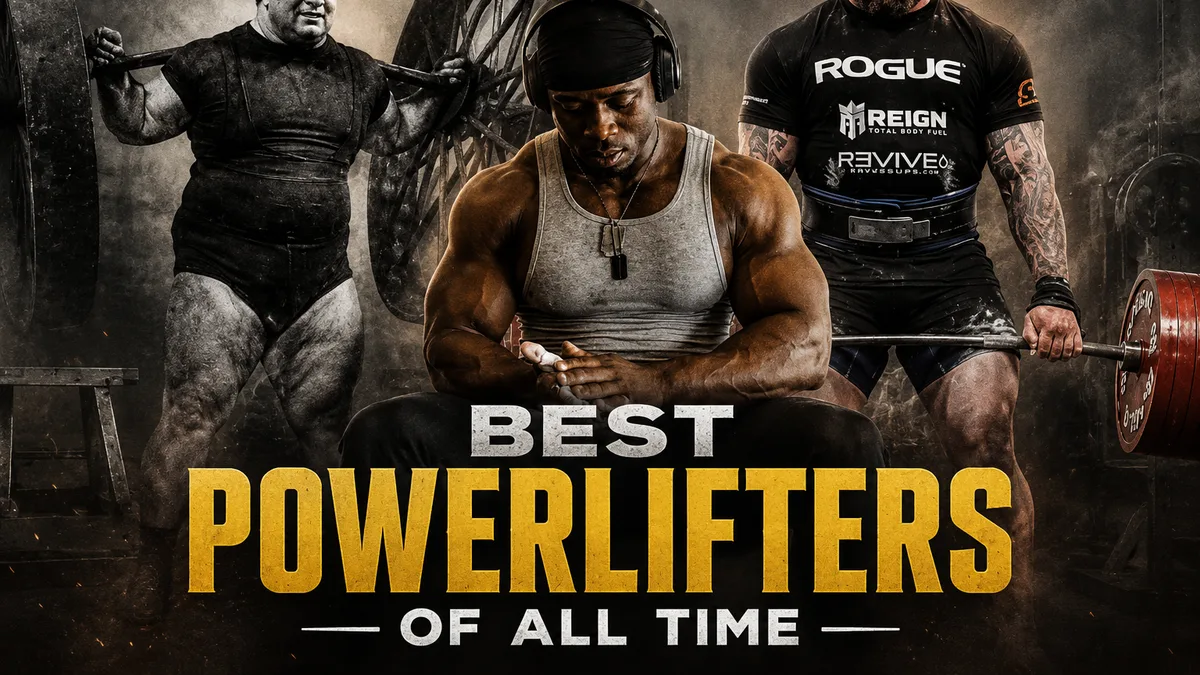
The greatest powerlifter of all time is Ed Coan, a near-unanimous choice among lifters and coaches. Across the 1980s, 1990s and 2000s he set more than 71 world records and posted bodyweight-adjusted totals that still rank at the very top of the sport. Behind him sit Lamar Gant, Ray Williams and Stefi Cohen, each defining a different corner of powerlifting.
What makes a powerlifter an all-time great?
Ranking the best powerlifters ever takes more than raw numbers. The sport spans different federations, equipment rules (raw versus equipped), and eras with different testing standards, so a single leaderboard rarely settles the argument. The criteria that matter most:
- Total world records set and broken
- Dominance within and across weight classes
- Longevity at the elite level
- Wilks or DOTS score (bodyweight-adjusted strength comparison)
- Influence on how the sport developed
Absolute weight on the bar impresses, but relative strength, the ratio of the lift to the athlete’s bodyweight, is what separates the true legends from the merely huge.
One thing worth saying plainly before the names: powerlifting has no single sanctioning body. A “world record” always belongs to a federation, and the drug-tested and untested sides of the sport keep separate books. Every figure below carries that label, because without it the comparisons are meaningless.
The powerlifters most widely considered the greatest
Ed Coan
Coan is close to a unanimous pick for greatest powerlifter in history. Competing mostly in the 100 kg (220 lb) and lighter classes, he set more than 71 world records across multiple federations, including a 1,117 kg (2,463 lb) total in the 110 kg class at the USPF World Championships in Las Vegas in December 1998, done at a bodyweight of 239 lb. That made him the lightest man to total over 2,400 lb. He carries a lifetime IPF ban after a 1996 positive test in Salzburg, which is why his best-known total came in the USPF rather than under IPF rules, yet his standing as “The GOAT” is essentially undisputed.
Lamar Gant
Gant is one of the most technically gifted powerlifters the sport has produced. In 1985 he became the first man to deadlift five times his own bodyweight, pulling 661 lb at 132 lb, and no one has repeated it since. He did it while competing with idiopathic scoliosis, a spinal curvature that shortened his reach on the bar and, unusually, worked in his favour on the deadlift. He entered the IPF Hall of Fame in 1980.
Ray Williams
Williams was the dominant super-heavyweight raw squatter of the late 2010s, becoming the first man to squat over 1,000 lb raw and eventually reaching 490 kg (1,080 lb) at the 2019 Arnold. That squat stood as the heaviest ever until June 2026. In 2025 he accepted a 16-month suspension after testing positive for heptaminol, a stimulant, at Powerlifting America Classic Open Nationals; USADA accepted that the positive came from a labelled dietary supplement rather than a deliberate doping programme. His ineligibility ran from April 2025.
Stefi Cohen
Cohen is the best-known female powerlifter of the modern era, with roughly 25 records to her name across several weight classes and federations, and she was the first woman to deadlift more than four times her bodyweight. Most of those records came in smaller, largely untested federations rather than the IPF, so calling her the outright greatest is a claim the sport argues about. After stepping away for a professional boxing run she returned at the 2025 IPL Olympia Pro in Las Vegas that October, setting a 185 kg squat IPL world record in the under-60 kg class.
Jesus Olivares
Olivares is the defining drug-tested raw super-heavyweight of the 2020s. He holds the heaviest tested raw total in history at 1,153.5 kg, set at Powerlifting America SBD Austin in November 2025, improving the 1,152.5 kg he posted at SBD Sheffield in 2023. He remains the benchmark in IPF-rules Classic competition.
All-time greats at a glance
| Lifter | Era | Division | Known for |
|---|---|---|---|
| Ed Coan | 1980s-2000s | Equipped / Raw | 71+ world records, all-time Wilks |
| Lamar Gant | 1970s-1980s | Equipped | First to deadlift 5x bodyweight (1985) |
| Ray Williams | 2010s-2020s | Raw (SHW, tested) | First 1,000 lb+ raw squat |
| Stefi Cohen | 2010s-present | Raw (Women’s) | Multi-class records, 4x BW deadlift |
| Jesus Olivares | 2020s-present | Raw (SHW, tested) | Heaviest drug-tested raw total |
The current era: powerlifting in 2025-2026
The all-time total record moved decisively in July 2026. Colton Engelbrecht of South Africa totalled 1,225 kg (2,700.7 lb) at the WRPF’s Nikolai Kagansky Memorial Cup in Moscow, weighing 125.3 kg, on lifts of 455 kg, 277.5 kg and 492.5 kg. The deadlift was the heaviest ever done in a powerlifting meet, and the total came with the highest male DOTS score on record at 693.75. The WRPF is an untested federation, so the honest framing is two records rather than one: Engelbrecht owns the heaviest raw total ever contested, and Olivares owns the heaviest done under drug-tested rules.
The squat record fell too. Devonte Lewis put up 490.5 kg at USAPL Raw Nationals on 12 June 2026, half a kilo past Ray Williams’ seven-year-old mark. On the women’s side, Tamara Walcott holds the all-time raw total at 759 kg (1,674 lb), set at the USPC Battle of the Beasts in May 2025, and Stefi Cohen’s return proved she had lost little during her boxing detour. You can check any of these against the meet-by-meet results in the OpenPowerlifting database, which is the closest thing the sport has to a neutral referee.
Equipment versus raw: a note on comparisons
Comparing lifters across eras runs into the split between equipped lifting (supportive suits and shirts) and raw lifting (a belt, plus knee sleeves or wraps). Equipped totals run higher in absolute terms, which is why direct comparisons without context can mislead. Knee wraps sit awkwardly in the middle: Engelbrecht’s earlier 1,155 kg all-time total, set at ProRaw Big Dogs 5 in Australia in November 2024, came in the raw-with-wraps division, which is not the same category as Olivares’ sleeves-only lifting. Wilks and DOTS scoring help normalize across bodyweights, but no formula solves the cross-era or cross-federation problem, so most rankings weigh dominance within a lifter’s own division.
Why these lifters matter
Beyond the numbers, these athletes grew powerlifting’s audience, inspired the next generation of competitors, and proved that the squat, bench and deadlift reward technical mastery and consistency as much as raw physical gifts. Their careers are a reminder that everything starts with proper lifting form on the three lifts, the same braced, neutral-spine fundamentals any beginner should groove before chasing bigger numbers. Even the biggest totals in the sport are built on the same fundamentals a beginner drills, starting with proper bench press form — arch, shoulder retraction, and a repeatable bar path — and proper deadlift form, where a neutral spine and a bar kept over the midfoot separate a big pull from a hurt back. From Coan’s pound-for-pound perfection to Engelbrecht’s 1,225 kg, each redefined what the sport believed was possible.
Freshness note: total, squat and deadlift records in this article moved three times between November 2024 and July 2026. Re-check the all-time figures against OpenPowerlifting and Powerlifting Records before quoting them, and re-check Ray Williams’ eligibility status, which was due to expire in August 2026.
Frequently asked questions
What are the three lifts in powerlifting?+
Powerlifting consists of the squat, the bench press, and the deadlift. Each lifter gets three attempts at each movement, and their best successful lift in all three is added together for a total. The highest total in a weight class wins the competition.
What is the difference between raw and equipped powerlifting?+
Raw powerlifting is performed with minimal supportive gear, usually just a belt, knee sleeves or wraps, and a singlet. Equipped powerlifting allows supportive suits and bench shirts that store elastic energy and boost the weights lifted. Records and totals differ significantly between the two divisions, so they are ranked separately.
Why do drug-tested and untested world records differ so much?+
Federations such as the IPF test in and out of competition and only ratify lifts done under those rules. Untested federations, including the WRPF, do not, so their numbers run higher. A lift is only a record within its own federation's rulebook, which is why two different lifters can both be called world-record holders in the same year.
What is the heaviest deadlift in powerlifting competition?+
Colton Engelbrecht pulled 492.5 kg (1,085.8 lb) at the Nikolai Kagansky Memorial Cup in Moscow in July 2026, passing Danny Grigsby's 487.5 kg. That is separate from strongman deadlifts such as Hafthor Bjornsson's 501 kg in 2020, which was done under strongman rules that permit lifting straps, not powerlifting rules.
Is powerlifting an Olympic sport?+
No, powerlifting is not part of the Olympic Games, though Olympic weightlifting (the snatch and the clean and jerk) is a separate sport that is. Powerlifting holds its own world championships governed by federations such as the IPF. Para powerlifting, a bench-press-only discipline, does feature at the Paralympic Games.
What are Wilks and DOTS scores?+
Wilks and DOTS are formulas that adjust a lifter's total for their bodyweight, allowing athletes of different sizes to be compared pound-for-pound. A lighter lifter with a very high total can outscore a much heavier lifter with a bigger absolute total. These scores are how the sport identifies its most efficient all-around strength athletes.
Sources
Play & tools
Free browser games and tools — no account, no download.
- Play today's Sports Connections — Today's Sports Connections — daily hints, answers, and play the grid.
- Play Guess the NFL Player — A new mystery NFL player every day. Eight guesses, with a clue on each — plus free unlimited mode.
- Explore all our games →
Related records & rankings guides
View all →
Best Female Weightlifters of All Time: Legends of the Sport
The best female weightlifters ever, ranked by Olympic golds, world titles, and records — from China's two-time champions to Hidilyn Diaz and Olivia Reeves.

The Oldest Stadiums Around the Globe: A Complete Guide
The oldest sports stadiums still in use include Lord's (1814), The Oval (1845), and Bramall Lane (1855). See the most historic venues still standing today.
Javelin Throw Explained: Rules, Technique & World Records
Javelin throw explained: weight, runway rules, throwing technique, the 1986 redesign, and world records — men's 98.48m, women's 72.28m, as of 2026.
Pole Vault Explained: Rules, Technique, Equipment and World Records
Pole vault explained: how the runway, pole and box work, the six phases of a vault, scoring rules, and current world records as of 2026.

Olympic Heptathlon History, Records and Legends
A concise history of the Olympic heptathlon, from the pentathlon switch in 1984 to Joyner-Kersee, Thiam, Klüft, Ennis-Hill, Hall and records.
Best VNL Players: The Top Stars of the Nations League
The best VNL players, named and ranked: Wilfredo León, Yuji Nishida, Paola Egonu, Tijana Bošković, Gabi and more — with why each one made the list.