
Best Female Weightlifters of All Time: Legends of the Sport
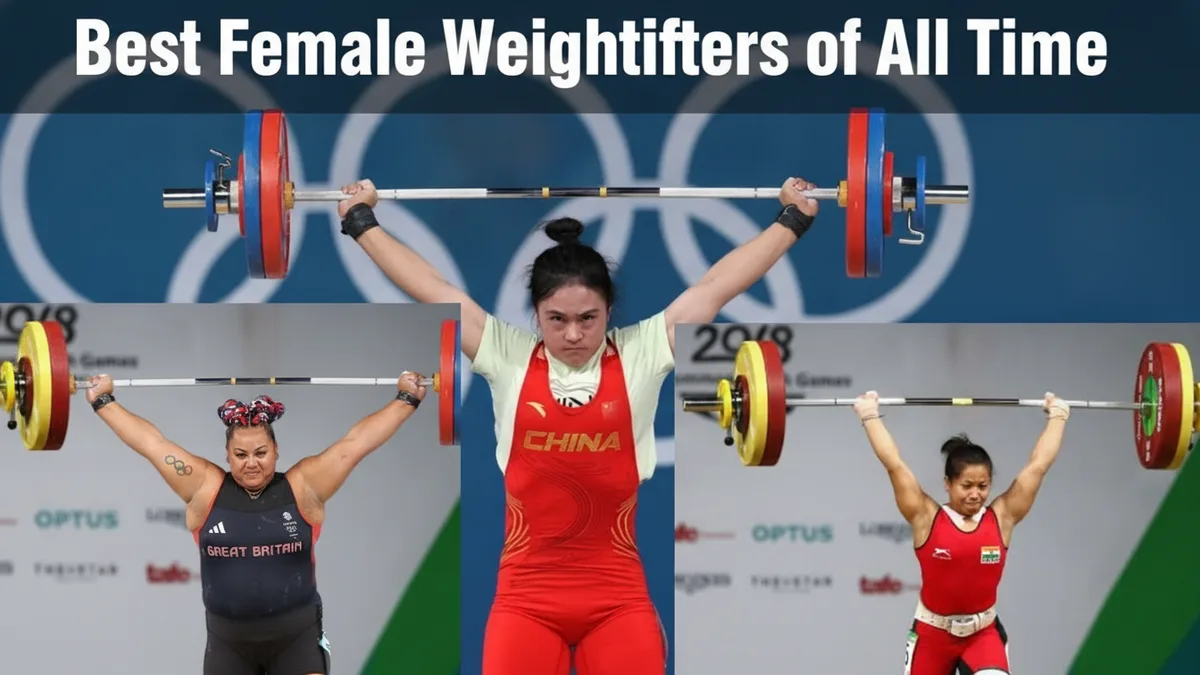
On this page13
- 01The greatest female weightlifters at a glance
- 02Hou Zhihui (China)
- 03Li Wenwen (China)
- 04Rim Jong-sim (North Korea)
- 05Deng Wei (China)
- 06Hidilyn Diaz (Philippines)
- 07Olivia Reeves (USA)
- 08Saikhom Mirabai Chanu (India)
- 09How we ranked these lifters
- 10How the two lifts work
- 11Era caveats: why cross-generation comparisons are hard
- 12The dominant programs: China and North Korea
- 13The bottom line
We rank by hardware that survives scrutiny: repeat Olympic golds count most, then world titles and ratified world records, then career longevity across restructured weight classes. Single breakout performances and any results later voided for doping are discounted.
The greatest female weightlifters at a glance
| Rank | Weightlifter | Country | Strongest record |
|---|---|---|---|
| 1 | Hou Zhihui | China | Two Olympic golds at 49kg |
| 2 | Li Wenwen | China | Two Olympic super-heavyweight golds |
| 3 | Rim Jong-sim | North Korea | Olympic golds in two classes |
| 4 | Deng Wei | China | World titles and world records |
| 5 | Hidilyn Diaz | Philippines | Country's first Olympic gold |
| 6 | Olivia Reeves | United States | Paris 2024 Olympic champion |
| 7 | Mirabai Chanu | India | Olympic silver and world title |
- Two-time Olympic champion
Hou Zhihui (China)
Hou anchors the list because she won 49kg gold at both Tokyo 2020 and Paris 2024 — and in Paris she broke the Olympic record in the clean and jerk to total 206kg, defending a title against a field built specifically to unseat her. Repeat Olympic golds are the rarest currency in the sport, and she holds two in the deepest, most contested division China fields.
She ranks above fellow two-time champion Li Wenwen only on degree of difficulty: the lightest class turns over fastest and forgives nothing technically, yet Hou stayed on top across a full four-year cycle and a weight-category reset. China's medal haul at recent Games leans heavily on producers like her.
Country: China · Class: 49 kg · Peak: 2016–2024 · Defining feat: back-to-back Olympic gold with a Paris clean-and-jerk record
- Superheavyweight great
Li Wenwen (China)
Li owns the heaviest women's division outright. She took +87kg gold at Tokyo 2020, then defended at Paris 2024 in the +81kg class with a 309kg total — a margin so wide the competition was effectively over before her final attempts. Two Olympic golds plus a run of world records give her the same top-tier résumé as Hou.
She sits just behind Hou because the superheavyweight class is shallower than the 49kg, where the depth of competition sharpens the achievement. Even so, no active woman has lifted heavier totals under Olympic conditions, which keeps her clear of everyone ranked below.
Country: China · Class: +81 / +87 kg · Peak: 2019–2024 · Defining feat: two Olympic golds, multiple world records
- Cross-class champion
Rim Jong-sim (North Korea)
Rim is the only lifter here to win Olympic gold in two different weight classes: 69kg at London 2012 and 75kg at Rio 2016, becoming the first DPR Korean woman to win two Olympic golds. Moving up a full category and staying dominant is a harder trick than defending one class, because it means rebuilding leverage and timing around a heavier body and bar.
She ranks below China's two-time champions because her golds are spread across two cycles rather than back-to-back, and North Korea's periodic absences from competition thinned her international record. She later added the 2019 World Championship total title in Pattaya.
Country: North Korea · Class: 69 / 75 kg · Peak: 2012–2019 · Defining feat: Olympic gold in two separate weight classes
- Record-setting world champion
Deng Wei (China)
Deng won 63kg gold at Rio 2016 by breaking the world and Olympic records with a 262kg total, and she stacked five World Championship titles around it. On raw output at her peak she matches anyone below her on this list.
She ranks behind the two-time Olympic champions for one reason: a single Olympic gold. Injury cost her the Tokyo 2020 team, freezing a career that was trending toward a second Games title. Her ceiling was arguably higher than her final medal count shows — the gap between her and Rim is that Rim converted twice on the Olympic stage.
Country: China · Class: 63 kg · Peak: 2013–2019 · Defining feat: Rio 2016 gold with world and Olympic records
- Historic first
Hidilyn Diaz (Philippines)
Diaz won the 55kg title at Tokyo 2020 to claim the first Olympic gold in Philippine history, following an Olympic silver at Rio 2016. Two Olympic medals across four appearances is a longevity case few on this list can match, and her win reshaped funding for the sport across Southeast Asia.
She ranks above the newer champions on career depth — four Games, two medals — while sitting below the multi-gold and multi-record lifters above her. Her placement rewards durability and impact as much as peak numbers; on total podium hardware alone she trades places with the athletes ranked just around her.
Country: Philippines · Class: 55 kg · Peak: 2016–2021 · Defining feat: first Olympic gold in Philippine history
- New-generation leader
Olivia Reeves (USA)
Reeves won 71kg gold at Paris 2024 with an Olympic snatch record and a 262kg total, then took the 77kg world title at the 2025 Worlds in Førde, Norway, setting three world records in the process. She is the strongest American woman the sport has produced this century.
She ranks here rather than higher only because her résumé is built on one Olympic cycle so far — an Olympic gold plus world titles, but not yet the repeat Games golds that separate the top three. On current trajectory heading toward LA 2028, she is the most likely name on this list to climb it.
Country: USA · Class: 71 / 77 kg · Peak: 2023–present · Defining feat: Paris 2024 gold, 2025 world champion with world records
- South Asian trailblazer
Saikhom Mirabai Chanu (India)
Chanu became world champion in the 48kg class in 2017 and won silver in the 49kg at Tokyo 2020, remaining India's most decorated weightlifter. She ranks seventh because she is the one entry here without an Olympic gold, but her body of work — a world title, an Olympic silver, and continued podiums into 2025 — clears the bar for inclusion.
Her value is also structural: she made weightlifting a mainstream pursuit across South Asia, much as India's strength-sports pioneers did in adjacent disciplines. Longevity keeps her on the list where flashier one-Games lifters fall off.
Country: India · Class: 48 / 49 kg · Peak: 2017–present · Defining feat: 2017 world champion; Tokyo 2020 Olympic silver
Reader interaction
Build your ranking
Drag the names into the order you think is right — or use the arrows — then submit to see how your list compares with everyone else's.
- Hou Zhihui (China)
- Li Wenwen (China)
- Rim Jong-sim (North Korea)
- Deng Wei (China)
- Hidilyn Diaz (Philippines)
- Olivia Reeves (USA)
- Saikhom Mirabai Chanu (India)
Audience ranking
How everyone ranked them
Built from reader rankings using position-based points.
The ranking above weighs Olympic golds most heavily, then world titles and ratified world records, then longevity — the yardsticks that hold up when a lifter’s era, weight class, or drug-tested status is questioned. The sections below explain that method and give the context you need to read the list critically.
How we ranked these lifters
Weightlifting rewards two things at once: absolute output and repeatability. A single record-breaking total is spectacular, but the sport’s history is littered with one-Games wonders whose numbers never held up. So repeat Olympic golds sit at the top of our criteria, because defending a title against a field built to beat you is the hardest thing to do in the sport.
World Championship titles and ratified world records come next, followed by career longevity — especially staying competitive through the weight-class restructures that have reshuffled the sport repeatedly since 2016. We discount any result later voided for doping, which is why some historically large totals do not appear here. Where two lifters are close, we favor the one whose achievements came in a deeper division, since beating more contenders means more.
How the two lifts work
Every ranking on this list rests on the same two movements. The snatch pulls the barbell from the floor to overhead in one continuous motion; the clean and jerk lifts it to the shoulders first, then drives it overhead. Each athlete gets three attempts per lift, and only the best successful attempt in each counts. Those two numbers add into a total, and the total decides the medals.
Because both lifts feed the same total, a champion cannot hide a weak movement. That is why the athletes at the top of this list are balanced — their snatch and clean and jerk are close in quality, so neither caps their score. The same braced, midfoot-loaded fundamentals that build a big pull also underpin gym staples like proper deadlift form and the barbell squat.
Era caveats: why cross-generation comparisons are hard
Comparing lifters across decades runs into three complications. First, weight categories have been redrawn multiple times — Hou Zhihui’s 49kg and Rim Jong-sim’s old 69kg are not the same benchmark — so raw record comparisons can mislead. Second, the anti-doping picture has changed sharply: the 2016–2024 restructures were partly designed to clean up the sport, meaning some older totals sit under a cloud that newer ones do not.
Third, depth of field varies by era and class. A gold won in a stacked division is worth more than one won in a thin field, even at the same bodyweight. We factored all three into the ranking rather than reading medal tables at face value.
The dominant programs: China and North Korea
China has produced more women’s weightlifting champions than any other nation, powered by a domestic system deep enough to field contenders in nearly every class — Hou Zhihui, Li Wenwen, and Deng Wei are all products of it. North Korea is the other historic powerhouse, and its women swept several titles at the 2025 World Championships in Førde, including Kim Il-gyong at 58kg.
Beyond those two, the podium has gone genuinely global. Olivia Reeves re-established the United States as a force, Norway’s Solfrid Koanda broke through at Paris 2024, and Thailand, Chinese Taipei, and Colombia remain regular medal threats. That spread is healthy for a sport once dominated by a handful of programs, and it echoes the widening base seen across strength disciplines generally.
The bottom line
There is no single “greatest,” but the tiers are clear. Two-time Olympic champions Hou Zhihui and Li Wenwen anchor China’s dynasty; Rim Jong-sim and Deng Wei form the next rung on the strength of a cross-class double and a record-laden peak; and Diaz, Reeves, and Chanu round out the group on longevity, historic firsts, and rising trajectories. Measured by the standard that matters most — sustained dominance across both lifts, cleanly — these are the athletes who define the best of women’s weightlifting as of 2026. Fans who follow athlete stories off the platform often ask next about the richest WAGs in sports.
Frequently asked questions
Who is considered the greatest female weightlifter of all time?+
There is no single consensus. China's Hou Zhihui and Li Wenwen, each a two-time Olympic champion after Tokyo 2020 and Paris 2024, have the strongest modern cases, while Hidilyn Diaz and two-time cross-class champion Rim Jong-sim are era-defining names. Some older tallies cited Tatiana Kashirina, but she was banned for eight years in 2023 and stripped of world titles and records, which removes her from serious rankings.
Why isn't Tatiana Kashirina on this list?+
Kashirina once held the heaviest lifts in women's history and five superheavyweight world titles, but in August 2023 the Court of Arbitration for Sport handed her an eight-year doping ban and voided her results from April 2013 to June 2017, stripping three world titles and her world records. Because our ranking discounts any achievement later erased for doping, her invalidated record disqualifies her despite the raw numbers she once posted.
Who won the women's weightlifting golds at Paris 2024?+
China led as Hou Zhihui (49kg) and Li Wenwen (+81kg) both defended their Olympic titles, with Luo Shifang taking the 59kg. Olivia Reeves of the USA won the 71kg with an Olympic snatch record, and Norway's Solfrid Koanda claimed the 81kg while breaking two Olympic records with a 275kg total — Norway's first weightlifting gold since 1972 and its first female Summer Games gold since 2004.
How is a weightlifting winner actually decided?+
Lifters get three attempts each in the snatch and the clean and jerk. Their best successful lift in each is added for a total, and the highest total in a weight category wins. If two athletes tie on total, the lighter bodyweight is placed higher; if they also weigh the same, whoever reached the total first wins. A weakness in either lift caps the total, so the greats are strong in both.
When did women's weightlifting become an Olympic sport?+
Women's weightlifting debuted at the Sydney 2000 Games with seven weight categories. The IWF had introduced a women's World Championship back in 1987, which built the talent pipeline. Weight categories have since been restructured several times — most notably between Rio 2016 and Tokyo 2020, and again for Paris 2024 — partly to strengthen anti-doping integrity, forcing even champions to change classes mid-career.
Is Olympic weightlifting safe for women to train?+
Yes. Taught with sound technique and sensible loading, Olympic weightlifting is a safe, effective way to build strength, power, and bone density, and it suits women across a wide range of ages. Like any sport it carries some injury risk, but good coaching and gradual progression manage it. The braced, neutral-spine fundamentals behind a safe pull are the same ones covered in proper deadlift and squat guides.
Sources
Play & tools
Free browser games and tools — no account, no download.
- Play today's Sports Connections — Today's Sports Connections — daily hints, answers, and play the grid.
- Play Guess the NFL Player — A new mystery NFL player every day. Eight guesses, with a clue on each — plus free unlimited mode.
- Explore all our games →
Related records & rankings guides
View all →
Best Female Skateboarders of All Time, Ranked
Leticia Bufoni, Lizzie Armanto, Sky Brown, Rayssa Leal, and Patti McGee headline our ranked list of the best female skateboarders, with the record behind each name.
Best Female Rugby Players of All Time: Union & Sevens
The best female rugby players ranked across Rugby Union and Sevens, from Portia Woodman-Wickliffe's try record to Emily Scarratt, Sarah Hunter and Ellie Kildunne.

Greatest Female Figure Skaters of All Time
The greatest female figure skaters in history, from Sonja Henie to Yuna Kim, who redefined the sport with artistry, mastery, and Olympic gold.

Most Popular Female Athletes on Twitter (X) Right Now
Serena Williams leads every woman in sport on X, ahead of Maria Sharapova, Alex Morgan, Ronda Rousey, and P.V. Sindhu in this ranked, named list of 11.

Best Powerlifters of All Time
A look at the greatest powerlifters in history, ranked by their dominance, world records, and lasting impact on the sport of powerlifting.

Best Sports for Girls: 10 Top Picks and Their Benefits
The best sports for girls, ranked and named: soccer, swimming, gymnastics, volleyball, tennis, basketball, track, softball, field hockey, and lacrosse.