
What Is Stoppage Time in Football? (Added Time)
On this page5
Stoppage time — also called added time or injury time — is the extra minutes a referee adds to the end of each half to make up for time lost during play. Substitutions, injuries, goal celebrations, VAR checks and time-wasting all stop the clock in spirit, and the referee gives that time back. It is added to the two 45-minute halves and is different from extra time.
How stoppage time works
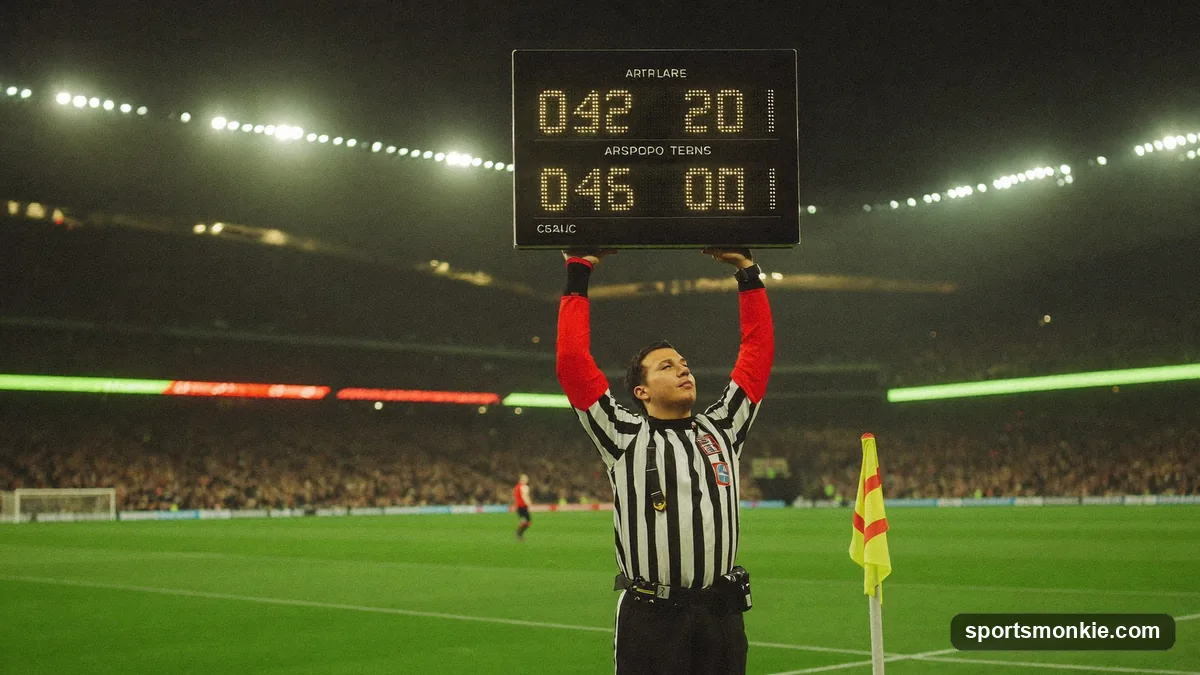
Football’s clock never actually stops — it runs continuously through 45 minutes each half. Instead of pausing it, the referee mentally tallies the time lost to major stoppages and adds it on at the end. The fourth official then holds up a board showing the minimum number of added minutes. Crucially, the referee can play beyond that minimum if fresh delays happen during added time itself.
Added time, injury time, stoppage time — same thing
The three terms are interchangeable. “Injury time” is the traditional name from an era when injuries were the main cause of delay; “added time” and “stoppage time” are the modern, more accurate labels, because today’s delays come from many sources.
| Cause of stoppage | Example |
|---|---|
| Substitutions | Slow changes late in the game |
| Injuries | Treatment on the pitch |
| Goal celebrations | Long celebrations after a goal |
| VAR checks | Reviews of goals, penalties, red cards |
| Time-wasting | Goalkeeper holding the ball, slow restarts |
Why there is more of it now
Since around the 2022 World Cup, referees have been instructed to add time back far more thoroughly. A 90-minute match often contains under an hour of the ball actually in play, so the change is meant to boost real action and remove the incentive to waste time. That is why added-time boards showing eight, ten or more minutes have become common.
Scoring in stoppage time
Stoppage time is ordinary live play, and some of the sport’s most iconic goals have arrived in it. A late winner, a penalty, or a red card can all happen after the 90. It is why sides chasing a result keep pressing to the final whistle, and why a lead is never safe — a single hat-trick or a late strike can still flip the scoreline.
Stoppage time vs. extra time
Do not confuse the two. Stoppage time is a few minutes tacked onto a normal half. Extra time is a separate 30-minute period played only in knockout games level after 90 minutes — and it has its own stoppage time added on top. Understanding the clock is the first step to reading a tight finish; explore more in our football guides and the offside rule.
Frequently asked questions
What is stoppage time in football?+
Stoppage time is extra time added by the referee to the end of each half to make up for play stopped during the 45 minutes — for substitutions, injuries, goal celebrations, VAR reviews and deliberate time-wasting. The referee alone decides how much to add, and the fourth official shows a minimum on a board. Play continues until the referee blows the whistle, which can be after the displayed minimum.
Is stoppage time the same as injury time or added time?+
Yes — stoppage time, added time and injury time are three names for the same thing. 'Injury time' is the older, traditional term from when most delays were for injuries; 'added time' and 'stoppage time' are the more accurate modern names, since delays now come from many sources. Commentators and federations use them interchangeably.
How is stoppage time calculated?+
The referee keeps a running tally during each half of time lost to major stoppages and adds it back at the end. Since around the 2022 World Cup, officials have been instructed to account more fully for delays, which is why added-time totals have grown — sometimes eight, ten or more minutes. The fourth official displays the minimum; the referee can extend it if new stoppages occur during added time itself.
Can you score in stoppage time?+
Absolutely, and some of football's most famous goals have come in stoppage time. It is normal, live play — the same rules apply. A goal, a red card, a penalty or a winning strike can all happen in added time, which is why teams keep pushing until the final whistle. Manchester United's 1999 Champions League final is the classic example of two stoppage-time goals deciding a match.
What's the difference between stoppage time and extra time?+
Stoppage time is the few minutes added to the end of a normal 45-minute half. [Extra time](/what-is-extra-time-in-football/) is a completely separate 30-minute period (two 15-minute halves) played only in knockout matches that are level after 90 minutes. Extra time itself also has its own stoppage time added to each of its halves.
Why is there so much stoppage time now?+
Since the 2022 World Cup, referees have been told to add back time more thoroughly for every significant delay — long goal celebrations, multiple substitutions, injury treatment, VAR checks and time-wasting. The aim is to increase the 'ball in play' time, since a 90-minute match often contains under an hour of actual action. The result is noticeably longer added-time boards than fans were used to.
Does time-wasting add to stoppage time?+
Yes. Deliberate time-wasting — a goalkeeper holding the ball, slow substitutions, delaying a restart — is one of the things referees are meant to add back. A player can also be booked for time-wasting. The rule change encouraging fuller added time was partly designed to remove the incentive to run the clock down late in a match.
Sources
Play & tools
Free browser games and tools — no account, no download.
- Play 38-0 — Sign a 4-4-2 of all-time football legends and chase a perfect 38-0 league season — perfect, not just unbeaten.
- Explore all our games →
Related football guides
View all →
Penalty Shootout Rules Explained (Football)
A penalty shootout decides a tied knockout match: teams take five penalties each, alternating, and the side with more goals wins. If level, it goes to sudden death.
What Is Extra Time in Football? The 30 Minutes
Extra time in football is two 15-minute halves played when a knockout match is level after 90 minutes. If still tied, it goes to a penalty shootout.

What Is the Away Goals Rule in Football? How It Worked
The away goals rule broke ties in two-legged ties by counting goals scored away from home as extra weight. Here's how it worked and why UEFA scrapped it.

What Is Stoppage Time in Football? How It Is Added
Stoppage time compensates for delays such as substitutions, injuries, goals, disciplinary action and video reviews.
What Is a Derby in Football? Local Rivalry Matches
A derby in football is a match between two rival clubs, usually from the same city or region. Think the Manchester derby, El Clasico or the Merseyside derby.
What Is a False Nine in Football? The Role Explained
A false nine is a centre-forward who drops deep into midfield instead of staying up front, dragging defenders out of position and creating space for teammates.