
Snowboard Bindings Size Guide: Fit by Boot Size
On this page6
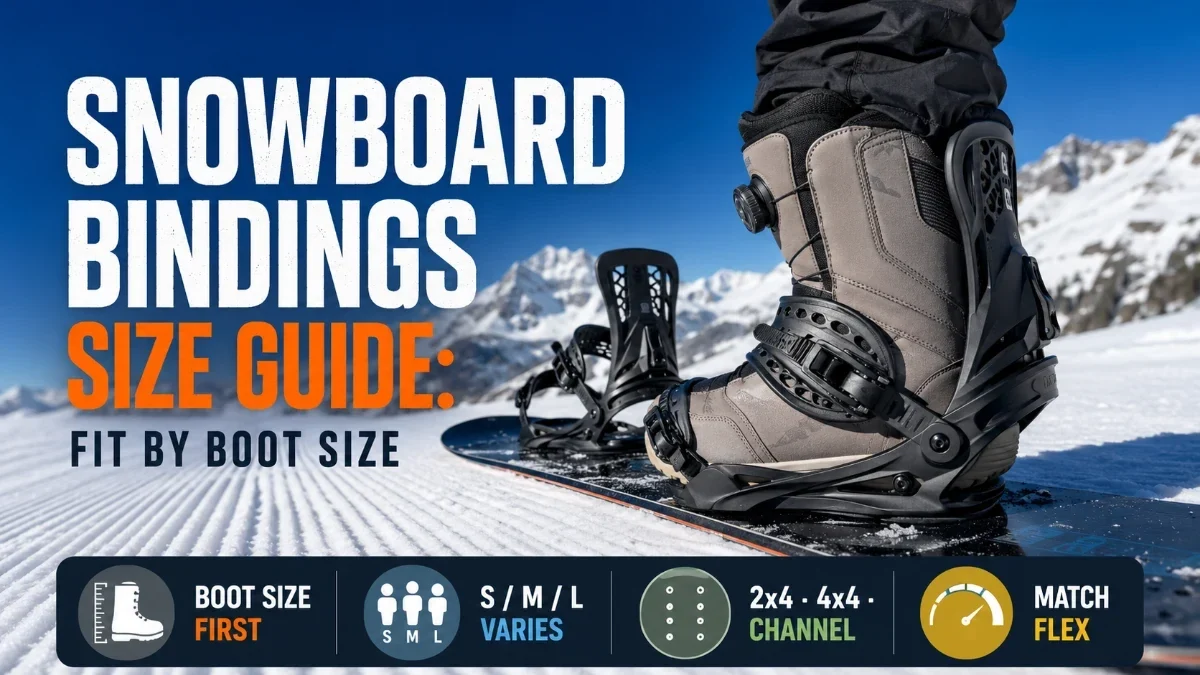
Snowboard bindings are sized off your snowboard boot size, not your street shoe size, and each size covers a range of boots rather than a single number. A men’s US 8 to 10 boot usually lands in a Medium, women’s 6.5 to 8.5 in a women’s Medium, but the exact cutoffs shift from brand to brand. The safe process: buy your boots first, note their labeled size, then match the binding to that number using the specific maker’s chart, and confirm the binding fits your board’s width and mounting pattern.
That last part trips people up more than the number itself. Bindings connect your boot to your board, so a size that fits your foot but overhangs a narrow board, or a disc that does not match your board’s insert pattern, is still the wrong buy. Here is how to get all three right in one pass.
What size snowboard binding do I need for my boot?
Start with the boot, because boots are the one piece that must fit precisely. Note the labeled boot size after it is heat-molded, then read the binding chart for that brand. Snowboard boot sizing often runs about half a size smaller than your everyday sneaker, which is exactly why sizing bindings off your shoe size leaves so many riders a size out.
There is no industry standard for where Small ends and Medium begins, which is the single biggest reason binding sizing feels confusing. As evo notes, the same boot can call for a Medium in one brand and a Large in another. Treat any chart as brand-specific, not universal.
Once you have a candidate size, do the physical check if you can: seat your actual boot in the binding. The heel should sit fully back in the heelcup, the boot should not rock side to side, and the toe should sit flush against the toe ramp without hanging far over the front.
Snowboard binding size chart by boot size
Here are the current men’s/unisex ranges from four popular brands, all in US boot sizes, so you can see how much the cutoffs actually move. Watch what happens at a size 10 boot.
| US boot size | Union | Burton | Now | Fix |
|---|---|---|---|---|
| 5.5–6 | Small | Small | Small | Small |
| 7 | Small | Small | Small | Small |
| 8 | Medium | Small/Medium | Medium | Small/Medium |
| 9 | Medium | Medium | Medium | Medium |
| 10 | Medium | Medium/Large | Medium | Medium/Large |
| 11 | Large | Large | Large | Large |
| 12–13 | Large | Large | Large | Large |
| 13–15 | X-Large | — | — | — |
A US men’s 10 boot reads as a solid Medium in Now and Union, but sits right on the Medium/Large seam for Burton and Fix. That is the overlap trap: buy “a Large because I’m a 10” without checking the brand and you can end up with a binding that never quite cinches down. Women’s charts run smaller across the board; Union’s women’s Small covers US 4 to 6.5, Medium 6.5 to 8.5, and Large 9 to 11.
What size binding if my boot is between two sizes?
Overlap zones are normal, and the right call depends on how you ride:
- Size down if you ride park or want a snappier, more responsive feel, or if your boots run low-profile. A slightly smaller binding wraps the boot tighter.
- Size up if comfort, easy strap travel, or bulky boots matter more, or if the smaller size forces the straps to their innermost setting with no room left.
When you cannot try it on, favor the size where your boot number sits in the middle of the range rather than at the very edge. A boot parked at the bottom of a Large will always feel loose; the same boot near the top of a Medium usually locks in.
How do I match binding width to my board?
If your boots fit your board and your bindings fit your boots, the bindings almost always fit the board too. The failure mode to avoid is boot overhang. A little overhang is good, since it gives you leverage to tip the board on edge, but too much means your toe or heel drags in the snow during a hard carve and washes the turn out.
Aim for roughly 1 to 1.5 cm of boot past each edge at most, split evenly toe and heel. Most bindings let you fine-tune this with adjustable gas pedals (the extendable toe ramp) and heel loops, so you can center the boot over the board’s waist. If your boots hang off badly no matter how you set the binding, the real fix is a wider board or a lower-volume boot, not a different binding size.
Which mounting system does my board use?
Before you buy, confirm how the binding bolts to the board. Nearly all boards use one of these:
| Pattern | Found on | What fits it |
|---|---|---|
| 4x4 | Older and many current non-Burton boards | Standard disc (included) |
| 2x4 | Most modern non-Burton boards | Standard disc (included), more stance options |
| 3D | Older Burton boards | 3D-specific disc |
| Channel (ICS) | All current Burton boards | Channel-compatible disc, or EST bindings |
Most non-Burton bindings ship with a disc that covers both 2x4 and 4x4, so they mount to the vast majority of boards. Burton is the outlier: its Channel system uses two long slots instead of holes. Per Burton, Channel boards work with Channel-compatible bindings or Burton’s EST bindings, while EST bindings only fit Channel boards. Burton’s Re:Flex bindings are the flexible middle ground, mounting to 2x4, 4x4, 3D, and Channel with the right disc. When in doubt, follow REI’s mounting guide and match the disc to your board before torquing anything down.
What flex rating should my bindings be?
Flex is usually rated 1 to 10 (some brands use 1 to 5), where lower is softer. Match it to your riding, then keep it in the same neighborhood as your board:
- Soft, 1–4: forgiving and playful. Best for beginners and park riders who want tweakability.
- Medium, 4–7: the all-mountain default. Enough response to carve, enough give to butter and jib.
- Stiff, 7–10: direct and fast-reacting. For aggressive carving, big-mountain, and high speed.
A stiff binding bolted to a soft jib board fights itself, and a soft binding on a stiff freeride deck feels vague at speed. Keep the two roughly aligned and you will not have to overthink it.
Once size, width, mount, and flex are sorted, you can shop with confidence. If you are still building your first setup, our snowboard bindings for beginners guide narrows the field to forgiving, budget-friendly picks, and the complete beginner’s snowboard guide walks through boards and boots too. For more gear breakdowns and season prep, browse the winter sports hub.
Frequently asked questions
How do I know what size snowboard bindings I need?+
Use your snowboard boot size, not your street shoe size, then check the specific brand's binding chart. Each size covers a range of boots rather than one number. Most men's size 8 to 10 boots land in a Medium, but ranges shift by brand, so always confirm against that maker's chart.
Is binding size based on boot size or shoe size?+
Binding charts use snowboard boot size, which often runs about half a size smaller than your street shoe once heat-molded. Buy your boots first, note their labeled size, and match the binding to that number. Sizing off your sneaker size is the most common mistake and can leave you a full size off.
What if my boot size falls between two binding sizes?+
In an overlap zone, size down if you ride park or want a snappy, responsive feel, and size up if comfort and easy strap adjustment matter more or your boots run bulky. When possible, set your actual boot in the binding: the heel should seat fully and the toe should sit flush with the toe ramp.
Do snowboard bindings fit all snowboards?+
Most do. The majority of boards use a 4x4 or 2x4 insert pattern, and standard bindings ship with discs for both. The exception is Burton's Channel (ICS) system, which needs Channel-compatible or EST bindings. Check your board's insert pattern before buying so the disc and screws line up.
How much heel and toe overhang is acceptable?+
A small amount is fine and even desirable for leverage. Aim for under about 1 to 1.5 cm of boot hanging past each edge, spread evenly. If the boot drags in the snow during a hard toeside or heelside carve, your board waist is too narrow, or your boots are too large for that width board.
Should binding flex match my board or my riding?+
Match it to your riding first, then keep it near your board's flex. Soft bindings (1 to 4 of 10) suit beginners and park riders; medium (4 to 7) covers all-mountain; stiff (7 to 10) suits fast carving and freeride. A stiff binding on a soft jib board fights itself, so keep the two roughly in the same zone.
Sources
Play & tools
Free browser games and tools — no account, no download.
- Play today's Sports Connections — Today's Sports Connections — daily hints, answers, and play the grid.
- Play Guess the NFL Player — A new mystery NFL player every day. Eight guesses, with a clue on each — plus free unlimited mode.
- Explore all our games →
Related winter sports guides
View all →
Snowboard Bindings for Beginners: Flex, Fit and Picks
The best snowboard bindings for beginners have soft-medium flex and easy entry. Strap vs rear-entry, sizing, and budget picks with real 2026 prices.
Snowboard Size Chart for Beginners: How to Size a Board
Snowboard size chart for beginners by weight, height, and boot width, plus how riding style shifts the number and the sizing mistakes that ruin a first season.
Snowboard Gear for Beginners: The Complete Checklist
The complete snowboard gear checklist for beginners, with real 2026 package prices and the rent-vs-buy math for a first season.
Ski Boot Flex Explained: Chart by Weight and Ability
Ski boot flex explained: what the number really measures, why it isn't standardized between brands, plus a flex chart by weight and ability level.
Ski Boot Sizing: How to Get the Right Fit
Ski boots are sized in Mondopoint (your foot length in cm). Learn to measure your Mondo size, pick flex and last width, and run the shell fit test.
Snowboard for Beginners: How to Choose Your First Board
The best beginner snowboard is soft, all-mountain, and hybrid or rocker. Get profile, flex, and size right, with budget picks and a full gear checklist.