
Shortest Cricketers of All Time: The Game's Smallest Stars
On this page14
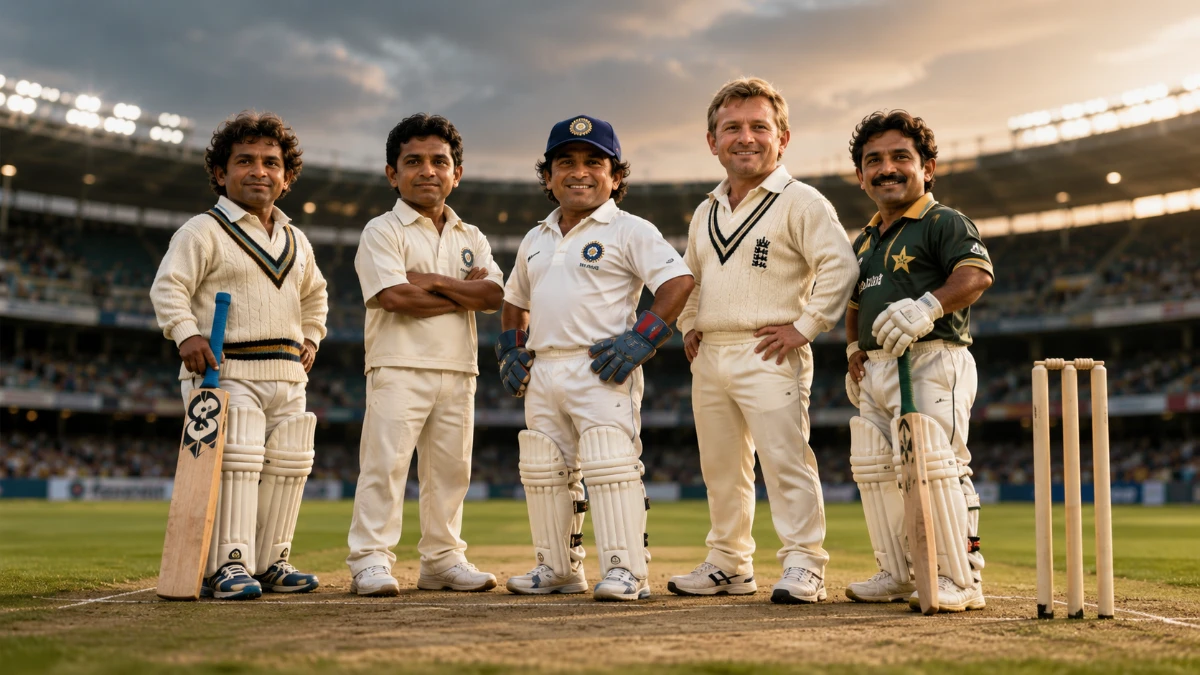
Kruger van Wyk stands about 4 feet 9 inches tall — shorter than most secondary-school students — yet he kept wicket for New Zealand in one-day and T20 internationals. He is the shortest player ever to represent a Test-playing nation, and he’s far from alone: cricket has a long history of compact players who made up for a lack of height with balance, reflexes, and technique. Here are the 12 shortest cricketers to play international cricket, ranked by height as of 2026.
Shortest Cricketers at a Glance
| Rank | Cricketer | Country | Approx. Height | Primary Role |
|---|---|---|---|---|
| 1 | Kruger van Wyk | New Zealand | ~4 ft 9 in (150 cm) | Wicketkeeper-batsman |
| 2 | Walter “Tich” Cornford | England | ~5 ft 0 in (152 cm) | Wicketkeeper |
| 3 | Sunil Gavaskar | India | ~5 ft 2 in (157 cm) | Opening batter |
| 4 | Alfred “Tich” Freeman | England | ~5 ft 2 in (157 cm) | Leg-spin bowler |
| 5 | Mushfiqur Rahim | Bangladesh | ~5 ft 3 in (160 cm) | Wicketkeeper-batsman |
| 6 | Parthiv Patel | India | ~5 ft 3 in (160 cm) | Wicketkeeper-batsman |
| 7 | David Boon | Australia | ~5 ft 3 in (160 cm) | Top-order batter |
| 8 | Gundappa Viswanath | India | ~5 ft 3 in (160 cm) | Middle-order batter |
| 9 | Mominul Haque | Bangladesh | ~5 ft 3.5 in (161 cm) | Top-order batter |
| 10 | Prithvi Shaw | India | ~5 ft 4 in (163 cm) | Opening batter |
| 11 | Kedar Jadhav | India | ~5 ft 4 in (163 cm) | All-rounder |
| 12 | Sachin Tendulkar | India | ~5 ft 5 in (165 cm) | Batter |
Heights are as commonly reported across cricket record sites; small variations exist between sources.
Kruger van Wyk
Born in South Africa and later capped by New Zealand, van Wyk is, at roughly 4 feet 9 inches, the shortest player ever to appear in international cricket. He played ODIs and T20Is as a wicketkeeper-batsman in the early 2010s, standing behind the stumps at a height most of his teammates could rest an arm on. His career was short by international standards, but his stature alone has kept his name at the top of every shortest-cricketers list since.
Walter “Tich” Cornford
Cornford is the shortest man to play Test cricket, at around 5 feet. The England wicketkeeper appeared in four Tests against New Zealand in 1930, all as a specialist gloveman, at a time when height was rarely a talking point for keepers the way it is for tallest cricketers and fast bowlers today. His nickname, “Tich,” was a straightforward nod to his size, and he remains a benchmark figure whenever this list comes up.
Sunil Gavaskar
Gavaskar, around 5 feet 2 inches, opened the batting for India against the fiercest fast-bowling attacks of the 1970s and 80s, most notably the West Indies, and did it for years without a helmet. He retired with over 10,000 Test runs and is regarded as one of the greatest openers the game has produced. His technique and courage against genuine pace made his height a non-issue and turned him into one of the most celebrated names among the greatest batsmen in cricket history.
Alfred “Tich” Freeman
Freeman, also known as “Tich,” was an England leg-spin bowler standing about 5 feet 2 inches, making him one of the few genuine bowlers on this list rather than a batter or keeper. He took over 3,700 first-class wickets in a long county career with Kent, though his Test opportunities were limited. His success shows that a short frame, while rare among bowlers, isn’t an automatic barrier for a spinner who relies on flight and turn instead of bounce.
Mushfiqur Rahim
Standing close to 5 feet 3 inches, Mushfiqur Rahim has been one of Bangladesh’s most important cricketers for close to two decades, keeping wicket and captaining the national side across formats. His compact frame has never limited his glovework, and he’s built one of the most consistent batting records in Bangladesh’s Test history, regularly featuring among the country’s leading run-scorers.
Parthiv Patel
Parthiv Patel, around 5 feet 3 inches, became India’s youngest Test wicketkeeper as a teenager and went on to a long career across formats, later captaining in domestic and franchise cricket. He’s one of the shortest players to have kept wicket at the international level in the 2000s and 2010s, sitting comfortably alongside taller names on any list of the greatest wicketkeepers in the sport’s history.
David Boon
The Australian opener, listed at about 5 feet 3 inches, was a fixture at the top of Australia’s order through the 1980s and 90s, known for his gritty, unglamorous approach against fast bowling. Boon played over 100 Tests and was part of Australia’s 1987 World Cup-winning squad, proving that a short, sturdy build could hold up an entire top order over more than a decade of international cricket.
Gundappa Viswanath
Viswanath, roughly 5 feet 3 inches, was a wristy, elegant middle-order batter who scored crucial runs for India through the 1970s, often in difficult conditions against strong bowling attacks. He formed a celebrated batting partnership era alongside Gavaskar and remains one of Indian cricket’s most stylish players, admired as much for his technique as for his numbers.
Mominul Haque
At around 5 feet 3.5 inches, Mominul Haque is one of the shortest modern Test batters and has captained Bangladesh in Test cricket. The left-hander built his reputation as a specialist against spin before developing into a more rounded top-order batter, and he remains a mainstay of Bangladesh’s Test line-up.
Prithvi Shaw
Prithvi Shaw, about 5 feet 4 inches, burst onto the international scene as a teenager with a century on Test debut for India and has since become a key opener in white-ball cricket. His compact stance and quick hands let him get on top of the bounce early, a trait shared by several short openers before him.
Kedar Jadhav
Jadhav, around 5 feet 4 inches, carved out a role as a versatile all-rounder for India, valued for his part-time bowling and finishing ability with the bat in limited-overs cricket. His low centre of gravity helped him manoeuvre the ball into gaps and rotate strike quickly, a skill set that kept him in India’s white-ball plans for several years.
Sachin Tendulkar
Tendulkar, at roughly 5 feet 5 inches, is the tallest player on this list and also its most decorated: the leading run-scorer in Test cricket history and one of the most complete batters the game has seen. His height, modest by the standards of modern fast bowlers, never affected his ability to dominate pace and spin alike across a 24-year international career, and he remains the standard against which most short batting greats are measured.
How We Ranked Them
This list is ordered by publicly reported height, shortest first, drawing on cricket record sites and long-running player-profile databases where individual measurements can vary slightly between sources. Only players who represented their country in international cricket (Test, ODI, or T20I) are included, which is why several notable short domestic players don’t appear. Where two players share a listed height, they’re ordered by the level and length of their international careers. As with all historical anthropometric data in cricket, treat exact figures as close estimates rather than laser-measured facts — the trend they show, that height has never decided who succeeds in this sport, is the reliable part.
Frequently asked questions
Who is the shortest cricketer of all time?+
New Zealand wicketkeeper-batsman Kruger van Wyk, at roughly 4 feet 9 inches (150 cm), is the shortest player to appear in international cricket. England's Walter 'Tich' Cornford, at around 5 feet (152 cm), is the shortest to play Test cricket specifically, since van Wyk's caps came in ODIs and T20Is.
How tall was Sunil Gavaskar?+
Sunil Gavaskar stood about 5 feet 2 inches (157 cm), making him one of the shortest opening batters ever to face fast bowling at Test level. He opened against the West Indies pace attacks of the 1970s and 80s without a helmet and retired with more than 10,000 Test runs.
How tall is Parthiv Patel and Mushfiqur Rahim?+
Parthiv Patel is listed at around 5 feet 3 inches (160 cm) and Mushfiqur Rahim at a similar 5 feet 3 inches (160 cm). Both became long-serving wicketkeeper-batters for India and Bangladesh respectively despite being among the shortest players in the modern international game.
Does being short help or hurt in cricket?+
It's a trade-off. A lower centre of gravity gives shorter players quicker footwork and better balance, which suits batting and wicketkeeping. The main drawback is reduced reach against short-pitched bowling, though many short batters, Gavaskar most famously, became elite players of pace anyway.
Are most short cricketers batters or wicketkeepers?+
Yes. Of the 12 shortest international cricketers, roughly half kept wicket at some stage of their career. A compact frame suits staying low behind the stumps, while fast bowling rewards the extra height and bounce that taller players provide, so very few short players become out-and-out quicks.
Who are the shortest Indian and Bangladeshi cricketers?+
Sunil Gavaskar (5 ft 2 in) and Gundappa Viswanath (5 ft 3 in) are among India's shortest greats, alongside Parthiv Patel and Kedar Jadhav. For Bangladesh, Mushfiqur Rahim and Mominul Haque, both around 5 ft 3 in, are the shortest players to captain the national side.
Can a short player be a fast bowler?+
It's rare but not impossible. Height helps generate bounce and a steep release angle, so almost every player on a shortest-cricketers list is a batter, wicketkeeper, or spinner. Alfred 'Tich' Freeman, a leg-spinner, is the closest thing to an exception among the shortest players in this list.
Sources
Play & tools
Free browser games and tools — no account, no download.
- Play today's Sports Connections — Today's Sports Connections — daily hints, answers, and play the grid.
- Play Guess the NFL Player — A new mystery NFL player every day. Eight guesses, with a clue on each — plus free unlimited mode.
- Explore all our games →
Related cricket guides
View all →
Best Women Cricketers of All Time: Legends of the Game
The 14 greatest women cricketers ever, ranked and named — from Belinda Clark and Mithali Raj to Ellyse Perry and Smriti Mandhana — with the records behind each.
Tallest Cricketers of All Time: Giants of the Game
The tallest cricketers ever, ranked by measured playing height: Mohammad Irfan's 7-foot-1 frame leads, with Marco Jansen the tallest active player at 6-foot-8.

Most Popular Cricketers in the World: All-Time Fan Favourites
Virat Kohli tops today's popularity charts, but Sachin Tendulkar, MS Dhoni, Babar Azam, and Brian Lara rank among the most popular cricketers ever. Ranked and explained.
Most Loved Cricketers of All Time: 12 Fan Favourites, Ranked
Sachin Tendulkar leads our ranking of cricket's most loved players, with MS Dhoni, Virat Kohli, Brian Lara, AB de Villiers and 8 more legends named and ranked.
Greatest Cricketers of All Time: The Full Ranked List
Don Bradman's 99.94 average tops our ranked list of the 14 greatest cricketers ever, from Tendulkar and Sobers to Warne, Murali and Kohli, with the stats behind each.
Longest Sixes in Cricket: The Biggest Hits Ever Recorded
The 12 longest sixes ever measured in cricket, ranked by distance — from Shahid Afridi's 153m strike at the Wanderers to Tim David's 129m hit in 2025.