
Tallest Cricketers of All Time: Giants of the Game
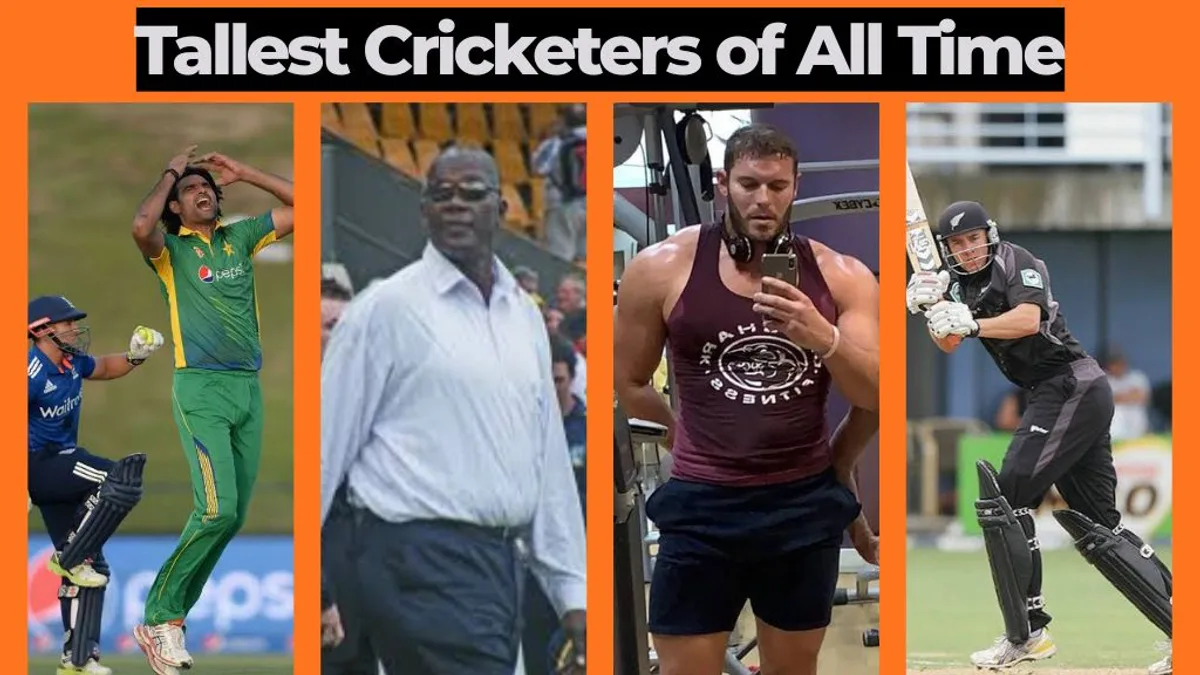
On this page17
- 01Mohammad Irfan
- 02Marco Jansen
- 03Boyd Rankin
- 04Billy Stanlake
- 05Kyle Jamieson
- 06Blessing Muzarabani
- 07Bruce Reid
- 08Joel Garner
- 09Jason Holder
- 10Curtly Ambrose
- 11Chris Tremlett
- 12Steven Finn
- 13How We Ranked the Tallest Cricketers
- 14Why Height Is Such a Weapon in Fast Bowling
- 15The Injury Tax of Extreme Height
- 16Heights at a Glance
- 17Where Height Stops Helping: Batting
Ranked strictly by measured playing height at international level, tallest first, using cricket anthropometry data cross-checked against player profiles. Beyond Mohammad Irfan the heights cluster within a couple of centimetres — a statistical dead heat — so inside the 6 ft 7 to 6 ft 8 band we order by international standing and note where sources disagree on an inch.
- Tallest ever
Mohammad Irfan
Irfan is the only man measured at 7 ft 1 in (2.16 m) at international level, which is why he leads by a clear five inches rather than sharing the top of a tie. That frame changes the geometry of a good-length ball: released from close to eight feet after his jump, it climbs toward the ribs and chin instead of sitting up to be driven, so batters set for the front foot get sawn off.
Injuries and a late start kept his career short — he was almost 30 on his ODI debut — and he took the bulk of his 80-plus international wickets in one-day cricket for Pakistan rather than Tests. He remains the benchmark every "tallest cricketer" debate opens with.
Country: Pakistan · Height: 7 ft 1 in (216 cm) · Role: Left-arm fast · Defining trait: Highest release point in the game's history
- Tallest active
Marco Jansen
Jansen stands 6 ft 8 in (203 cm) — often mis-listed taller — which ties him with the historic 6 ft 8 band below, but he ranks ahead of it because he is the only one of that group still adding to his record and the only front-line all-rounder among them. He bowls genuine left-arm pace and bats high enough to matter, a two-way value none of the pure quicks here offer.
His 2024-25 seasons made the case in numbers: a record-fast 27-ball T20I fifty against India in November 2024, career-best Test figures of 7 for 13 against Sri Lanka at Durban, then a player-of-the-match all-round display in India in late 2025 that helped South Africa win a Test series there for the first time in over two decades.
Country: South Africa · Height: 6 ft 8 in (203 cm) · Role: Left-arm fast all-rounder · Distinction: Tallest cricketer currently playing
- Two-nation giant
Boyd Rankin
Rankin sits at the top of the 6 ft 8 in (204 cm) band and owns a quirk none of his height-peers can match: he played international cricket for two different countries, appearing at World Cups for Ireland before a single Test for England in the 2013-14 Ashes at Sydney.
His height did the heavy lifting — steep bounce that troubled batters even on flat, low pitches — but the two-nation career, a relic of the era before eligibility rules tightened, is what makes him the most unusual entry on this list.
Countries: Ireland / England · Height: 6 ft 8 in (204 cm) · Role: Right-arm fast-medium · Quirk: Played for two nations
- Australia's tallest
Billy Stanlake
Stanlake is the tallest player to represent Australia, listed at 6 ft 8 in (204 cm), an inch that edges most of the 203 cm names beneath him. He built his international work almost entirely in the short formats, where one unplayable over of extreme pace and lift can decide a T20 in a handful of deliveries.
What separates him from the older giants here is role, not size: injuries and the modern workload split him into a white-ball specialist rather than a five-day banker.
Country: Australia · Height: 6 ft 8 in (204 cm) · Role: Right-arm fast · Niche: T20 pace-and-bounce specialist
- Test enforcer
Kyle Jamieson
Jamieson is the most productive Test bowler of the modern 6 ft 8 in (203 cm) group, which is why he ranks above the other actives at his exact height. He extracts bounce from surfaces that offer bowlers little else and pairs it with control rare in a man his size.
His signature moment came in New Zealand's 2021 World Test Championship final win over India, where he dismissed Virat Kohli in both innings — the kind of top-order scalp that separates a height novelty from a genuine strike bowler.
Country: New Zealand · Height: 6 ft 8 in (203 cm) · Role: Right-arm fast-medium · Feat: Dismissed Kohli twice, 2021 WTC final
- Zimbabwe's spearhead
Blessing Muzarabani
At 6 ft 8 in (203 cm), Muzarabani leads Zimbabwe's attack and is the tallest quick his country has produced. His whip-like action and steep bounce make him unusually awkward to face for batters used to shorter Associate-era bowling.
He ranks here on height rather than volume of honors — Zimbabwe play a lighter international schedule than the Test giants above — but his best spells against higher-ranked sides show the leverage his frame gives him.
Country: Zimbabwe · Height: 6 ft 8 in (203 cm) · Role: Right-arm fast-medium · Role on team: Attack leader
- 80s left-arm threat
Bruce Reid
Reid, also 6 ft 8 in (203 cm), was one of Australia's most feared left-arm quicks across the late 1980s and early 90s, combining height, angle and pace into a genuine strike weapon in both Tests and one-day cricket.
He is the cautionary entry on this list: a career repeatedly broken by back and stress injuries, the recurring tax on bowling fast from an unusually tall, thin frame. When fit he produced some of the best match returns of any Australian quick of his era against England — but "when fit" is doing a lot of work.
Country: Australia · Height: 6 ft 8 in (203 cm) · Role: Left-arm fast · Caveat: Career cut short by back injuries
- Big Bird
Joel Garner
Garner is the most decorated bowler in the 6 ft 8 in (203 cm) band, a pillar of the great West Indies pace attacks of the late 1970s and 80s. His yorker, dropped from that height, skidded in at ankle level exactly when batters braced for something full and hittable.
The numbers back the legend: an ODI economy rate barely above three runs an over across his career, and figures of 5 for 38 in the 1979 World Cup final, still one of the great limited-overs bowling displays. He ranks below the taller names purely on the measuring tape, not on merit.
Country: West Indies · Height: 6 ft 8 in (203 cm) · Role: Right-arm fast · Feat: 5/38 in the 1979 World Cup final
- Tallest all-rounder
Jason Holder
Holder, at 6 ft 7 in (201 cm), is the tallest genuine batting all-rounder the modern game has produced, and the only man on this list valued as much for his bat as his bowling. He rose to No. 1 in the ICC Test all-rounder rankings and captained the West Indies Test side.
That dual value is what earns him a place ahead of the pure quicks of similar height: he offers a Test-class lower-order bat and dependable seam bowling in one frame, where the others offer bounce alone.
Country: West Indies · Height: 6 ft 7 in (201 cm) · Role: Fast-medium all-rounder · Feat: Former No. 1 ICC Test all-rounder
- Height plus control
Curtly Ambrose
Ambrose stood 6 ft 7 in (201 cm) and turned height into accuracy rather than raw hostility. He finished with 405 Test wickets, and batters across two decades rated the length he hit — dropped from that height onto a spot that gave almost no scoring room — as close to impossible to get away.
His most famous spell, 7 for 1 against Australia in a 1993 collapse, remains the clearest evidence that his size mattered less than where he put the ball. See how that return sits among the most Test wickets taken by West Indies quicks.
Country: West Indies · Height: 6 ft 7 in (201 cm) · Role: Right-arm fast · Feat: 405 Test wickets; 7/1 vs Australia, 1993
- Ashes weapon
Chris Tremlett
Tremlett, 6 ft 7 in (201 cm), used his height to generate bounce that troubled well-set batters on surfaces where other seamers went flat. His high point was the 2010-11 Ashes in Australia, where he was a regular wicket-taker in a series England won on the road.
Like several tall quicks here, injuries chewed into his availability, but at his best he was a bounce-first strike option rather than a swing bowler — a role his frame made him uniquely suited to.
Country: England · Height: 6 ft 7 in (201 cm) · Role: Right-arm fast-medium · Peak: 2010-11 Ashes in Australia
- Steep bounce
Steven Finn
Finn, also 6 ft 7 in (201 cm), built his England career on the steep bounce his height produced, particularly against batters unused to a fast bowler releasing from that far above the pitch. He was a key part of England's Test attacks through the early 2010s.
His frame was also a management problem: coaches periodically retooled his action to ease the physical strain of bowling fast at that height, a reminder that the same leverage that beats batters can also work against the bowler.
Country: England · Height: 6 ft 7 in (201 cm) · Role: Right-arm fast · Note: Action reworked to manage physical strain
Reader interaction
Build your ranking
Drag the names into the order you think is right — or use the arrows — then submit to see how your list compares with everyone else's.
- Mohammad Irfan
- Marco Jansen
- Boyd Rankin
- Billy Stanlake
- Kyle Jamieson
- Blessing Muzarabani
- Bruce Reid
- Joel Garner
- Jason Holder
- Curtly Ambrose
- Chris Tremlett
- Steven Finn
Audience ranking
How everyone ranked them
Built from reader rankings using position-based points.
The ranked cards above are the list. The sections below explain how we measured and ordered them, why height is such a weapon for bowlers, and where it stops helping.
How We Ranked the Tallest Cricketers
Placement is driven by one number: confirmed playing height at international level, tallest first. We took heights from established cricket anthropometry data and cross-checked them against player profiles from cricket’s major statistical databases.
Two rules handle the messy parts. First, where sources disagree on a player — common with informally measured heights — we use the most widely cited figure and flag the dispute in the card. Second, beyond Mohammad Irfan the field bunches inside a two-centimetre window, which is smaller than the measurement error itself. Inside that 6 ft 7 to 6 ft 8 in band we treat the heights as tied and order by international standing, so a World Cup-winning great isn’t buried under a one-cap debutant who happened to be measured a centimetre taller.
The list covers men’s international cricket only. Height comparisons in women’s cricket and domestic-only careers were out of scope.
Why Height Is Such a Weapon in Fast Bowling
A taller bowler releases the ball from higher up and drags a longer lever through the crease. Both add pace, but the real prize is the angle of descent. A delivery released from near eight feet drops onto a good length and keeps climbing, arriving at chest or throat height where a shorter bowler’s ball would sit up around the waist to be driven or pulled.
That extra lift attacks the batter’s decision-making, not just their reflexes. Set for a front-foot push, they find the ball spitting past the splice; forced onto the back foot, they lose the drive. It is the single mechanical reason a length that looks harmless from one bowler becomes a problem from another five inches taller.
The Injury Tax of Extreme Height
Height is not free. The same leverage that steepens the bounce also multiplies the load through the lower back and hips at the moment of delivery, and tall fast bowlers break down more often than most. Bruce Reid, Chris Tremlett and Steven Finn all lost chunks of their careers or had their actions rebuilt to survive the workload. It is why several players on this list appeared in fewer matches than their ability warranted, and why raw height on a debut sheet says little about how long a career will last.
Heights at a Glance
| Player | Country | Height | Role |
|---|---|---|---|
| Mohammad Irfan | Pakistan | 7 ft 1 in (216 cm) | Left-arm fast |
| Marco Jansen | South Africa | 6 ft 8 in (203 cm) | Left-arm fast all-rounder |
| Boyd Rankin | Ireland / England | 6 ft 8 in (204 cm) | Right-arm fast-medium |
| Billy Stanlake | Australia | 6 ft 8 in (204 cm) | Right-arm fast |
| Kyle Jamieson | New Zealand | 6 ft 8 in (203 cm) | Right-arm fast-medium |
| Blessing Muzarabani | Zimbabwe | 6 ft 8 in (203 cm) | Right-arm fast-medium |
| Bruce Reid | Australia | 6 ft 8 in (203 cm) | Left-arm fast |
| Joel Garner | West Indies | 6 ft 8 in (203 cm) | Right-arm fast |
| Jason Holder | West Indies | 6 ft 7 in (201 cm) | Fast-medium all-rounder |
| Curtly Ambrose | West Indies | 6 ft 7 in (201 cm) | Right-arm fast |
| Chris Tremlett | England | 6 ft 7 in (201 cm) | Right-arm fast-medium |
| Steven Finn | England | 6 ft 7 in (201 cm) | Right-arm fast |
Heights are as commonly reported at peak career; small variations appear across sources.
Where Height Stops Helping: Batting
Batters get a diluted version of the same trade-off. Extra reach helps against width and lets a tall player get on top of steep bounce, but it also means more stumps to protect when driving, and a longer lever to control when a ball is on the stumps. That balance is why the top-order ranks aren’t full of giants and why the tallest batting specialists top out well below the tallest bowlers. For the opposite extreme — where a low center of gravity became an asset — see our list of the shortest cricketers in the game.
Frequently asked questions
Who is the tallest cricketer of all time?+
Mohammad Irfan of Pakistan, at roughly 7 ft 1 in (2.16 m), is the tallest man ever to play international cricket. No other international player has been measured taller, and his nearest rivals sit around 6 ft 8 in — a gap of about five inches. His height gave him the highest ball-release point the game has seen, which is why a good-length delivery from him reared up toward the ribs.
Who is the tallest active cricketer right now?+
South Africa's Marco Jansen, listed at 6 ft 8 in (203 cm), is the tallest cricketer currently playing international cricket. He is often mis-reported as taller, but official profiles put him at 203 cm. Uniquely among the giants, Jansen is a two-way player: he bowls genuine left-arm pace and bats high enough to serve as an all-rounder across all three formats, rather than being a height-driven specialist.
Why are almost all the tallest cricketers fast bowlers?+
Extreme height converts most directly into fast-bowling value. A taller bowler releases the ball from higher and swings a longer arm through the crease, producing steeper bounce off a good length — the hardest length for batters to score off. Batting rewards timing and balance more than reach, so height offers batters a smaller edge. That mismatch is why the tallest-ever list is stacked with quicks, not top-order batters.
Are there any tall specialist batters in cricket?+
They are rare. Jason Holder, at 6 ft 7 in, is the tallest genuine batting all-rounder in the modern game, valued for his lower-order runs as much as his seam bowling. New Zealand's Peter Fulton built a top-order Test career at around 6 ft 5 in. But no batting specialist approaches the 6 ft 8-plus heights of the tallest bowlers, because extra reach comes with more stumps to defend and a longer lever to control.
Does being very tall hurt a fast bowler's body and career?+
Often, yes. The leverage that beats batters also loads the spine and joints harder on every delivery. Bruce Reid's career was repeatedly broken by back and stress injuries, Chris Tremlett lost spells to breakdowns, and Steven Finn had his action reworked to ease the strain. Tall quicks tend to carry heavier injury histories than shorter bowlers, which is why several of the giants here played fewer matches than their talent promised.
How are cricketers' heights measured, and why do sources disagree?+
Most listed cricket heights come from team profiles and media rather than standardized medical measurement, so figures drift by an inch or two between sources — Marco Jansen alone is variously listed at 203 cm and 209 cm. We use the most widely cited, best-supported figure for each player and treat differences of a centimetre or two as noise. That is also why several players here effectively share a rank at 6 ft 8 in.
Sources
Play & tools
Free browser games and tools — no account, no download.
- Play today's Sports Connections — Today's Sports Connections — daily hints, answers, and play the grid.
- Play Guess the NFL Player — A new mystery NFL player every day. Eight guesses, with a clue on each — plus free unlimited mode.
- Explore all our games →
Related cricket guides
View all →
Best Women Cricketers of All Time: Legends of the Game
The 14 greatest women cricketers ever, ranked and named — from Belinda Clark and Mithali Raj to Ellyse Perry and Smriti Mandhana — with the records behind each.
Shortest Cricketers of All Time: The Game's Smallest Stars
Kruger van Wyk, Walter Cornford, Sunil Gavaskar and more — the 12 shortest cricketers to play international cricket, ranked by height with career notes.

Tallest Bowlers in Cricket History
Mohammad Irfan, at 7 ft 1 in, is the tallest bowler in cricket history. Here are the giants of fast bowling and how their height turned into steepling bounce.
Longest Sixes in Cricket: The Biggest Hits Ever Recorded
The 12 longest sixes ever measured in cricket, ranked by distance — from Shahid Afridi's 153m strike at the Wanderers to Tim David's 129m hit in 2025.

Biggest Cricket Stadiums in the World: Top 10 by Capacity
The biggest cricket stadiums ranked by seating capacity, from India's 132,000-seat Narendra Modi Stadium and the MCG to Eden Gardens, Raipur, and Perth's Optus.

Most Successful Cricket Teams in History: The All-Time Rankings
Every major cricket nation ranked by ICC titles: Australia's 10 trophies, the West Indies dynasty, India's seven, and South Africa's 2025 WTC breakthrough.