
The Longest Drive Ever Recorded: Golf's Distance Records

On this page6
The longest drive ever recorded in competition belongs to Mike Austin, who struck a 515-yard drive at the 1974 US National Seniors Open in Las Vegas, aged 64, a mark Guinness World Records still credits as the longest competitive drive. You will also hear about Carl Cooper’s 787-yard monster, but that one comes with an asterisk: most of the distance was a lucky bounce down a cart path, not a struck shot. And for perspective on both, the average male amateur drives the ball only around 215 to 220 yards.
Golf’s distance records are a tangle of real feats, freak bounces, and downhill help. Here is what actually happened.
Mike Austin and the 515-yard record
On 25 September 1974, at Winterwood Golf Course in Las Vegas, Mike Austin, a 64-year-old with a PhD in kinesiology and a reputation as a swing savant, hit a drive that finished 515 yards away on a par-4. A 27 mph tailwind and firm desert fairway helped, but the strike itself was real, and Guinness credited it as the longest drive in a competitive event.
Austin was no gimmick. He understood the mechanics of a golf swing as well as anyone of his era and spent decades teaching a technique built around effortless speed. That the record still stands more than five decades later, through the era of titanium drivers and launch monitors, says something about how rare a perfect confluence of swing, wind, and ground really is.
The Carl Cooper myth, told honestly
Then there is Carl Cooper. At the 1992 Texas Open, the journeyman pro pushed a drive on a par-4 that caught a downhill concrete cart path and kept rolling, and rolling, finishing roughly 330 yards past the hole for a total of about 787 yards. It is a wonderful story and a genuinely measured distance. It is not a record.
Guinness does not recognise Cooper’s drive precisely because the yardage came from a hard path, not a fair strike through turf. Had the ball landed on grass it would have stopped hundreds of yards shorter. So when the 787-yard figure circulates online as the “longest drive ever,” the honest footnote is: longest roll, not longest drive.
Golf’s notable long drives, in context
Here is how the headline numbers compare, and what each one actually means.
| Drive | Player | Distance | Context |
|---|---|---|---|
| Longest competitive drive (record) | Mike Austin, 1974 | 515 yards | Tailwind, firm desert fairway; Guinness-credited |
| Longest “drive” by total roll | Carl Cooper, 1992 | ~787 yards | Rolled down a cart path; not a record |
| Longest on the PGA Tour (measured) | Various, downhill holes | ~470–498 yards | Firm, downhill, wind-aided setups |
| Long-drive competition record | Long Drivers Association | 400+ yards (carry) | Special equipment and setups |
| Average male amateur drive | Recreational golfers | ~215–220 yards | Typical real-world tee shot |
The gap between the top of that table and the bottom is the whole point. Record drives are freaks of wind, ground, and once-in-a-lifetime contact. The number that describes your golf, and mine, sits far lower down.
Tiger, the tour, and how far pros really hit it
Tiger Woods’ longest measured drive in competition is usually put around 498 yards, from a downhill hole at the 2002 Mercedes Championships in firm conditions. Impressive, but note the setup: elevation and firm turf did much of the work. His everyday driving average sat closer to 285 to 300 yards, elite, but a world away from the record.
That pattern holds across the tour. Even the longest hitters average in the low 300s, and their headline “longest drives” almost always involve downhill terrain and a following wind. Raw swing speed matters, but so does the ground and the air. How that speed and distance track over a golfer’s life is its own story, one we break down in our guide to average driving distance by age.
What actually makes a drive go far
Every record on that list shares the same three ingredients, and none of them is simply muscle. The first is clubhead speed, how fast the driver is moving at impact, which sets the ceiling on distance. The second is a clean strike from the centre of the face, because contact off the toe or heel bleeds away speed and sends the ball offline. The third, and the most underrated, is launch conditions: a high launch with low spin carries and rolls the farthest, which is why modern drivers and ball-fitting chase that exact window.
Then come the free yards nobody can train for. A firm, downhill fairway can add 50 to 100 yards of roll. A strong tailwind does the same through the air. Thin air at altitude, as at Jade Dragon or Mike Austin’s desert, reduces drag and stretches every carry. Read the record drives again with that in mind and the pattern is obvious: Austin had wind and firm desert turf, Cooper had a concrete path, Tiger had downhill slopes. The swing lit the fuse, but the conditions supplied most of the powder.
For your own game, the lesson is that chasing speed alone is a slow road. A better strike and the right launch, usually found in a proper club fitting, add distance far more reliably than swinging out of your shoes and topping it.
What the records mean for your game
The practical takeaway is not to chase 500 yards. It is to be realistic about your own numbers. If you carry the ball 215 yards, you are an average male amateur; clear 250 and you are already above the pack. Knowing your true distances with every club, not your best-ever single strike, is what actually lowers scores, which is why we built a full golf club distances chart to map realistic yardages.
Chasing the longest drive ever is fun to read about and pointless to imitate. The players who defined the sport, gathered in our greatest golfers roundup, won on control and course management, not one heroic bomb. Measure your game by what actually counts as a good score, not by a 64-year-old’s tailwind miracle in the Nevada desert.
Frequently asked questions
Did Carl Cooper really drive 787 yards?+
The ball travelled about 787 yards, but not through the air. At the 1992 Texas Open, Carl Cooper's tee shot caught a downhill concrete cart path and rolled roughly 330 yards past the hole. Guinness does not count it as a record because the distance came from the path, not a fair strike.
What was Tiger Woods' longest drive?+
Tiger Woods' longest measured drive in competition is often cited at 498 yards at the 2002 Mercedes Championships, aided by downhill terrain and firm conditions. In everyday play his drives averaged closer to 285 to 300 yards, still elite but far short of long-drive specialists.
What percentage of golfers drive the ball 250 yards?+
Distance data from tracking systems suggests only a minority of amateur men, well under a third, carry or roll the ball past 250 yards off the tee. The average male recreational drive sits closer to 215 to 220 yards, so a genuine 250-yard drive is above average, not routine.
What is the longest drive in a long-drive competition?+
Purpose-built long-drive events produce the sport's biggest hits. Competitors regularly carry the ball past 400 yards on firm, downwind grids, and Mike Dobbyn's 551-yard drive at the 2007 World Long Drive Championship ranks among the longest in the discipline's competitive history.
Sources
Play & tools
Free browser games and tools — no account, no download.
- Play today's Sports Connections — Today's Sports Connections — daily hints, answers, and play the grid.
- Play Guess the NFL Player — A new mystery NFL player every day. Eight guesses, with a clue on each — plus free unlimited mode.
- Explore all our games →
Related golf guides
View all →
Average Driving Distance by Age: Where Do You Stand?
The average male amateur drives it around 225 yards, peaking in the 20s and 30s and dropping roughly 30 yards by the 60s. See the full breakdown by age and handicap.
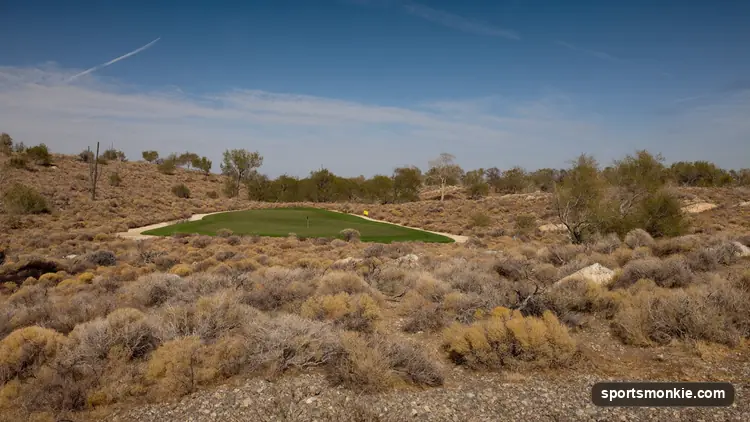
The Longest Golf Courses in the World
The longest golf course in the world is Australia's Nullarbor Links at 1,365 km. The longest conventional 18-hole course is Jade Dragon in China at 8,548 yards.
What Is a Hole-in-One in Golf?
A hole-in-one is a score of one stroke on a par-three, par-four or par-five hole, although the hole's official par and format still matter.

How to Hit a Pitch Shot in Golf: Setup, Distance Control & Trajectory
To hit a pitch shot, take a lofted wedge, play the ball center, put 60% of your weight on your lead foot, and control distance with backswing length, not hand speed.

The Career Grand Slam in Golf, Explained
The career grand slam means winning all four professional majors in a career. Only six men have done it, most recently Rory McIlroy in 2025.

Golf Drop Rules, Explained
Golf drop rules under Rule 14.3: drop from knee height into a relief area, and replay if the ball rolls out. When you drop and what it costs.