
Interlock vs Overlap Grip: Which Should You Use?
On this page6
Interlock and overlap are the two dominant ways to join your hands on the club. Interlock locks the trail-hand pinky and lead-hand index finger together; overlap rests the trail pinky on top of the crease between the lead-hand fingers. Interlock tends to suit smaller hands and weaker fingers, while overlap suits most players with average-to-large hands. Neither is objectively better, and major champions have used both.
The choice matters less than golfers fear, but there is a sensible default for your hands, and picking it early saves you fighting your grip for years.
The three grips, quickly
There are really three ways to hold a club, and the first two are the ones worth debating:
- Overlap (Vardon): the trail-hand little finger rests on top of, or in the groove between, the lead-hand index and middle fingers. Named for Harry Vardon, who popularised it over a century ago, it has long been called the tour standard.
- Interlock: the trail-hand pinky and the lead-hand index finger hook together, physically linking the hands. Jack Nicklaus adopted it because his relatively small hands felt more secure locked together.
- Ten-finger (baseball): all ten fingers sit on the grip with nothing linked. It is the most intuitive and the least common at the top level, but useful for juniors, beginners, and players with weak grip strength or arthritis.
Do the pros overlap or interlock?
Here is the number most articles get wrong. The old line is that nearly every tour pro overlaps, but current data says otherwise. When Golf Digest audited the entire 2024 PGA Championship field, it found roughly 58% of players interlocked, 41% overlapped, and just one player used a baseball grip. Among American players in that field, more than 60% interlocked.
So the honest answer is that the tour is close to an even split, tilting slightly toward interlock among the current generation. The takeaway for you is not which grip wins a headcount, but that both are proven at the highest level of the sport, which frees you to choose on comfort rather than fashion.
Interlock vs overlap: the comparison
| Feature | Interlock | Overlap (Vardon) |
|---|---|---|
| How the hands join | Trail pinky and lead index finger lock together | Trail pinky rests on the lead-hand fingers |
| Best suited to | Smaller hands, shorter fingers, weaker grip strength | Average-to-large hands, most golfers |
| Feel | Very connected, hands act as one unit | Slightly freer, more feel in the fingers |
| Common complaint | Can feel cramped, may encourage over-gripping | Pinky can slip for players with small hands |
| Notable pros | Jack Nicklaus, Tiger Woods, Rory McIlroy | Ben Hogan, Arnold Palmer, and much of the tour |
Both grips do the same essential job: they unify the hands so the wrists hinge and release together rather than fighting each other. The differences at the margin are about hand size and personal feel, not about power or accuracy in any measurable, universal way.
Which should you use?
For most golfers with average or larger hands, start with the overlap. It keeps the hands slightly freer, tends not to encourage a death grip, and is the more common teaching default. If your hands are on the smaller side, your fingers are short, or the overlap ever feels like your pinky is sliding off, switch to the interlock, which is exactly why Nicklaus chose it.
Reach for the ten-finger grip only if you are a junior, a genuine beginner building strength, or a player whose hands cannot comfortably link, for instance because of arthritis. It sacrifices a little precision at the top for security and comfort, which is a fair trade for those players.
Whichever you pick, grip strength, meaning how the hands rotate on the club, matters far more to your ball flight than the link between your fingers. A weak or strong hand position changes where the face points at impact, so our guide to a strong vs weak golf grip is the more important read if your shots curve too much in one direction.
The DeChambeau exception
If you want proof that grip style is personal, look at Bryson DeChambeau. He uses neither a textbook interlock nor overlap, favouring an unconventional, near ten-finger hold on oversized jumbo grips, all built around his single-length irons and a single-plane golf swing. It works because it fits his system, not because it follows a rule. That is the real lesson: the grip that lets you return the face square and hold on under pressure is the right one for you.
Try both, then commit
Spend one range session hitting a dozen balls with each grip, back to back, and pay attention to two things: which one lets your hands feel connected without tension, and which one you stop thinking about faster. Then commit. Switching grips is uncomfortable for a week or two because the hands have to relearn the release, so give a new grip real time before you judge it. If you are between the two and genuinely cannot tell, you have small-to-average hands, and you want the safe default, start with the overlap and only move to interlock if your pinky ever slips.
Related topic guides
Frequently asked questions
Do pros use interlock or overlap?+
Both, and it is closer than the old wisdom suggests. Golf Digest's audit of the entire 2024 PGA Championship field found 58% of players interlocked and 41% overlapped, with under 1% using a baseball grip. Overlap was long called the tour standard, but among today's players the split is nearly even.
Does Rory McIlroy use overlap or interlock?+
Rory McIlroy uses an interlocking grip, where the trail-hand pinky and lead-hand index finger lock together. He joins Jack Nicklaus and Tiger Woods, the two most famous interlockers in the game's history, so the world's best have won majors with this grip for decades.
Does Bryson DeChambeau use interlock or overlap?+
Neither in the standard sense. DeChambeau uses an unconventional grip closer to a ten-finger style on oversized jumbo grips, matched to his single-length irons and one-plane swing. He is the clearest example that grip style is personal, not a rule everyone must follow.
Does Tiger Woods use interlock or overlap?+
Tiger Woods interlocks, and always has. His grip is so ingrained that years of pressure between the fingers physically reshaped his right pinky. Woods and Jack Nicklaus, both interlockers, are two of the most decorated players ever, which permanently ended the idea that interlock is only for beginners.
Sources
Play & tools
Free browser games and tools — no account, no download.
- Play today's Sports Connections — Today's Sports Connections — daily hints, answers, and play the grid.
- Play Guess the NFL Player — A new mystery NFL player every day. Eight guesses, with a clue on each — plus free unlimited mode.
- Explore all our games →
Related golf guides
View all →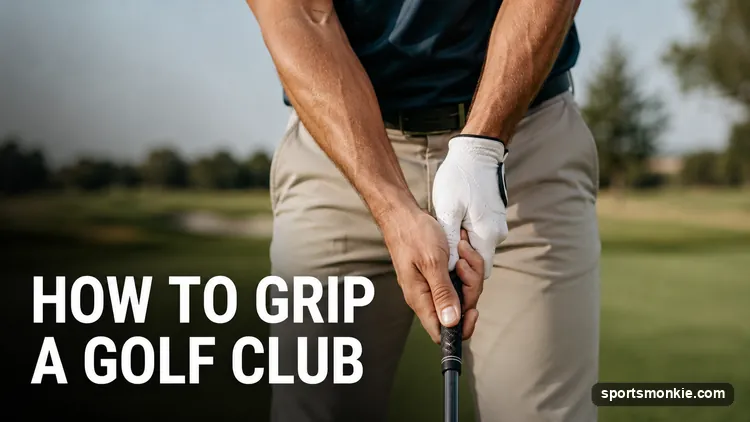
How to Grip a Golf Club: The Correct Grip in 5 Steps
To grip a golf club correctly, rest it diagonally across your lead-hand fingers, close the hand so the V points at your trail shoulder, then set your trail hand so both palms face each other. Here is the full 5-step setup, pressure scale, and fixes for the grip faults that cause slices and hooks.
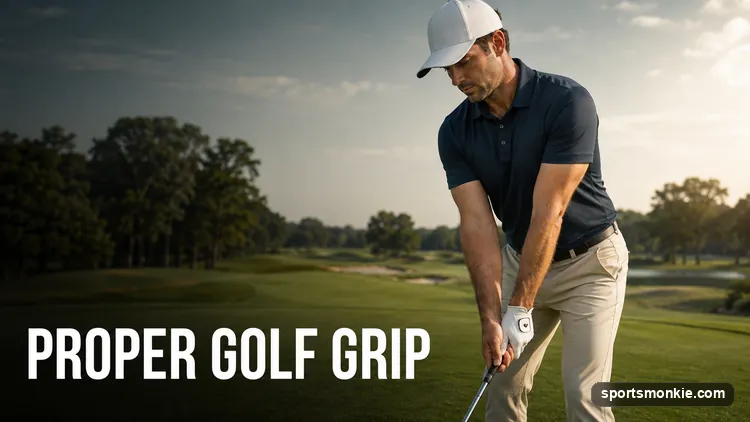
Proper Golf Grip: What a Correct Grip Looks Like and Why It Matters
A proper golf grip has neutral hands, matching V's pointing at your trail shoulder, light pressure, and unified hands acting as one unit through impact.
Strong vs Weak Golf Grip: What Each Does to Ball Flight
Strong vs weak golf grip: a strong grip closes the face for a draw, a weak grip opens it for a fade. What each does to ball flight, and which to use.
Golf Swing Tips for Beginners: 9 Fixes That Cut Strokes Fast
The best golf swing tips for beginners start with grip, setup, and a slower takeaway — nine checkpoints that fix slices, chunks, and tops in one range session.
How to Swing a Golf Club: The Complete Step-by-Step Guide
How to swing a golf club starts with a solid grip and setup, then a one-piece takeaway, a controlled backswing, and a downswing led by the hips. Here is the full sequence.
Why Do Golfers Wear One Glove? (And Which Hand)
Why do golfers wear one glove? It goes on the lead hand for grip and protection. Here is which hand it fits, why only one, and when pros wear none.