
How Long Does a Polo Match Last? Chukkas Explained

On this page7
- 01How long is a chukka in polo?
- 02How many chukkas are in a polo match, and why does it vary?
- 03Polo match duration by level of play
- 04What happens at halftime, and why do people stomp on the field?
- 05What makes a polo match run longer than scheduled?
- 06Is arena polo faster to watch than outdoor polo?
- 07The real cost behind those short chukkas
A polo match lasts 1 to 2 hours from the first bell to the last, built from 4 to 8 playing periods called chukkas, each running 7 to 7.5 minutes. Add the breaks between chukkas, a longer halftime, and you get a running time that swings with the level of play: a club match wraps in about an hour, a high-goal tournament final can push past two.
That range confuses first-time spectators because no single number is “the” answer. How long the match actually runs depends on how many chukkas are scheduled, whose rulebook the club follows, and how often the umpire’s whistle stops the clock.
How long is a chukka in polo?
A chukka is the basic unit of play in polo, and its length depends on which governing body’s rules the club uses. Under Hurlingham Polo Association rules — the standard for the UK and most of the polo world — a chukka is timed to run 7 minutes. When the bell rings at 7:00, play doesn’t stop dead; it continues for up to another 30 seconds, or until the ball goes out of play, whichever comes first.
In the United States, the U.S. Polo Association uses a slightly longer chukka: 7 minutes 30 seconds. Australian clubs, including the South East Queensland Polo Club, follow the shorter 7-minute HPA-style chukka with the same 30-second overtime allowance. It’s a small gap, but it means a six-chukka US match runs about 3 minutes longer on the clock than the same-length match in the UK or Australia, before you even count stoppages.
How many chukkas are in a polo match, and why does it vary?
This is the number that actually decides how long you’ll be watching. Chukka count isn’t fixed league-wide; it’s set by the combined handicap rating of the two competing teams, which is why a Tuesday club game and a Saturday tournament final don’t run the same length at all.
- Low-goal matches (lower combined handicap): 4 chukkas
- Medium-goal matches: 5 chukkas
- High-goal / tournament matches: 6 chukkas
- The highest-rated elite tournaments: up to 8 chukkas under the HPA’s full rules, though this ceiling is rarely used outside the top international events
Cowdray Park Polo Club, one of the sport’s most established venues, confirms this low/medium/high-goal split directly, and the same handicap-based scaling shows up at Australian clubs, where a 4-goal match plays 4 chukkas and a 10-goal match plays 6. If you’re heading to a casual Sunday club match, expect the short end. If it’s a named tournament final, budget for the long end.
Polo match duration by level of play
| Level of play | Chukkas | Chukka length | Interval | Halftime | Typical total time |
|---|---|---|---|---|---|
| Arena (indoor) club polo | 4 | 7.5 min | ~3–4 min | rolled into break | 45 min – 1 hour |
| Low-goal / club outdoor | 4 | 7 min (UK/AU) or 7.5 min (US) | 3 min | 5 min | ~1 hour |
| Medium-goal | 5 | 7–7.5 min | 3 min | 5 min | ~1 hr 15 min |
| High-goal / tournament | 6 | 7–7.5 min | 3–4 min | 5–10 min | 1.5–2 hours |
| Elite / full HPA maximum | 8 | 7 min | 3 min | 5 min | 2+ hours |
The “typical total time” column runs longer than a straight math of chukkas times minutes, because it folds in the intervals, halftime, and the fact that the clock keeps stopping for fouls. Treat the table as a planning guide, not a stopwatch guarantee.
What happens at halftime, and why do people stomp on the field?
Officially, the HPA sets halftime at 5 minutes, the same length as the interval between any other two chukkas. In practice, most club and exhibition matches, especially in the US, stretch halftime to around 10 minutes, because it’s built around a tradition rather than just a breather: divot stomping.
Four chukkas of galloping ponies tear the turf into loose clumps called divots. At halftime, spectators are invited onto the field to press them back down by foot. Newport Polo calls it a “time-honored tradition” that does double duty: it repairs the pitch for the second half and gives the crowd something to do besides check their phones. It’s also, practically, why halftime runs longer than the standard 5-minute interval. You can’t herd a few hundred people onto a field and off again in five minutes.
What makes a polo match run longer than scheduled?
The chukka clock is generous about stopping. Play halts, and the clock with it, for:
- Fouls: the most common source of delay. Polo’s foul list covers dangerous riding lines, illegal hooking, and crossing the ball’s line of travel, and every whistle stops the game clock until play restarts.
- Broken tack or equipment: a snapped rein, a lost stirrup, or a mallet that needs replacing.
- Injury to a horse or player: matches stop immediately and don’t restart until it’s safe to.
- Weather: lightning or a waterlogged pitch can pause or suspend outdoor matches; there’s no indoor fallback the way there is with arena polo.
- Sudden-death overtime: if the score is level after the final chukka, there’s no 30-second grace period at that point. An extra chukka is played, and the first goal wins outright, which can add several more minutes.
None of these show up in the base “chukkas times minutes” math, which is exactly why a scheduled 1-hour club match can run closer to 90 minutes on a rough afternoon.
Is arena polo faster to watch than outdoor polo?
Generally, yes, and it’s the better option if you’re short on time. Arena polo is played 3-a-side (versus 4-a-side outdoors) on a smaller, boarded surface, and the ball stays live off the walls instead of going out of bounds constantly, which keeps play flowing. Per World Polo Guide, an arena chukka runs 7.5 minutes, matches typically use 4 to 6 chukkas, and the whole thing tends to wrap inside an hour. If you’re taking a first-timer to their first match and worried about attention spans, an indoor or arena fixture is the shorter, punchier introduction to the sport.
If you want the full rulebook behind all of this (scoring, fouls, the offside-style “line of the ball” rule, and team positions), that’s covered separately in our polo rules explainer. And once you know how long you’ll be standing pitch-side, it’s worth knowing who you’re likely watching: our list of the best polo teams in the world rounds up the high-goal sides that fill out those longer 6-chukka tournament cards.
The real cost behind those short chukkas
Here’s what the clock doesn’t tell you: a 7-minute chukka is short on purpose, because a galloping polo pony can’t sustain that pace much longer without being pushed too hard. That’s why serious players rotate a fresh horse in for nearly every chukka rather than riding one pony the whole match — a 6-chukka tournament game can mean six or more ponies per player, each one needing the same care, feeding, and stabling as any other performance horse. If that side of the sport interests you, our polo pony cost breakdown prices out the string you see change over at every break.
Going to your first match? Plan your afternoon around the format, not just the sport: an arena fixture is done in under an hour, a high-goal tournament final can run two, and either way, our guide on what to wear to a polo match covers the one rule that matters most — shoes that survive the halftime divot stomp.
FAQs
How long is a chukka in polo? A chukka is timed at 7 minutes under Hurlingham Polo Association and Australian rules, or 7 minutes 30 seconds under United States Polo Association rules. Play can run up to 30 extra seconds after the bell if the ball is still live, so a chukka rarely ends at the exact second the clock says.
How many chukkas are in a professional polo match? High-goal tournament polo is usually 6 chukkas. The exact number is set by the combined handicap of the two teams: low-goal matches often play 4, medium-goal 5, and the Hurlingham Polo Association’s full rules allow up to 8 chukkas for the highest-rated games, though that maximum is rare outside elite tournaments.
How long does halftime last in polo? Official Hurlingham Polo Association rules set halftime at 5 minutes, the same length as a mid-game interval. Many club and exhibition matches, especially in the US, stretch it to around 10 minutes so spectators have time to walk onto the field and stomp divots before the second half starts.
Why do spectators stomp divots at halftime? Galloping ponies tear up chunks of turf called divots. Stomping them flat repairs the playing surface for the second half and prevents a bad bounce from injuring a horse or player. It’s become a signature spectator tradition at outdoor clubs from Newport to Cowdray Park, not just groundskeeping.
What happens if a polo match is tied at the end? The last chukka ends outright once the bell rings, with no 30-second grace period, unless the score is level. If it’s tied, an extra sudden-death chukka is played: whichever team scores next wins immediately. This can add anywhere from a few minutes to a full extra chukka to the running time.
Is arena (indoor) polo shorter than outdoor polo? Usually, yes. Arena polo is played 3-a-side on a smaller enclosed surface, typically over 4 chukkas of 7.5 minutes each, versus up to 6 or 8 outdoors. With less ground to cover between plays, arena matches commonly wrap up in under an hour, making them a faster watch for new spectators.
Frequently asked questions
How long is a chukka in polo?+
A chukka is timed at 7 minutes under Hurlingham Polo Association and Australian rules, or 7 minutes 30 seconds under United States Polo Association rules. Play can run up to 30 extra seconds after the bell if the ball is still live, so a chukka rarely ends at the exact second the clock says.
How many chukkas are in a professional polo match?+
High-goal tournament polo is usually 6 chukkas. The exact number is set by the combined handicap of the two teams: low-goal matches often play 4, medium-goal 5, and the Hurlingham Polo Association's full rules allow up to 8 chukkas for the highest-rated games, though that maximum is rare outside elite tournaments.
How long does halftime last in polo?+
Official Hurlingham Polo Association rules set halftime at 5 minutes, the same length as a mid-game interval. Many club and exhibition matches, especially in the US, stretch it to around 10 minutes so spectators have time to walk onto the field and stomp divots before the second half starts.
Why do spectators stomp divots at halftime?+
Galloping ponies tear up chunks of turf called divots. Stomping them flat repairs the playing surface for the second half and prevents a bad bounce from injuring a horse or player. It's become a signature spectator tradition at outdoor clubs from Newport to Cowdray Park, not just groundskeeping.
What happens if a polo match is tied at the end?+
The last chukka ends outright once the bell rings, with no 30-second grace period, unless the score is level. If it's tied, an extra sudden-death chukka is played: whichever team scores next wins immediately. This can add anywhere from a few minutes to a full extra chukka to the running time.
Is arena (indoor) polo shorter than outdoor polo?+
Usually, yes. Arena polo is played 3-a-side on a smaller enclosed surface, typically over 4 chukkas of 7.5 minutes each, versus up to 6 or 8 outdoors. With less ground to cover between plays, arena matches commonly wrap up in under an hour, making them a faster watch for new spectators.
Sources
Play & tools
Free browser games and tools — no account, no download.
- Play today's Sports Connections — Today's Sports Connections — daily hints, answers, and play the grid.
- Play Guess the NFL Player — A new mystery NFL player every day. Eight guesses, with a clue on each — plus free unlimited mode.
- Explore all our games →
Related guides
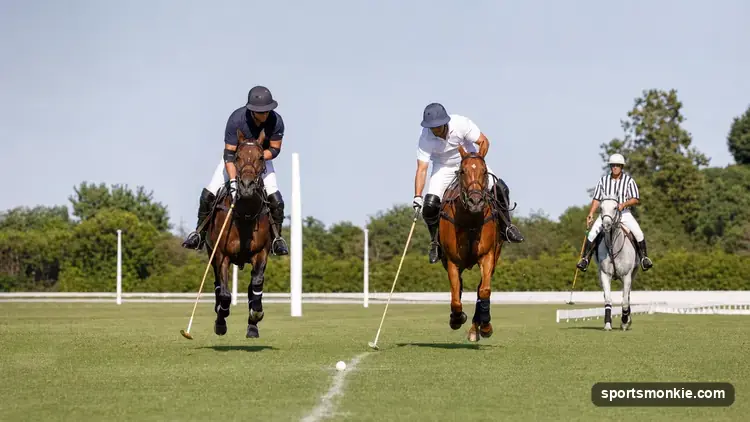
Polo Rules Explained: A Beginner's Guide to the Sport
Polo rules in plain English: teams of four score with a mallet and ball on horseback over 4-6 chukkas. Here's the right-of-way rule, handicaps and field size.

Best Polo Teams in the World: Top 10 Squads Ranked
La Natividad-La Dolfina, Ellerstina-Indios Chapaleufu, and La Dolfina Saudi lead the world's best polo teams, with Argentina, the USA, UK, and UAE fielding the top high-goal outfits as of 2026.
How Long Does It Take to Swim a Mile?
How long to swim a mile: 40-50 min for beginners, 30-35 for intermediates, 22-28 for advanced swimmers. Full pace tables plus exact pool-length math.
How Does MMA Scoring Work? Judging Explained
MMA judges score each round 10-9 on effective striking, grappling and control. Judging criteria, decision types and how a UFC fight is scored.
How Long Are Boxing Rounds? Length & Rest Times
Men's boxing rounds are three minutes with a one-minute rest; women's rounds are usually two minutes. Round length, rest and total fight time explained.

How Many Rounds Are in a Boxing Match?
Professional title fights are 12 rounds, non-title bouts 4–10, and amateur fights 3 rounds. Round counts explained, plus why boxing dropped 15-round bouts.