
Golf Chipping Technique: How to Chip Crisply Every Time

On this page7
- 01What Is the Correct Chipping Setup?
- 02How Do You Actually Swing on a Chip Shot?
- 03Hinge and Hold: The Move That Fixes Flippy Chips
- 04How Far Back Should the Ball Be, and With Which Club?
- 05The Landing-Spot Method for Distance Control
- 06Common Chipping Mistakes and Quick Fixes
- 07A 15-Minute Chipping Practice Plan
Solid golf chipping technique is built at address, not during the swing: a narrow stance, the ball played back of center, your hands pressed ahead of the ball, and roughly 60-70% of your weight on your lead foot. From that setup you make a quiet, putting-style stroke controlled by your shoulders and chest, with the wrists staying firm so the club is “hinged and held” through impact. Get those four setup pieces right and crisp, ball-first contact becomes the default rather than the accident.
What Is the Correct Chipping Setup?
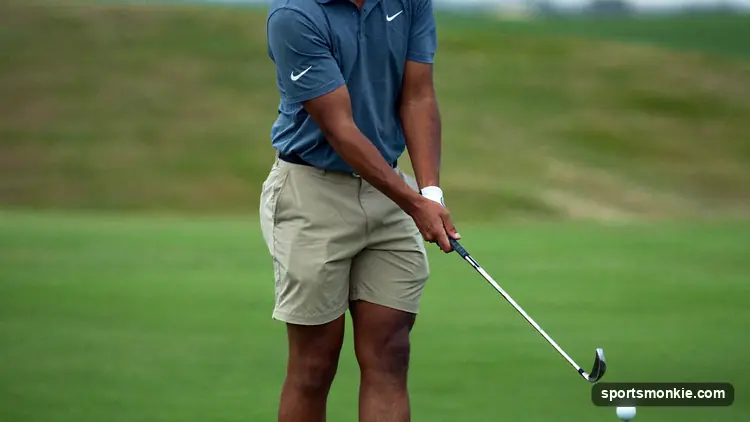
The setup does 80% of the work. Stand with your feet close together, narrower than shoulder width, and open your stance slightly so your lead foot is pulled back a few inches. This lets your hips clear and gives you a clear view down the line. Play the ball back of center, push your hands so the grip end points at your lead hip, and shift your weight forward until you feel pressure under your lead heel. This weight-forward, hands-ahead position pre-sets the descending strike that catches the ball before the turf.
If your full-swing fundamentals are shaky, fix those first, because chipping borrows the same address logic covered in our guide to golf swing technique. A neutral grip helps here too; a stronger or weaker hold changes how the face delivers, so review how to grip a golf club if your chips curve unexpectedly.
How Do You Actually Swing on a Chip Shot?
Chip with your body, not your hands. The best mental image is a putting stroke with a lofted club: rock your shoulders back and through while your arms, hands, and the club move as one connected unit. The clubhead should stay low to the ground going back, then your chest rotates through impact so the handle keeps leading the clubhead. There is almost no independent wrist action. If you feel your right hand (for a right-hander) trying to scoop or lift the ball into the air, you are fighting the loft the club already has.
Let the loft do the lifting. A wedge is built to launch the ball; your job is to deliver a slightly downward, accelerating strike and trust the face. This is the single mindset shift that separates clean chippers from choppers, and it is the same “big-muscle” control we teach in how to swing a golf club.
Hinge and Hold: The Move That Fixes Flippy Chips
“Hinge and hold” describes what your wrists should do, or rather not do, through the ball. On short chips you keep hinge minimal and simply hold the angle you started with, so the shaft stays leaning toward the target at impact. The failure mode is the opposite: the trail wrist unhinges and flips past the lead wrist just before contact, adding loft, thinning the strike, and killing distance control.
To groove the feel, make slow rehearsal swings and stop at impact, checking that your lead wrist is flat and the clubface has not passed your hands. Beginners often find this easier after building general swing consistency, so pair it with the fault-based routines in our golf swing drills guide. Hold that structure and your contact point becomes repeatable, which is the whole game in the short game.
How Far Back Should the Ball Be, and With Which Club?
Ball position and club selection together control trajectory and roll. Here is a simple framework:
| Shot | Ball position | Club | Result |
|---|---|---|---|
| Low runner | Back of center | 8-iron / PW | Low flight, lots of roll |
| Standard chip | Back of center | 9-iron / PW | Short carry, medium roll |
| Higher chip | Center | Sand wedge | More carry, less roll |
| Soft, stopping chip | Slightly forward | Lob wedge | High flight, quick stop |
The guiding principle is to use the least loft that gets the job done. If you have plenty of green between you and the hole, a lower-lofted chip that runs like a putt is far more forgiving than a high, spinny wedge. Save the lofted shots for when you must carry a bunker or stop the ball fast on a short-sided pin — and when the carry gets long enough that the ground game runs out, switch to the higher, softer play in our guide on how to hit a pitch shot in golf. Think about it the way you would read a putt, then just add a little air to start; that overlap is why practicing golf putting drills sharpens your chipping too.
The Landing-Spot Method for Distance Control
Amateurs aim at the hole; good chippers aim at a landing spot. Pick a specific patch of green where you want the ball to touch down first, then let your club choice control how far it rolls out from there. A chip with a pitching wedge might land 20% of the way to the hole and roll the rest; a sand wedge might land 60% of the way and roll a little.
Rehearse the shot looking at that landing spot, not the flag, so your brain calibrates the pace. This is the fastest way to stop leaving chips 15 feet short or blowing them past. For a deeper walkthrough of the whole scoring shot, our dedicated guide on how to chip in golf breaks the read-and-land routine down step by step.
Common Chipping Mistakes and Quick Fixes
- Weight on the back foot. The most common fault. Feel pressure under your lead heel at address and keep it there. Weight forward equals ball first.
- Too much backswing. A long backswing forces deceleration. Shorten it and accelerate through; match follow-through length to backswing length.
- Scooping the ball. Trying to help the ball up flips the wrists. Trust the loft and rotate your chest through impact instead.
- Ball too far forward. This adds loft and invites a thin strike. For standard chips, keep it back of center with the hands ahead.
- Standing too tall or too far away. Stand closer, choke down on the grip, and get your eyes more over the ball for control, like you would over a putt.
If your misses are wild rather than just short-game specific, the leak may trace back to your full swing rather than your chipping; the setup checkpoints in our golf swing tips for beginners apply directly. And no, chipping fundamentals are not the same as driving fundamentals, so do not carry your how to hit a driver setup, wide stance and ball forward, into the short game.
A 15-Minute Chipping Practice Plan
You do not need a huge practice green to get better. Try this routine:
- Minutes 1-4: Ladder drill. Chip to targets at 10, 20, and 30 feet, changing only the length of your stroke. Build feel for distance without changing clubs.
- Minutes 5-9: One-club challenge. Hit ten chips with a single wedge to different pins, adjusting landing spots instead of swing size. This trains creativity and trajectory control.
- Minutes 10-13: Hinge-and-hold reps. Make slow, stop-at-impact rehearsals checking a flat lead wrist, then hit five real chips keeping that structure.
- Minutes 14-15: Up-and-down game. Drop three balls in different lies and try to chip and one-putt each. Play it like the course, with a score, so practice mirrors pressure.
For more ways to isolate each skill, work through our full set of golf chipping drills, which target contact, distance, and landing spot one at a time. Run this two or three times a week and your scrambling percentage will climb faster than almost any other practice you could do. The short game is where handicaps actually fall, and crisp chipping is the cheapest stroke-saver in golf. Take these fundamentals to the practice green this week and start turning missed greens into saved pars.
Frequently asked questions
What is the correct chipping technique in golf?+
Set up with a narrow, slightly open stance, play the ball back of center, push your hands ahead of the ball, and lean 60-70% of your weight onto your lead foot. Then rock your shoulders like a putting stroke, keeping your wrists quiet, so the clubhead strikes the ball first and the ground second.
Where should the ball be in my stance when chipping?+
Position the ball back of center, roughly off your trail-foot instep, for a standard chip. Playing it back promotes a slightly descending strike and ball-first contact. Move it a touch forward for a higher, softer chip, and further back for a lower, running shot, but never so far back that your hands sit behind it.
Why do I keep hitting my chips fat or thin?+
Fat and thin chips almost always come from weight hanging on your back foot and the hands flipping at the ball. That bottoms the swing out behind the ball, so you either hit the ground first (fat) or catch the ball on the way up (thin). Keep your weight forward, hands ahead, and rotate your chest through instead of scooping.
Should I hinge my wrists when chipping?+
For a standard short chip, keep wrist hinge to a minimum and let your shoulders control the stroke, which is far more repeatable under pressure. Longer or higher pitch shots use more hinge, but the classic chipping fault is too much wrist action, not too little. Firm wrists produce cleaner, more predictable contact.
What club should I use for chipping?+
There is no single right club. A pitching wedge or 9-iron rolls more and flies lower; a sand or lob wedge flies higher and stops faster. Many good chippers pick the club by how much green they have to work with, using less loft when they can let the ball run like a putt toward the hole.
How do I stop decelerating on chip shots?+
Make your backswing shorter than you think and then accelerate smoothly through the ball, so the through-swing is at least as long as the backswing. A common trick is to feel like the length of your follow-through matches your backswing. Taking the club back too far forces you to slow down to control distance, which causes chunks and skulls.
Sources
Play & tools
Free browser games and tools — no account, no download.
- Play today's Sports Connections — Today's Sports Connections — daily hints, answers, and play the grid.
- Play Guess the NFL Player — A new mystery NFL player every day. Eight guesses, with a clue on each — plus free unlimited mode.
- Explore all our games →
Related golf guides
View all →
How to Chip in Golf: A Beginner's Step-by-Step Guide
Learn how to chip in golf with a narrow stance, weight forward, and a putting-style stroke that uses the loft of the club. Follow these steps to stop chunking and thinning around the green.

How to Hit a Pitch Shot in Golf: Setup, Distance Control & Trajectory
To hit a pitch shot, take a lofted wedge, play the ball center, put 60% of your weight on your lead foot, and control distance with backswing length, not hand speed.

The Bump and Run: Golf's Highest-Percentage Short-Game Shot
The bump and run flies low and rolls to the hole like a putt. Here is the best club to use, when to play it over a chip or flop, and how to hit it.
What Is a Tight Lie in Golf? How to Play It
A tight lie is a ball sitting on firm, closely mown turf with little grass underneath. Move the ball back, hands ahead, and strike ball-first. Here is how to play every lie.

9 Best Golf Chipping Drills to Sharpen Your Short Game
The best golf chipping drills train one skill at a time: the ladder drill for distance control, the landing-spot drill for where the ball lands, and the coin drill for clean contact. Here are 9 drills to lower your scores around the green.

Golf Putting Technique: How to Grip, Aim, and Stroke It Pure
Good golf putting technique comes down to four things: a light square grip, eyes over the ball, a shoulder-driven stroke, and a face that returns square. Here is how to build each one.