
8 Best Golf Swing Drills to Fix Your Swing Fast (Ranked by Fault)

On this page6
The best golf swing drills fix one fault at a time instead of trying to overhaul your whole swing in a single session. Below are 8 drills, each matched to a specific problem: swing path, weight shift, tempo, takeaway, transition, and impact. Work through the ones that match your miss and the changes will hold up on the course, not just on the range.
How to Pick the Right Drill for Your Miss
Identify what your ball flight is telling you before grabbing a bucket of balls. A slice or big miss right usually means an over-the-top path. Fat and thin shots point to a poor weight shift or early extension — and if your hips thrust toward the ball, work the dedicated golf early extension drills that keep your posture intact through impact. Inconsistent contact with no clear pattern often means tempo is the problem. Match the drill to the fault rather than working all eight at random — targeted practice beats generic repetition, a point covered further in our guide to golf swing technique.
The 8 Best Golf Swing Drills
1. Alignment-Stick Path Drill (fixes: swing path, slices)
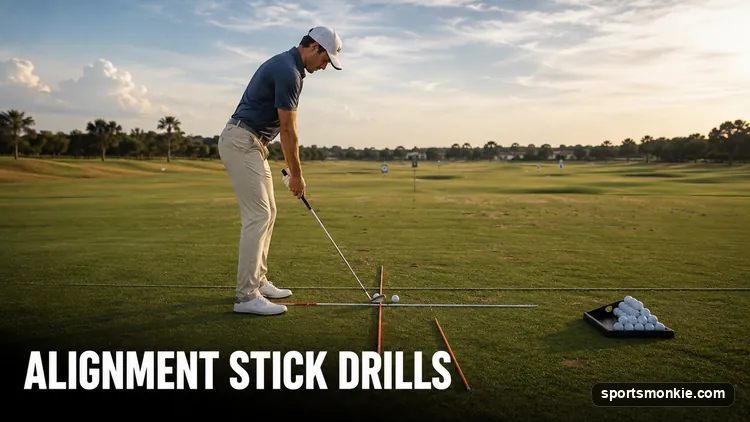
Lay one alignment stick on the ground pointing at your target, running just outside your ball. Lay a second stick a few inches further outside, angled to match your swing plane. Make slow swings and try to swing the clubhead under the outer stick on the way down; clipping it means you’re coming over the top, the single most common fault behind a slice. See our full breakdown of the over-the-top golf swing for why it happens, and our dedicated set of alignment stick drills for eight more ways to use the sticks to fix aim, path, and plane.
2. Step Drill (fixes: weight shift, tempo)
Start with your feet together, then step toward the target with your lead foot as you start the downswing, planting it just before impact. This forces your lower body to initiate the downswing and shifts your weight forward automatically — the move most amateurs skip. Do 10 reps with a mid-iron before full shots, and if weight shift is your core miss, work the dedicated golf weight transfer drills that isolate it.
3. Pump Drill (fixes: over-the-top, downswing sequence)
Swing to the top of your backswing and pause. “Pump” the downswing halfway 2-3 times, feeling your hips start the move while your arms and club trail behind, then release fully through the ball on the final pump. This rehearses the correct sequence — lower body first, hands last — without giving you time to rush the transition. If sequencing is your core fault, our dedicated golf swing sequence drills break the kinematic order down step by step. For a full set of transition fixes, see our dedicated golf downswing drills.
4. Towel-Under-Arm Drill (fixes: disconnection, slicing, weak contact)
Tuck a small towel or headcover under your lead armpit and make half-speed swings without letting it drop. If the towel falls, your arms are separating from your body’s rotation, a common cause of inconsistent contact and slices. Keeping the connection forces your torso to control the swing instead of your arms and hands.
5. Impact Bag Drill (fixes: weak or thin strike, wrist position)
Set an impact bag (or a stack of towels) where the ball would sit and make slow, deliberate swings into it, stopping at the moment of impact. Check that your lead wrist is flat, your hips are open, and your weight has moved onto your lead side. This drill builds the “feel” of a solid, compressed strike faster than range balls, where poor contact is easy to ignore. If flush contact is your main weakness, work the dedicated set of golf ball striking drills that isolate low point and compression.
6. One-Arm Drill (fixes: release, clubface control)
Hit soft half-shots with only your lead arm on the club, then repeat with only your trail arm. The lead-arm version teaches you to control the clubface through impact instead of flipping at it; the trail-arm version builds the extension and release that generate speed. Start with chip-height swings before adding length, and if squaring the face is your real weakness, work through our full guide on how to release the golf club to fix release timing at the source.
7. Takeaway Gate Drill (fixes: takeaway path, early wrist hinge)
Place two tees just wider than your clubhead, framing a “gate” just outside the ball on your target line. Swing the club back through the gate without touching either tee. A takeaway that starts too far inside or outside sets up compensations for the rest of the swing — a fault worth isolating with a dedicated set of golf takeaway drills, and the same starting move drilled in depth in our golf backswing drills and covered in our guide on how to swing a golf club. If the gate also exposes wrists that set too early or too late, work through these golf wrist hinge drills to fix the timing of your wrist set.
8. Slow-Motion Full-Swing Drill (fixes: tempo, sequencing, overall rhythm)
Make full swings at roughly 50% speed, focusing on smoothly transitioning from backswing to downswing rather than rushing the transition. Count “one-two” in your head — backswing on one, downswing-through-impact on two — to build a consistent tempo ratio. This drill is the best finisher because it strings together everything the other seven drills isolated, and a swing built to reach a balanced, held finish sequences better on its own — the whole idea behind our golf follow-through drills. If rhythm is your main miss, a dedicated set of golf swing tempo drills drills the 3:1 ratio far more precisely than this generic slow-motion pass.
Why Drills Beat Just Hitting Balls
Hitting range balls without a plan mostly grooves whatever pattern you already have, good or bad. Drills strip away everything except the one moving part that’s broken, which is why a 20-minute drill session often beats hitting 100 balls with no target fault. Use the range for testing; use drills for changing. Once the fix holds, structure the rest of your session around driving range practice drills that force random, target-based reps so the change survives to the course.
Common Mistakes Golfers Make With Swing Drills
Trying every drill in one session. Pick one or two drills tied to your actual miss and repeat until automatic before adding a third — bouncing between drills scatters focus.
Skipping the slow-motion phase. Rushing straight to full-speed shots lets old habits take over before the new pattern is grooved. Every drill above should start at half speed or slower.
Practicing without a ball flight check. A drill only works if it changes your shots. After 10-15 slow reps, hit a few real balls and watch the flight; if nothing changes, revisit the cause.
Ignoring grip and setup. No drill fixes a swing built on a poor grip or misaligned stance. If your proper golf grip or setup is off, correct that first, and run through a few golf posture drills so your spine angle and tilt give every swing drill a stable base to work from.
A Simple 3-Week Drill Practice Plan
Week 1 — Isolate the fault. Pick the drill matching your biggest miss and do 15 slow reps, 4 days this week, with no ball.
Week 2 — Add the ball, stay slow. Keep the same drill, but hit soft half-shots at 50% speed after every 3-4 reps. Watch for the fault disappearing in your ball flight.
Week 3 — Build to full speed. Increase swing speed gradually, checking that the drill feeling holds. Finish by hitting 10 full-speed shots and tracking old fault versus fix.
Once a drill move holds up at full speed, pair it with a how to increase golf swing speed routine, since a technically sound swing is what lets you add speed without losing accuracy. If lower scores are the real goal, these drills compound fastest for players working through our guide on how to break 100 in golf, where consistent contact matters more than distance.
When to Drill and When to Just Play
Drills belong in practice sessions, not on the course. Consciously executing a drill cue mid-round — “shift weight, then pump the transition” — overloads your brain and usually produces worse shots than trusting your normal swing. Do the conscious work on the range and at home; let the course be where you simply react and play.
Frequently asked questions
What is the best golf swing drill for beginners?+
The alignment-stick drill is the best starting point because it gives instant visual feedback on swing path without needing a coach. Lay one stick along your target line and a second just outside the ball; if your clubhead clips the outer stick, you are swinging over the top.
How often should I practice golf swing drills?+
Three to four sessions of 15-20 minutes a week beats one long range session. Swing changes need repetition without fatigue, since tired muscles revert to old patterns. Do drills slowly and deliberately before you ever try to hit a full-speed shot with the new move.
Can golf swing drills fix a slice?+
Yes, if you pick the right one. A slice is almost always an over-the-top path with an open clubface, so the alignment-stick drill and the pump drill target it directly. Add the towel drill to keep your arms connected to your body through impact, which closes the face naturally.
Do I need a golf ball to practice swing drills?+
No. Most of the drills on this list, including the step drill, pump drill, and towel drill, work better without a ball at first because you can focus entirely on the motion. Add a ball only after the feeling becomes repeatable at half speed.
How long does it take for a swing drill to become permanent?+
Most golfers need 2 to 4 weeks of consistent, focused reps before a drill move shows up automatically on the course. The change has to survive the jump from slow-motion practice to full-speed swings under pressure, which is why the practice plan below builds speed in stages.
What is the pump drill in golf?+
The pump drill is a transition drill where you swing to the top, pause, then rehearse the first move down (lower body first, arms trailing) two or three times before finally releasing through the ball. It retrains the downswing sequence and is one of the fastest fixes for an over-the-top move.
Should I do swing drills at the range or at home?+
Both, at different stages. Learn the movement pattern at home in a mirror or in front of a phone camera with no ball, then transfer it to the range once it feels automatic. Trying to learn a new pattern for the first time while also hitting balls at full speed slows down the fix.
Sources
Play & tools
Free browser games and tools — no account, no download.
- Play today's Sports Connections — Today's Sports Connections — daily hints, answers, and play the grid.
- Play Guess the NFL Player — A new mystery NFL player every day. Eight guesses, with a clue on each — plus free unlimited mode.
- Explore all our games →
Related golf guides
View all →
8 Golf Swing Sequence Drills to Fix Your Kinematic Sequence
Eight golf swing sequence drills that fix an arms-first downswing by training the kinematic order — hips, torso, arm, then club — for a lower-body-first move.

8 Golf Weight Transfer Drills to Fix Your Weight Shift Fast
Eight golf weight transfer drills ranked by how fast they fix your weight shift, each matched to a specific fault: reverse pivot, hanging back, early extension, or a lazy transition.
10 Alignment Stick Drills for Golf (Fix Aim, Path & Plane)
Ten alignment stick drills that fix golf's invisible faults—aim, swing path, and plane—using two cheap rods, each with a setup, a cue, and the exact miss it repairs.

Golf Swing Technique: The Correct Mechanics, Step by Step
Correct golf swing technique comes down to five repeatable checkpoints — grip, setup, takeaway, downswing sequence, and impact position. Here's how to build and groove them.

9 Golf Driving Range Practice Drills That Transfer to the Course
The 9 best driving range practice drills, ranked by how directly they lower scores — built on random practice, real targets, and a full pre-shot routine that transfers.

9 Golf Follow-Through Drills for a Balanced, Powerful Finish
Nine golf follow-through drills ranked by impact: hold-the-finish, belt-buckle-to-target, step-through, and more to train balance, full rotation, and a repeatable finish.