
10 Fittest Male Athletes in the World, Ranked
On this page15
Placement rewards checkable numbers over reputation: measured body composition, dominance in formats built to test all-round fitness (CrossFit, the decathlon), and sustained elite output over 15-plus years. Single-skill speed or strength scores lower than proven breadth.
The world's fittest male athletes at a glance
| Rank | Athlete | Sport | Standout fitness case |
|---|---|---|---|
| 1 | Cristiano Ronaldo | Football | Elite body composition and longevity |
| 2 | Rich Froning Jr. | CrossFit | Four straight Games titles |
| 3 | Mat Fraser | CrossFit | Five straight Games titles |
| 4 | LeBron James | Basketball | Elite output into a 23rd NBA season |
| 5 | Novak Djokovic | Tennis | Endurance across 24 major titles |
| 6 | Michael Phelps | Swimming | Multiple-event Olympic dominance |
| 7 | Jan Frodeno | Triathlon | Olympic-to-Ironman range |
| 8 | Kevin Mayer | Decathlon | World-record 10-event score |
| 9 | Kohei Uchimura | Gymnastics | Six years unbeaten in all-around |
| 10 | Rafael Nadal | Tennis | Two decades of clay-court endurance |
- Sub-7% at 41
Cristiano Ronaldo
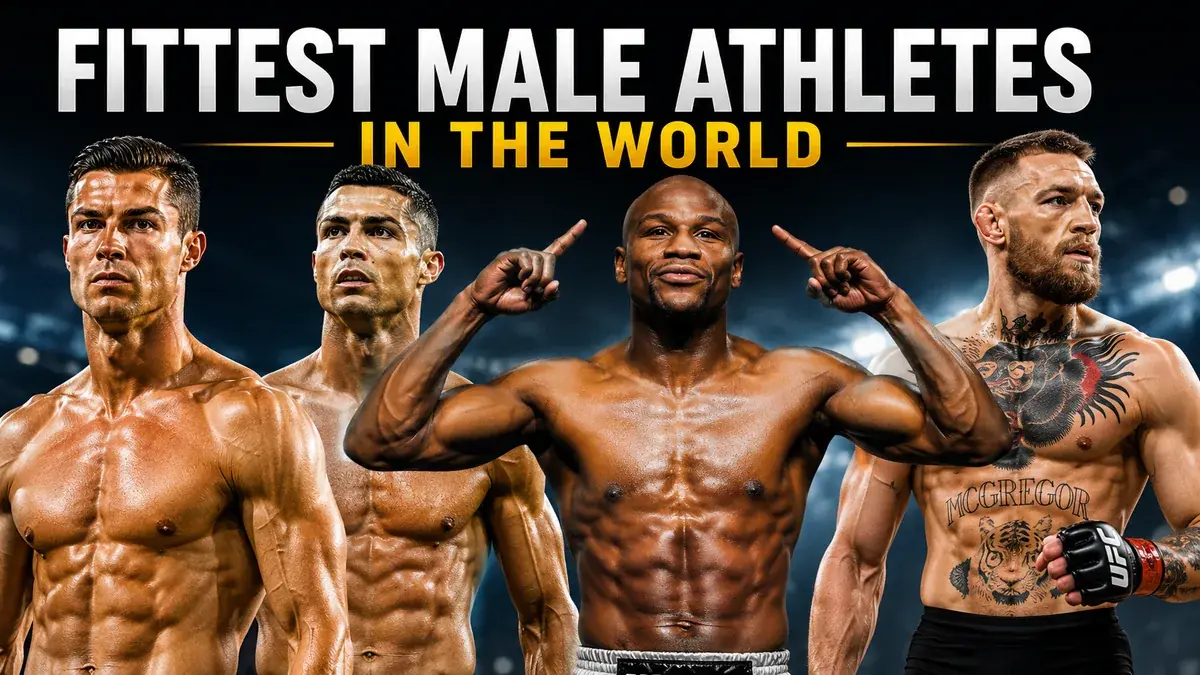
Ronaldo leads because his fitness is the most measured, and the numbers read like a mid-20s athlete's: around 7% body fat at 41, against roughly 50% muscle mass, while still starting for Al Nassr under a contract that runs to 2027. He ranks above the CrossFit champions below him on longevity — he is producing this output in live top-flight matches, not in a controlled competition season.
His routine runs multiple sessions a day, five days a week, layered on top of match play, and Sports Illustrated and Men's Health have both placed him at or near the top of past fitness rankings. Compare that discipline against his career rival in why Cristiano Ronaldo is better than Messi.
Sport: Football · Peak: ~7% body fat at 41 · Team: Al Nassr (through 2027) · Status: Active
- 4x Fittest on Earth
Rich Froning Jr.
Froning was the first athlete to win four straight individual CrossFit Games titles (2011–2014), the run that turned "Fittest Man on Earth" from a slogan into a record. He then anchored CrossFit Mayhem to multiple team championships — a harder test of range, since it demands staying elite across Olympic lifting, gymnastics, and metabolic conditioning at once.
What separates him from the retired names lower down is durability: he finished 17th worldwide in the 2026 Open in the Men's 35–39 division, a competitive placing more than a decade past his individual peak. Few fitness careers stay measurable at 15-plus years.
Sport: CrossFit · Peak: 4 straight Games titles (2011–14) · Recent: 17th, 2026 Open (35–39) · Status: Competing
- 5-title record holder
Mat Fraser
Fraser holds the individual record Froning set and then lost: five consecutive CrossFit Games titles from 2016 through 2020. Each required topping a field across dozens of workouts spanning strength, gymnastics, and endurance over several days, with almost no room to hide a weakness — and he won by margins that ended most events early.
He sits below Froning here only on span, not peak: Fraser retired in February 2021 at the top, and his window of dominance was shorter. The back he broke in a 2009 weightlifting accident was supposed to end his athletic career; instead it preceded the most dominant run the sport has recorded.
Sport: CrossFit · Peak: 5 straight Games titles (2016–20) · Signature: most individual titles ever · Status: Retired 2021
- Record 23rd NBA season
LeBron James
James is the first player in NBA history to reach a 23rd season, and he entered 2025–26 at 41 still on an NBA roster — the durability case, not a single peak number. Basketball's stop-start mix of sprinting, jumping, and contact ends most careers by 35; sustaining any professional role two decades past a debut is the outlier.
That longevity rests on a training and recovery regimen he has made public, chronicled alongside the business empire it funded in LeBron James's net worth. He ranks below the CrossFit pair because his fitness is inferred from career length rather than a competition built to measure it head-to-head.
Sport: Basketball · Peak: first-ever 23rd NBA season at 41 · Signature: two-decade durability · Status: Active
- 24 majors at 38
Novak Djokovic
Djokovic's 24 men's singles majors are a record, and the fitness case is the engine behind them: five-set matches routinely past four hours, won deep into his late 30s. At 38 he reached the 2026 Australian Open final before losing to Carlos Alcaraz, still contesting best-of-five finals against opponents half his age.
His flexibility and court coverage have been called freakish by opponents for over a decade, and he treats diet, sleep, and recovery as a competitive edge. He ranks below LeBron on raw career span but above the retired names on current-day, live competitive fitness.
Sport: Tennis · Peak: 24 Grand Slam singles titles · Recent: 2026 Australian Open finalist at 38 · Status: Active
- 23 Olympic golds
Michael Phelps
Phelps retired in 2016 with 23 Olympic gold medals, the most of any Olympian in any sport, and that count came from an aerobic engine that let him swim multiple finals in a single session without fading. His frame — long torso, short legs, a wingspan several inches past his height — became shorthand for a swimmer's ideal.
He ranks here rather than higher because his dominance, though total, was inside one discipline. See how his numbers stack up against the sport's other greats in the greatest swimmers in the world.
Sport: Swimming · Peak: 23 Olympic golds (most ever) · Signature: multiple finals per session · Status: Retired 2016
- Sprint-to-Ironman range
Jan Frodeno
Frodeno was elite at both ends of triathlon distance, which is what earns his spot: Olympic gold over the short course in Beijing 2008, then three Ironman World Championships (2015, 2016, 2019) over the 140.6-mile format — a 2.4-mile swim, 112-mile bike, and a full marathon back to back.
That span, from Olympic-distance speed to Ironman endurance, is close to a complete test of aerobic and muscular fitness in one career. He retired at the end of 2023 after a farewell race in Nice. For what his signature event demands, see the order of a triathlon.
Sport: Triathlon · Peak: 3x Ironman World Champ + 2008 Olympic gold · Signature: short-course to Ironman range · Status: Retired 2023
- Decathlon world record
Kevin Mayer
The decathlon is the closest thing sport has to an all-round fitness exam, and Mayer holds its world record: 9,126 points across ten events at the 2018 Décastar in Talence, breaking Ashton Eaton's mark. Scoring that high means posting elite numbers in sprinting, three jumps, three throws, hurdles, and a closing 1500m — inside two days.
No single-discipline specialist is asked for that breadth, which is why the event outranks narrower sports on any fitness list. See exactly what those ten events require in decathlon events in order.
Sport: Decathlon · Peak: 9,126-point world record (2018) · Signature: 10 events, two days · Status: Active
- Six years unbeaten
Kohei Uchimura
"King Kohei" went unbeaten in all-around gymnastics from 2009 to 2015 — six straight years across Olympics and world championships — and won back-to-back Olympic all-around golds in 2012 and 2016. Gymnastics is judged on strength, flexibility, power, and precision simultaneously, and demands a strength-to-weight ratio few sports approach.
He ranks near the foot of the list only because his peak sits further back: he retired in January 2022 at 33, worn down by two decades at that level. His full-career case sits alongside the sport's other legends in the best gymnasts in the world.
Sport: Gymnastics · Peak: 6 years unbeaten (2009–15) · Signature: 2x Olympic all-around gold · Status: Retired 2022
- 14 French Opens
Rafael Nadal
Nadal's 22 Grand Slam titles, including a record 14 French Opens, came from a style built on physical punishment: heavy topspin, relentless court coverage, and rallies longer than almost any other player's. Staying elite on clay, tennis's most demanding surface, for two decades is its own fitness case.
That style also billed him — hip surgery in 2023, chronic foot and knee issues managed for years — which is why he ranks below athletes whose bodies stayed intact longer. He competed at the top level into his late 30s before retiring after the 2024 Davis Cup.
Sport: Tennis · Peak: 22 majors, 14 French Opens · Signature: two decades of clay dominance · Status: Retired 2024
Reader interaction
Build your ranking
Drag the names into the order you think is right — or use the arrows — then submit to see how your list compares with everyone else's.
- Cristiano Ronaldo
- Rich Froning Jr.
- Mat Fraser
- LeBron James
- Novak Djokovic
- Michael Phelps
- Jan Frodeno
- Kevin Mayer
- Kohei Uchimura
- Rafael Nadal
Audience ranking
How everyone ranked them
Built from reader rankings using position-based points.
A bodybuilder can squat twice his bodyweight and gas out running a 5K. A marathoner can hold a sub-5-minute mile for two hours and struggle with a single pull-up. “Fittest” isn’t one attribute, and any list that pretends otherwise is quietly picking a definition. This one states it and ranks against it — measured output, not fame.
Strength specialists deserve their own frame of reference, too. Our ranking of the greatest Indian bodybuilders compares athletes by verified competitive titles and historical impact rather than treating physique sport as proof of all-round fitness.
How we ranked them
Three things move an athlete up. First, documented physical metrics — body fat, competition scores, VO2 max proxies — over reputation. Second, dominance in formats built specifically to test broad fitness, which is why CrossFit champions and a decathlon world-record holder rank high: their sports measure the exact thing this list is about. Third, longevity, since holding an elite physical level for 15–20 years is harder to fake than a single peak season.
Retired athletes are included and can rank as high as active ones, because a career-best number doesn’t expire. Deliberately downweighted: pure sprint specialists and single-skill stars whose dominance is real but narrow — genuine peak speed or strength, but not the breadth the word “fittest” implies. For how “greatest” and “fittest” claims get argued in sports generally, see what GOAT means in sports.
At a glance
| Rank | Athlete | Sport | Signature fitness feat | Status (2026) |
|---|---|---|---|---|
| 1 | Cristiano Ronaldo | Football | ~7% body fat at 41, still starting for Al Nassr | Active |
| 2 | Rich Froning Jr. | CrossFit | First to win 4 straight individual Games titles (2011–14) | Competing (Masters) |
| 3 | Mat Fraser | CrossFit | 5 consecutive Games titles (2016–20), most ever | Retired 2021 |
| 4 | LeBron James | Basketball | First player to reach a 23rd NBA season, at 41 | Active |
| 5 | Novak Djokovic | Tennis | 24 Grand Slam singles titles; 2026 Australian Open finalist | Active |
| 6 | Michael Phelps | Swimming | 23 Olympic golds, most decorated Olympian ever | Retired 2016 |
| 7 | Jan Frodeno | Triathlon | 3x Ironman World Champ + 2008 Olympic gold | Retired 2023 |
| 8 | Kevin Mayer | Decathlon | World record 9,126 points across 10 events (2018) | Active |
| 9 | Kohei Uchimura | Gymnastics | 2x Olympic all-around gold, unbeaten 2009–2015 | Retired 2022 |
| 10 | Rafael Nadal | Tennis | 22 majors, 14 French Opens on the sport’s hardest surface | Retired 2024 |
Why the criteria change the order
Swap the yardstick and the list reshuffles. Rank purely on VO2 max and endurance athletes — Frodeno, plus cross-country skiers who never make mainstream lists — climb over the ball-sport stars. Rank on raw strength-to-weight and the gymnast and CrossFit athletes lead. Rank on a single explosive number, like a 40-yard dash or a vertical jump, and sprinters most people would call the fittest alive don’t appear here at all, because that dominance is narrow by design.
That is the honest catch with the whole genre: “fittest” is a composite no one metric captures. Weighting breadth and longevity, as this list does, favors athletes who are good-to-elite across many demands over those who are historically great at one. It’s a defensible choice, not the only one.
Where the debate usually lands
Two names come up in almost every argument and sit just off this list. Usain Bolt’s top-end speed is unmatched, but sprinting tests one system for under ten seconds — extraordinary, and narrow. The reigning CrossFit Games champion each year has the most literal claim of all, since the event is designed to crown the “Fittest on Earth,” which is why the discipline supplies two of the top three here.
The other recurring question is women’s fitness, judged on the same measured-output basis rather than against a male baseline. For that ranking, see the fittest female athletes in the world.
Frequently asked questions
Is Cristiano Ronaldo really the fittest male athlete in the world?+
He is the most-measured answer, which is why he tops this list. At 41 he has been recorded at around 7% body fat while still starting in a top league, numbers notable for a player half his age. It is a defensible No. 1, but 'fittest' has no single scale — a CrossFit champion tested across strength and endurance has an equally strong claim under different criteria.
Who is the fittest man in the world according to CrossFit?+
By the sport's own record book, Mat Fraser: five consecutive individual Games titles from 2016 to 2020, the most anyone has won. Rich Froning set the earlier benchmark with four straight (2011–2014) before Fraser surpassed it. The CrossFit Games exists specifically to crown a 'Fittest on Earth,' testing strength, gymnastics, and conditioning together, so its winners carry the most literal version of the label.
Why is LeBron James on a fittest-athlete list instead of a purer athlete?+
His case is durability, not a single peak metric. Entering 2025–26 he became the first player in NBA history to reach a 23rd season, still on a roster at 41. Basketball's mix of sprinting, jumping, and contact ends most careers by 35, so sustaining any professional role two decades in is a fitness outlier that a one-season highlight cannot match.
What makes the decathlon such a strong fitness test?+
It spreads ten events — from the 100m sprint to a closing 1500m — across two exhausting days, so no single weakness can hide. A sprinter can be unfit at distance and still dominate their lane; a decathlete cannot. Kevin Mayer's world-record 9,126 points in 2018 required elite speed, three kinds of jumping, three throws, and endurance in the same body, which is why the event ranks above narrower sports here.
How does VO2 max relate to being the 'fittest' athlete?+
VO2 max measures how much oxygen the body can use during hard exercise, and it is one of the clearest scientific proxies for cardiovascular fitness. Endurance athletes like triathletes and cross-country skiers post some of the highest readings ever recorded. It captures aerobic capacity well but ignores strength, power, and skill, so a high VO2 max alone does not settle the 'fittest' argument — it is one input among several.
Can a retired athlete still count as one of the fittest?+
Yes, and several here are retired — Fraser, Phelps, Frodeno, Uchimura, Nadal. Their credentials are locked into career-best numbers that remain unmatched: a five-title CrossFit run or 23 Olympic golds does not expire when someone stops competing. It is a different claim from an active athlete's current-day conditioning, but an equally valid one, which is why this list ranks both together rather than splitting them.
Sources
Play & tools
Free browser games and tools — no account, no download.
- Play today's Sports Connections — Today's Sports Connections — daily hints, answers, and play the grid.
- Play Guess the NFL Player — A new mystery NFL player every day. Eight guesses, with a clue on each — plus free unlimited mode.
- Explore all our games →
Related records & rankings guides
View all →
Fittest Female Athletes in the World: The Elite List
The 10 fittest female athletes in the world — Simone Biles, Katie Ledecky, Serena Williams, Tia-Clair Toomey and more — ranked by the records and physical demands behind each.
Greatest Tennis Players of All Time (Men's)
A ranked look at the greatest men's tennis players ever, from the Big Three of Djokovic, Nadal and Federer to Laver, Sampras and Borg, updated for 2026.

Six Kings Slam Moved From October to December as Riyadh Attacks Close the Airport
The Six Kings Slam exhibition in Riyadh has been moved from October 21-24 to December 27-30 after attacks closed the city's airport. The six players had not confirmed the new dates.
Hurkacz Beats Djokovic for the First Time in Nine Meetings as the Beijing Toll Catches Up in Shanghai
Hubert Hurkacz beat Novak Djokovic 6-4 6-3 in Shanghai, his first win in nine meetings, three days after Djokovic's Beijing title ended in a retirement.

Medvedev Disqualified From China Open Semi-Final After Ball Hits Spectator in the Eye
Daniil Medvedev was disqualified from the China Open semi-final against Novak Djokovic after a rebounding ball he hit struck a front-row spectator in the eye.

Djokovic Calls Rule 'Stupid' After Zverev's Video Review Replays a Point at the China Open
Novak Djokovic called a video-review rule 'stupid' after Alexander Zverev won a replayed point over an LED board change at the China Open in Beijing.