
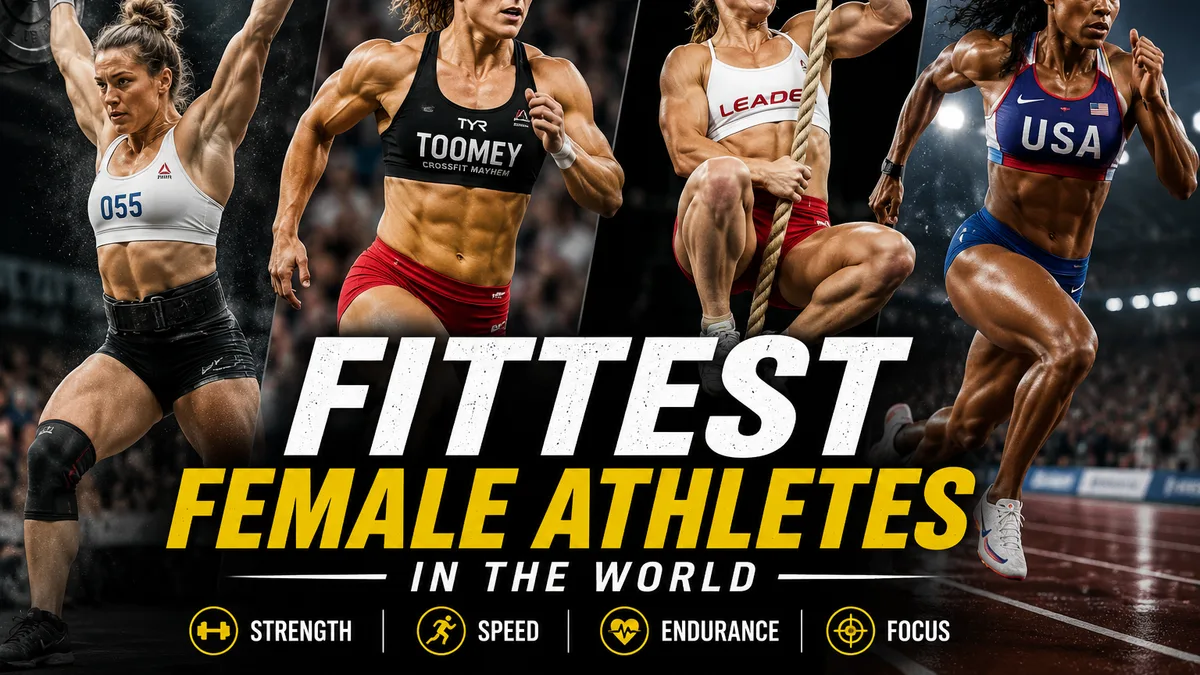
Fittest Female Athletes in the World: The Elite List
On this page14
- 01The world's fittest female athletes at a glance
- 02Simone Biles
- 03Katie Ledecky
- 04Serena Williams
- 05Tia-Clair Toomey
- 06Mikaela Shiffrin
- 07Amanda Nunes
- 08Allyson Felix
- 09Alex Morgan
- 10Claressa Shields
- 11Courtney Dauwalter
- 12How we ranked the fittest female athletes
- 13How fitness is judged across sports
- 14Specialists vs. all-rounders
We ranked each athlete on the physical quality her sport rewards most — power-to-weight, aerobic capacity, repeated-sprint endurance or mixed-modal conditioning — and weighted breadth of fitness above depth in a single lane. Verified records, medal counts and title histories (current through the 2025-26 seasons) break the ties.
The world's fittest female athletes at a glance
| Rank | Athlete | Sport | Standout fitness quality |
|---|---|---|---|
| 1 | Simone Biles | Gymnastics | Explosive power-to-weight ratio |
| 2 | Katie Ledecky | Swimming | Race-pace aerobic capacity |
| 3 | Serena Williams | Tennis | Repeatable explosive power |
| 4 | Tia-Clair Toomey | CrossFit | Strength-endurance balance |
| 5 | Mikaela Shiffrin | Alpine skiing | Power and balance under load |
| 6 | Amanda Nunes | MMA | Power and fight-long durability |
| 7 | Allyson Felix | Track | Sustained sprint power |
| 8 | Alex Morgan | Football | Repeated top-speed sprints |
| 9 | Claressa Shields | Boxing | Strength without lost speed |
| 10 | Courtney Dauwalter | Ultrarunning | 100-mile endurance |
- Power-to-weight
Simone Biles
Biles ranks first because no athlete on this list converts strength into control the way she does: she generates Olympic-lifting-level force in a fraction of a second, then lands it. She topped Sports Illustrated's women's Fittest 50 three times (2017, 2019, 2020), and no gymnast of either gender owns more hardware — 11 Olympic and 30 World Championship medals, 41 combined.
She sits above Katie Ledecky because gymnastics penalizes any weakness across four apparatus, while a swimmer wins on one axis. Biles also has more named skills on the Code of Points than any gymnast, several rated at the sport's top difficulty tier — see the best gymnasts in the world for the full case.
Sport: Gymnastics · Peak: 41 combined Olympic + World medals · Defining trait: max force per pound of bodyweight
- Aerobic engine
Katie Ledecky
Ledecky's fitness is a different machine entirely: sustained aerobic output at race pace for up to 15 straight minutes. She holds the long-course world records in the 800m and 1500m freestyle and, through the 2025 World Championships, has won 32 combined world and Olympic golds (9 Olympic, 23 World) among more than 40 career medals.
She ranks below Biles only because her dominance runs along a single quality — endurance — rather than the multi-directional demand a gymnast faces. What separates her from other distance swimmers is pacing discipline: seven straight World titles in the 800m, held lap after lap without the usual late-race fade. She stands among the greatest swimmers of all time.
Sport: Swimming · Peak: 800m & 1500m free world records · Defining trait: race-pace aerobic capacity
- Explosive power
Serena Williams
Williams earns a top-three place on repeatable power, not raw endurance. Tennis rallies are short and violent, and few players in history have produced her output deep into three-set matches — a serve past 120 mph driven by leg drive and core rotation. Her 23 Grand Slam singles titles are the most of the Open Era, backed by four Olympic golds.
Her durability is the outlier: after stepping away in 2022, she made a singles return at Wimbledon 2026 at age 44, pushing a much younger opponent to three sets. That she could still compete at that level, two decades into a career, is itself a fitness marker.
Sport: Tennis · Peak: 23 Open-Era Grand Slam singles titles · Defining trait: repeatable explosive power
- Mixed-modal
Tia-Clair Toomey
Toomey ranks here for the broadest fitness on the list. CrossFit is engineered to expose any single gap — a 1-rep-max lift one hour, a five-kilometre run the next — so her eighth CrossFit Games title in 2025 (2017-2022, 2024, 2025) means no real weakness in strength, endurance, gymnastics or Olympic lifting. That total is double any previous Fittest Woman on Earth.
Her edge traces back to raw strength: she competed in weightlifting at the Rio 2016 Olympics before turning to CrossFit, a foundation most rivals had to build from scratch.
Sport: CrossFit · Peak: 8 Games titles (most ever) · Defining trait: no gap across strength and endurance
- Balance + power
Mikaela Shiffrin
Skiing rewards a strange blend — explosive leg power to hold a tuck at 80-plus mph, elite balance through turns that generate several times bodyweight in force, and nerve on a course where one error ends the run. Shiffrin owns 110 World Cup wins, the most in history and the only total past 100 by any skier.
She added slalom gold at the 2026 Milano-Cortina Games — a third career Olympic gold, more than a decade after her first — and a record-tying sixth overall World Cup title that same season. Longevity at that output is a fitness quality most sports never see.
Sport: Alpine skiing · Peak: 110 World Cup wins · Defining trait: power plus balance under load
- Anaerobic durability
Amanda Nunes
MMA asks for anaerobic power inside a five-minute round, the aerobic base to repeat it across five rounds, and the durability to absorb strikes and grappling most sports never face. Nunes held two UFC titles at once, and her combined title reign of 3,940 days is the longest in promotion history across any weight class.
She also retired as champion in 2023 with the most consecutive wins and most knockouts by a woman in UFC history — the reason fans of the best female MMA fighters of all time put her at the top.
Sport: MMA · Peak: 3,940 days as champion · Defining trait: power plus fight-long durability
- Sprint longevity
Allyson Felix
Felix is the most decorated athlete in World Athletics Championships history with 20 medals, and her combined Olympic and World total of 31 makes her track and field's most decorated overall. At Tokyo she became the first woman to win seven Olympic golds in track and field.
Sprinting punishes age first — power output usually fades earliest of any discipline. Felix was still collecting global medals more than 15 years into her senior career, a longevity curve almost no sprinter sustains.
Sport: Track and field · Peak: 31 combined Olympic + World medals · Defining trait: sprint power held for 15+ years
- Repeated-sprint
Alex Morgan
Soccer's fitness demand is repeated-sprint endurance: forwards cover roughly 10 kilometres a match while repeatedly hitting top speed to beat a defender's first step, then recovering to do it again minutes later. Morgan closed her career in 2024 with 224 caps and 123 goals for the U.S. women's national team.
Her honors — two World Cup titles (2015, 2019) and Olympic gold in 2012 — sit on top of a Golden Boot-winning NWSL season at age 33, proof that quality held up match after match for over a decade.
Sport: Soccer · Peak: 123 goals in 224 caps · Defining trait: repeated top-speed sprints
- Multi-division
Claressa Shields
Shields is the first boxer of either gender to win undisputed titles in three weight classes — junior middleweight, middleweight and heavyweight — in the four-belt era. Adding that much mass while staying undefeated demands a rare balance: extra strength to handle bigger opponents without losing the hand speed and conditioning that made her dominant lighter.
On top of that she won back-to-back Olympic golds (2012, 2016), and ESPN ranked her the top pound-for-pound female boxer in 2025 — a direct read on that adaptability.
Sport: Boxing · Peak: undisputed in 3 divisions · Defining trait: strength added without losing speed
- Extreme endurance
Courtney Dauwalter
Dauwalter closes the list at the opposite extreme from Biles: the capacity to keep moving through the night and over mountain terrain for 15 to 26 hours. In 2023 she became the first person of either gender to win ultrarunning's "triple crown" in a single year — Western States 100, Hardrock 100 and UTMB.
Her Western States run broke the previous women's course record by nearly 80 minutes. She has stayed near the front of major 100-milers since, evidence that her recovery and durability match her raw endurance.
Sport: Ultrarunning · Peak: 2023 triple crown (first ever) · Defining trait: 100-mile durability
Reader interaction
Build your ranking
Drag the names into the order you think is right — or use the arrows — then submit to see how your list compares with everyone else's.
- Simone Biles
- Katie Ledecky
- Serena Williams
- Tia-Clair Toomey
- Mikaela Shiffrin
- Amanda Nunes
- Allyson Felix
- Alex Morgan
- Claressa Shields
- Courtney Dauwalter
Audience ranking
How everyone ranked them
Built from reader rankings using position-based points.
The 10 athletes above sit at the extremes of what a human body can do — and they got there by chasing opposite goals. That is the whole problem with ranking “fitness” across sports, and the sections below explain how we handled it and how the physical demands actually differ.
How we ranked the fittest female athletes
There is no single fitness number that ranks a gymnast against an ultrarunner, so we did not invent one. Instead each athlete earned her place on a documented, sport-specific case, judged on the same categories Sports Illustrated used for its long-running Fittest 50 — power, speed, strength, agility, endurance, flexibility and durability — measured against the demands of her own event and cross-checked against verified records, medal counts and title histories through the 2025-26 seasons.
The one tiebreaker we applied consistently: breadth beats depth. An athlete who has to be strong, fast and durable all at once (Biles, Toomey) ranks above a specialist who wins on a single overwhelming quality (Ledecky, Dauwalter), because a multi-quality profile is harder to build and rarer to find. Where two athletes were close, the more complete fitness profile won.
How fitness is judged across sports
“Fitness” is not one trait. Sports scientists assess it across several mostly independent dimensions, and world-class athletes rarely max out more than a few:
| Dimension | What it measures | Athletes who lead it |
|---|---|---|
| Aerobic capacity (VO2 max) | Sustained oxygen use at pace | Ledecky, Dauwalter |
| Power-to-weight | Force generated per pound of bodyweight | Biles, Shiffrin |
| Anaerobic power | Short, maximal effort | Williams, Nunes |
| Repeated-sprint endurance | High-speed efforts with brief recovery | Morgan, Felix |
| Mixed-modal conditioning | Strength and endurance in one session | Toomey |
| Durability / longevity | Holding output across years or hours | Felix, Williams, Dauwalter |
A distance swimmer and a boxer can both be “elite” while sharing almost none of the same physical strengths, which is exactly why this list draws from many sports rather than one.
Specialists vs. all-rounders
The sharpest divide on the list is between specialists and all-rounders. Single-sport athletes such as Ledecky and Dauwalter post the most extreme numbers in their one lane — aerobic outputs close to the theoretical ceiling for their events. Multi-discipline athletes such as Toomey, and heptathletes and triathletes more broadly, post less extreme peaks but leave no exploitable weakness, because a single gap loses the competition.
Neither profile is “fitter” in the abstract; they are optimized for different questions. Our ranking leans toward the all-rounders at the very top only because a complete profile is the harder thing to build. For the companion ranking built the same way, see the fittest male athletes in the world; for how these names rank commercially rather than physically, the most marketable female athletes is a useful next read.
Frequently asked questions
Who is considered the fittest female athlete in the world?+
Simone Biles is the name that recurs most, largely from Sports Illustrated's Fittest 50, which she topped in 2017, 2019 and 2020. The case rests on power-to-bodyweight: gymnastics forces her to generate Olympic-lifting-level force in a fraction of a second and then control the landing across four different apparatus. Her 41 combined Olympic and World medals — the most of any gymnast — back the physical argument with results.
How does Katie Ledecky's fitness compare to the others?+
Ledecky owns the purest aerobic engine on this list. She holds the long-course world records in the 800m and 1500m freestyle and, through the 2025 World Championships, has won 32 combined world and Olympic golds among more than 40 career medals. She ranks just behind Biles because her dominance runs along one quality — sustained endurance — while gymnastics rewards power, control and flexibility all at once.
Is Serena Williams still one of the fittest athletes after returning in 2026?+
Yes, in the specific sense that matters for tennis. Williams stepped away in 2022, then made a singles return at Wimbledon in 2026 at age 44, pushing a much younger opponent to three sets. Tennis fitness is repeatable explosive power rather than raw endurance, and a serve and groundstrokes that still held up two decades into her career are a durability marker few athletes in any sport reach.
What makes Tia-Clair Toomey one of the fittest women alive?+
Toomey has won eight CrossFit Games titles (2017-2022, 2024 and 2025), double any previous Fittest Woman on Earth. CrossFit is designed to punish any single weakness — a maximal lift and a long run can land in the same day — so eight wins means no real gap in strength, endurance, gymnastics or Olympic lifting. Her weightlifting background, including the Rio 2016 Olympics, supplies the raw-strength base.
Are female athletes as fit as male athletes?+
Female athletes reach fitness levels that are world-class by any objective standard. Physiological differences in body composition and muscle mass make direct cross-gender comparisons less meaningful than judging each athlete against the demands of her own sport. Ledecky's aerobic ceiling, Biles's power output and Toomey's mixed-modal conditioning are all near the top of what any human — of either gender — has recorded in those disciplines.
How current are these rankings?+
The list is updated through the 2025-26 competitive seasons. That window captures Toomey's eighth CrossFit Games title in 2025, Ledecky's medal haul at the 2025 World Championships, Shiffrin's slalom gold at the 2026 Milano-Cortina Olympics and Serena Williams's 2026 Wimbledon return. Retired names such as Allyson Felix and Alex Morgan stay on the list because their careers set benchmarks that current athletes are still measured against.
Sources
Play & tools
Free browser games and tools — no account, no download.
- Play today's Sports Connections — Today's Sports Connections — daily hints, answers, and play the grid.
- Play Guess the NFL Player — A new mystery NFL player every day. Eight guesses, with a clue on each — plus free unlimited mode.
- Explore all our games →
Related records & rankings guides
View all →
10 Fittest Male Athletes in the World, Ranked
Ronaldo's 7% body fat, Fraser's five CrossFit titles, LeBron's record 23rd NBA season: ten male athletes ranked on measurable fitness numbers, not reputation.

Most Marketable Female Athletes in the World, Ranked
Coco Gauff, Caitlin Clark, A'ja Wilson and Iga Swiatek lead the world's most marketable female athletes, ranked by endorsement income, sponsor depth and reach.
Best Female NASCAR Drivers of All Time, Ranked
The 10 most accomplished female NASCAR drivers, ranked by on-track results — from 1949 pioneer Sara Christian to Danica Patrick and full-time racer Toni Breidinger.
Best Female MMA Fighters of All Time, Ranked
The greatest female MMA fighters ever, ranked with the case for each: Amanda Nunes, Valentina Shevchenko, Ronda Rousey, Cris Cyborg, Zhang Weili and more.

Most Popular Female Athletes on Twitter (X) Right Now
Serena Williams leads every woman in sport on X, ahead of Maria Sharapova, Alex Morgan, Ronda Rousey, and P.V. Sindhu in this ranked, named list of 11.

Most Followed Athletes on Twitter/X, Ranked
Cristiano Ronaldo leads the most followed athletes on X/Twitter with 113M+ followers, ahead of Virat Kohli and Neymar. See the full ranked top 11 with counts.