
Order of a Triathlon: Swim, Bike, Run Explained
On this page6
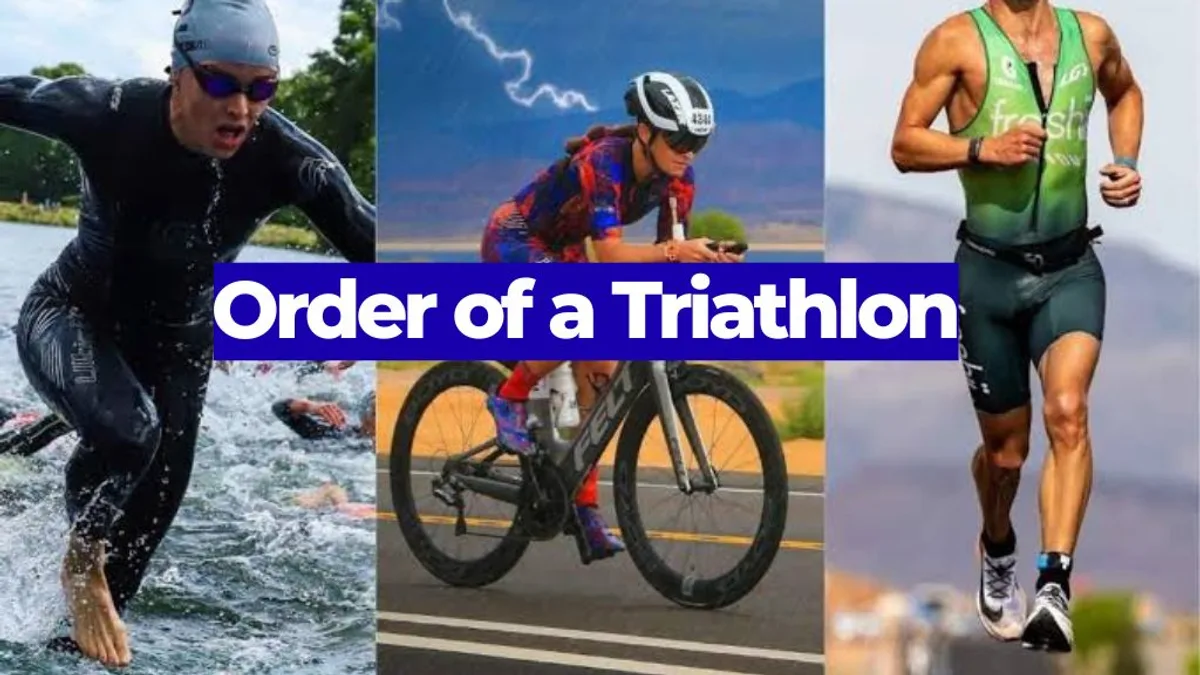
A triathlon always runs in the same order: swim, then bike, then run. That sequence is fixed by World Triathlon rules at every distance, from super-sprint to full Ironman, and the two timed transitions between legs are called T1 and T2.
Ask a first-timer why and most guess tradition. It isn’t. Swap the order and you’d have exhausted runners wading into open water, which is exactly the kind of decision that gets people killed.
Why That Order?
Two things drove it:
- Safety. A tired swimmer is a drowning risk. Put the swim first, while everyone still has full lungs and clear heads, and you cut that risk down.
- Physiology. Cycling is low-impact, so it gives the legs a chance to recover before the run, which is the hardest thing on joints of the three disciplines.
Triathlon Distances
The order stays fixed, but the distances change a lot depending on the race:
| Race Format | Swim | Bike | Run |
|---|---|---|---|
| Super Sprint | ~400 m | ~10 km | ~2.5 km |
| Sprint | 750 m | 20 km | 5 km |
| Olympic | 1.5 km | 40 km | 10 km |
| Half (70.3) | 1.9 km | 90 km | 21.1 km |
| Full Ironman | 3.8 km | 180 km | 42.2 km |
The Olympic distance is what you’ll see at the Games. Ironman is the one people train a year for.
The Transition Zones
Racers call transitions “the fourth discipline” for a reason: fumble one and you can lose minutes you’ll never get back on the course.
T1 (Swim to Bike)
- Exit the water, strip off the wetsuit if you wore one
- Helmet goes on before you touch the bike (mandatory under World Triathlon rules)
- Clip in and mount at the designated line
T2 (Bike to Run)
- Rack the bike, helmet off
- Swap cycling shoes for running shoes
- Head out onto the run course
Both transitions are timed, starting the moment you exit one segment and ending when you begin the next.
What Happens in Each Leg
Swim
Most World Triathlon events use open water: a lake, reservoir, or the sea. Some beginner and indoor events use a pool instead. Wetsuits are typically allowed once the water dips below 20°C.
Bike
Road bikes and time-trial bikes dominate the field. Drafting is banned in most age-group races and in Ironman, with penalties for anyone caught doing it. Elite World Triathlon races are the exception: draft-legal racing is part of the format there.
Run
Roads or mixed terrain, usually. Pacing matters more here than in a standalone run, since athletes are hitting this leg on legs already worked over by the bike.
Relay Triathlon
In relay format, three athletes split the work, one leg each, but the order still runs swim-bike-run. It’s a common way for groups to enter as a team, or for someone who’s strong in only one discipline to take part without training for all three.
The Mixed Relay, on the Olympic programme since Tokyo 2020, works differently: four athletes (two men, two women) each complete a full short triathlon in sequence, so the swim-bike-run cycle repeats four times.
What if you change the order?
You get a different sport, and it gets a different name. The swim-bike-run sequence is what makes a triathlon a triathlon, so events that reorder or drop a discipline are classed separately:
| Event | Sequence |
|---|---|
| Triathlon | Swim, bike, run |
| Duathlon | Run, bike, run |
| Aquathlon | Swim, run |
| Aquabike | Swim, bike |
Duathlon is the most common alternative, popular in winter or where open water isn’t available, and it sandwiches the bike between two runs rather than putting the run last. Notice what none of them do: put a swim at the end. The safety logic that fixed the order in the first place applies just as firmly to every variant.
Frequently asked questions
What order do you do a triathlon in?+
Triathlon always follows swim, bike, run, in that exact order. The swim comes first while athletes are freshest and conditions are safest, followed by cycling, and finishing with the run. The sequence is fixed by World Triathlon rules and does not vary by distance.
Why does the triathlon start with swimming?+
Safety, above all. An exhausted athlete in open water can drown, so the swim goes first while energy and judgement are highest. The order also descends in risk: a rider who bonks can stop safely, and a runner who bonks simply walks.
How long is each leg in an Olympic triathlon?+
An Olympic-distance triathlon is a 1.5 km swim, a 40 km bike, and a 10 km run. It is the format used at the Olympic Games and is roughly double the sprint distance, which is the most common entry point for newcomers.
What are T1 and T2 in a triathlon?+
The two transitions. T1 is swim-to-bike, where athletes strip the wetsuit, put on a helmet and shoes, and run the bike out. T2 is bike-to-run. Both are timed as part of your total, which is why triathletes call transition the fourth discipline.
What are the triathlon distances?+
Five standard ones. Super-sprint is roughly 400 m / 10 km / 2.5 km, sprint is 750 m / 20 km / 5 km, Olympic is 1.5 km / 40 km / 10 km, half-Ironman (70.3) is 1.9 km / 90 km / 21.1 km, and full Ironman is 3.8 km / 180 km / 42.2 km.
Can you do a triathlon in a different order?+
Not in a sanctioned triathlon. Events that reorder or drop disciplines get different names: a duathlon is run-bike-run, an aquathlon is swim-run, and an aquabike is swim-bike. Winter and off-road variants exist too, but swim-bike-run defines triathlon itself.
Sources
Play & tools
Free browser games and tools — no account, no download.
- Play today's Sports Connections — Today's Sports Connections — daily hints, answers, and play the grid.
- Play Guess the NFL Player — A new mystery NFL player every day. Eight guesses, with a clue on each — plus free unlimited mode.
- Explore all our games →
Related guides
Triathlon Training Plan for Beginners
A beginner triathlon training plan: how to train for swim, bike and run, a sample weekly schedule, gear basics, and how long you need to prepare.
How Long Does It Take to Swim a Mile?
How long to swim a mile: 40-50 min for beginners, 30-35 for intermediates, 22-28 for advanced swimmers. Full pace tables plus exact pool-length math.
How to Swim: Complete Technique Guide for All 4 Strokes
Learn how to swim with correct technique for freestyle, breaststroke, backstroke, and butterfly. Body position, breathing, kick, and drills to swim farther and faster.
Heptathlon Events Explained: Order, Rules and Scoring
The heptathlon has seven events over two days. See the event order, scoring, false-start rules, tie rule, records and beginner training notes.
Medley Relay Explained: Stroke Order, Exchanges & Strategy
The medley relay swims backstroke, breaststroke, butterfly, then freestyle. Learn the medley relay swimming order, exchange rules, and race strategy.
What Is the Individual Medley in Swimming? Order, Distances & Rules
Individual medley swimming has one swimmer race all four strokes in a fixed order: butterfly, backstroke, breaststroke, freestyle. Here's how it works.