
9v9 Soccer Formations: Best Youth Shapes for U11/U12 Explained
On this page8
The best 9v9 soccer formations for youth teams are 3-3-2, 3-2-3, 2-4-2, 3-4-1, and 2-3-3 — each arranging eight outfield players (plus a goalkeeper) differently across defense, midfield, and attack. There’s no single “correct” shape; the right one depends on your players’ speed, technical level, and whether you’re protecting a lead or chasing a game.
Why 9v9 Formations Matter at U11/U12
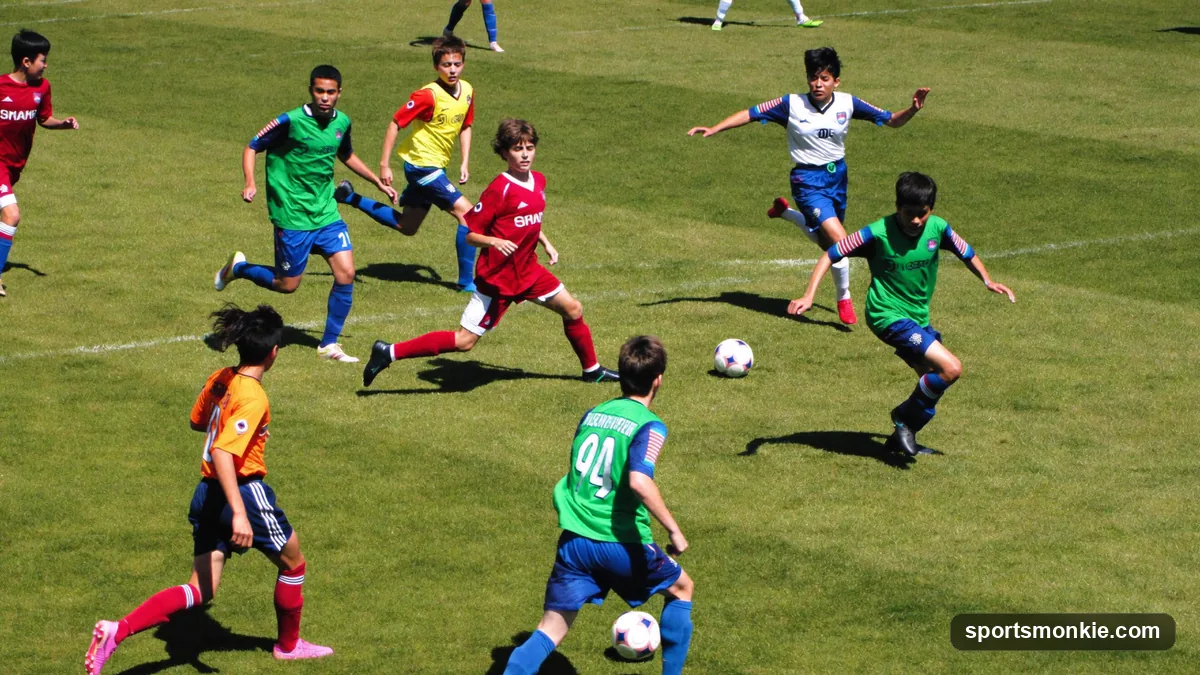
In the United States, 9v9 is the standard format for U11 and U12 age groups, sitting between 7v7 small-sided soccer and full 11v11. Nine players per side (eight outfield plus a goalkeeper) is deliberately chosen as a developmental bridge: the field is bigger than 7v7 but smaller than a full pitch, so young players can start learning back-line cover, midfield triangles, and wide attacking play without being overwhelmed by 11v11 spacing. Unlike 7v7 soccer formations, which usually skip a true midfield line entirely, 9v9 shapes start to resemble scaled-down versions of the systems used in 11v11 soccer formations.
3-3-2: The Balanced Default
The 3-3-2 is the most commonly used 9v9 formation and a sensible starting point for most coaches.
How it lines up: A back three (two center backs and a sweeper, or three flat center backs) sits in front of the goalkeeper. Three midfielders — a center mid flanked by two wide mids — occupy the middle third. Two forwards lead the attack, often playing as a strike partnership.
- Strengths: Even coverage across the pitch with no glaring weak zone; the three-player midfield gives control of possession and easy support in both directions; teaches the back-three shape that carries directly into 11v11.
- Weaknesses: Can get narrow and lose width if the wide midfielders tuck in too much; only two forwards can struggle to press a back three or back four alone.
- Best for: Technically balanced teams and coaches who want a low-risk, teach-everything formation.
3-2-3: Width and Wing Play
The 3-2-3 trades a midfielder for a third forward, making it the more attacking cousin of the 3-3-2.
How it lines up: The same back three sits behind a compact two-player central midfield. Up top, three forwards spread across the width of the field — a central striker flanked by two wide forwards who stretch the opposition defense.
- Strengths: Excellent width and multiple attacking options; wide forwards create one-on-one chances and stretch defenses thin; good for teams with pace out wide.
- Weaknesses: Only two central midfielders can be outnumbered against a 3-3-2 or 2-4-2, making it easier for opponents to dominate possession through the middle.
- Best for: Teams with fast, confident wide players who thrive in one-versus-one situations.
2-4-2: Midfield Control
The 2-4-2 sacrifices a defender for a fourth midfielder, prioritizing possession over defensive numbers.
How it lines up: Just two center backs anchor the defense. Four midfielders — often two central and two wide, or a flat bank of four — dominate the middle of the field, feeding two forwards up top.
- Strengths: Numerical superiority in midfield means more passing options and easier ball retention; wide midfielders can double as auxiliary fullbacks when defending.
- Weaknesses: Only two defenders is thin cover in behind, so quick transitions or a fast forward in behind can be dangerous; requires disciplined recovery runs from the midfield four.
- Best for: Possession-focused, technically strong teams with disciplined players who track back.
3-4-1: Protecting a Lead
The 3-4-1 is the most defense-minded common 9v9 shape, useful for game management rather than everyday attacking play.
How it lines up: A back three sits deep, protected by a compact bank of four midfielders spread across the width of the field. A single central forward plays alone up top, often dropping deep to link play rather than staying high and isolated.
- Strengths: Very hard to break down centrally; the double defensive line (back three plus midfield four) compresses space and limits clean shooting angles; ideal when nursing a lead.
- Weaknesses: The lone forward gets isolated with little support, making it difficult to build sustained attacks or hold the ball up field.
- Best for: Facing a stronger opponent, protecting a narrow lead late in a game, or teams still building attacking confidence.
2-3-3: Maximum Attacking Pressure
The 2-3-3 is the most aggressive standard 9v9 formation, built for teams that want to chase games or press relentlessly.
How it lines up: Only two defenders hold the back line. A flat three-player midfield sits in front of them, and three forwards spread across the attacking third to overload the opposition’s back line.
- Strengths: Six attacking players create constant pressure and numerical overloads high up the field; effective when trailing and needing a quick equalizer.
- Weaknesses: Two defenders are extremely exposed to counterattacks; requires excellent fitness and discipline from the midfield three to track back and cover.
- Best for: Chasing a result late in a game, or teams built around pace and pressing rather than defensive solidity.
9v9 Formation Comparison Table
| Formation | Defenders | Midfielders | Forwards | Best For |
|---|---|---|---|---|
| 3-3-2 | 3 | 3 | 2 | Balanced, all-purpose teams |
| 3-2-3 | 3 | 2 | 3 | Wide attacking, fast wingers |
| 2-4-2 | 2 | 4 | 2 | Possession, midfield control |
| 3-4-1 | 3 | 4 | 1 | Protecting a lead, compact defense |
| 2-3-3 | 2 | 3 | 3 | Chasing a game, high pressing |
Choosing the Right Formation for Your Team
Match the formation to your players, not the other way around. If your squad has strong, disciplined central midfielders, 3-3-2 or 2-4-2 will get the most out of them. If your best players are fast wide forwards, 3-2-3 or 2-3-3 lets them attack space one-on-one. If you’re facing a stronger opponent or trying to close out a game, 3-4-1 keeps things compact. Whatever base shape you use, the underlying idea is the same one behind every soccer formation explained at higher levels: balance defensive cover against attacking numbers, and adjust based on what your opponent gives you. For a broader look at how the sport’s tactics evolve across age groups and levels, see our football/soccer hub.
Unlike the fully specialized forward lines used in senior 11v11 soccer formations, 9v9 forwards are still learning to combine and press as a unit — so simpler, well-taught shapes like 3-3-2 usually develop players faster than complex systems borrowed from the professional game.
Frequently asked questions
What is the best 9v9 soccer formation?+
For most U11/U12 teams, 3-3-2 is the best default 9v9 formation because it spreads players evenly across defense, midfield, and attack with no obvious weak zone. Teams with faster wide players often prefer 3-2-3, while possession-heavy squads lean toward 2-4-2.
How many players are on the field in 9v9 soccer?+
Nine players per team are on the field in 9v9 soccer, including the goalkeeper, so each formation describes eight outfield players (for example, 3-3-2 means three defenders, three midfielders, and two forwards).
What age group plays 9v9 soccer?+
9v9 soccer is the standard format for U11 and U12 players in the United States, serving as the transition stage between 7v7 small-sided games and full 11v11 soccer at U13.
Is 3-3-2 or 3-2-3 better for 9v9?+
3-3-2 is generally better for balance and midfield control since it fields three central midfielders, while 3-2-3 is better for teams that want to attack down the wings with three forwards, at the cost of midfield numbers.
What formation is best for a weaker 9v9 team?+
3-4-1 is the best 9v9 formation for a weaker or younger team protecting a lead, because it keeps a back three plus four midfielders compact in front of the defense and limits the space opponents can attack into.
How does 9v9 prepare players for 11v11?+
9v9 introduces the core shapes of 11v11 in miniature — a back three or four, a central midfield unit, and width from wide players — so players learn positional discipline and spacing before adding two more teammates and a bigger field at 11v11.
Can you play a diamond in 9v9 soccer?+
Yes, some coaches run a 3-1-3-1 or diamond-shaped midfield in 9v9 to develop a holding midfielder, but it demands more tactical understanding than 3-3-2 or 2-4-2 and suits more experienced teams.
Sources
Play & tools
Free browser games and tools — no account, no download.
- Play 38-0 — Sign a 4-4-2 of all-time football legends and chase a perfect 38-0 league season — perfect, not just unbeaten.
- Explore all our games →
Related football guides
View all →
11v11 Soccer Formations: The Full-Sided Guide to Every Shape
11v11 soccer formations explained: how full-sided lineups work, the most common shapes (4-4-2, 4-3-3, 4-2-3-1, 3-5-2, 5-3-2), and how to pick one.
Soccer Tactics Explained: Football Tactical Systems, Formations & Styles
Soccer tactics explained: how formations, pressing, possession, and defensive systems shape football tactical systems, from 4-4-2 to tiki-taka and gegenpressing.
ECNL vs MLS NEXT: Youth Soccer Compared
ECNL and MLS NEXT are the top US youth soccer leagues. How they differ on college recruiting vs pro pathway, cost, boys and girls play, and which fits your player.
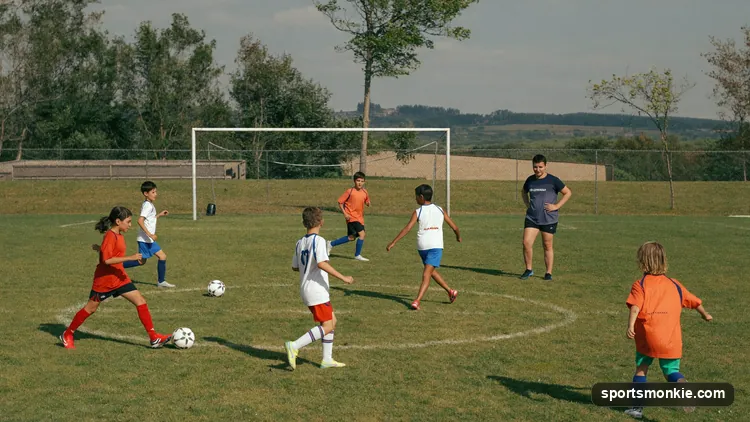
7v7 Soccer Formations: Best Youth Shapes for U9/U10 Explained
The best 7v7 soccer formations for youth teams are 2-3-1, 3-2-1, 2-1-2-1, 3-1-2, and 1-3-2 — each suited to a different style of U9/U10 play.
High Press in Soccer: What It Is and How It Works
High press in soccer explained: how teams trap opponents deep, key triggers, man vs zonal systems, and why Klopp, Guardiola and Bielsa built careers on it.
Inverted Fullback Explained: What It Means in Soccer Tactics
What is an inverted fullback in soccer? Learn how the role works, why Pep Guardiola popularized it, and which players do it best.