
Why Is Golf So Expensive? Where the Money Goes
On this page4
Golf is expensive because it charges you in several places at once: a set of clubs runs $300 to $3,000, a single round costs $25 at a municipal course to $250-plus at a resort, a private membership starts around $10,000 in initiation, and balls, lessons and dress-code clothing stack on top. Demand is part of it too, with US participation up 41% since 2019 according to the National Golf Foundation, tightening tee-time supply. But most of what makes golf pricey is optional. Get the fixed costs right and the rest is a menu you control. Here is exactly where the money goes, and which lines you can cut without noticing.
Where does the money in golf actually go?
| Cost category | Typical 2026 range (US) | Fixed or optional? |
|---|---|---|
| Clubs (full set) | $300 beginner / $700-$1,200 mid / $2,000-$3,000+ premium | Mostly optional (buy used/last-year) |
| Golf balls (per dozen) | $20-$25 value / $50-$55 premium (Pro V1) | Optional (value balls play fine) |
| Municipal green fee | $25-$40 per round | Fixed-ish, cheapest access |
| Public daily-fee round | $30-$80 per round | Optional (choose the course) |
| Resort / upscale round | $100-$250+ per round | Optional (a splurge) |
| Private membership | $10,000-$100,000+ initiation, $2,000-$20,000+ dues | Optional, the big one |
| Lessons | $50-$150 per session | Optional but high-value |
| Shoes & apparel | $80-$250 shoes, plus collared dress code | Semi-fixed (dress codes) |
Ranges are drawn from Golfer Hive’s cost breakdown and Golf Monthly’s investigation into the cost of playing. The table makes the real story obvious: almost every large number is a choice. Membership and resort golf are where costs explode, and both are avoidable.
Why has golf gotten more expensive?
The pandemic-era boom is the main driver. Participation jumped as people looked for a safe outdoor activity, and by 2026 the National Golf Foundation counts play up 41% since 2019, approaching 50 million participants. More golfers chasing the same tee times and the same club inventory pushed prices up on basic supply and demand, and general inflation did the rest on materials, labor and course upkeep.
Here is the counterintuitive part worth knowing before you complain at the pro shop: golf’s price rises have actually lagged other leisure spending. The NGF’s April 2026 analysis puts the rise in public green fees at about 29% since 2019, against roughly 50% for NFL game attendance and 60% for movie tickets over the same stretch. Golf feels expensive partly because of its country-club image, not only its actual inflation.
Why are golf clubs so expensive?
A premium driver or iron set carries real engineering cost, but you are also paying for marketing and tour endorsements folded into the sticker. That is why a new set spans $300 for a beginner package to over $3,000 for premium gear. The performance gap between the two is real but small for most amateurs, and it shrinks further once you consider that last season’s flagship, now discounted, and quality used clubs deliver nearly the same result.
For a new or improving player, spending $2,000 on clubs before your swing has settled is the classic overspend. Our guide to golf clubs for beginners covers what to actually buy first, and the golf club fitting cost breakdown explains when paying a fitter earns its money back and when it does not.
Where should you cut golf costs first?
Attack course access, because that is where casual golfers bleed the most over a year. Play municipal courses at $25 to $40, book twilight rates for 30% to 50% off peak, and walk instead of paying for a cart. Those three habits alone can halve your green-fee spend. Next, drop premium balls until you stop losing three a round; a $20 dozen plays fine while you are learning. Practice deliberately at the range rather than buying extra rounds, since driving range buckets cost a fraction of a green fee.
The one place not to cut hard is lessons early on. A handful of sessions fixes faults that otherwise cost you strokes and enjoyment for years, and cheaper golf you actually enjoy is the whole point. To see how the round-by-round math shakes out, read our average cost of a round of golf guide, then visit the full golf hub for more ways to play the game for less.
Freshness note: green-fee inflation, ball prices and membership dues move yearly; the NGF updates participation and pricing data each spring. Re-check the percentage rises and green-fee averages annually.
Frequently asked questions
Why is golf so expensive?+
Golf stacks several recurring costs: equipment ($300-$3,000 for a set), course access ($25-$250+ a round or a club membership), balls, lessons and dress-code apparel. Demand also spiked after 2020, with US participation up 41% since 2019 per the National Golf Foundation, pushing tee times and gear prices higher.
How much does golf cost per year?+
A casual public-course golfer who plays a few times a month spends roughly $1,000-$2,500 a year on green fees, balls and the occasional lesson, spreading a club purchase over several seasons. A private-club member pays far more once dues and initiation are counted, often $5,000-$20,000+ annually.
Why are golf clubs so expensive?+
Premium clubs carry high research, materials and marketing costs, and tour-player endorsements are baked into the price. A new set ranges from about $300 for a beginner package to over $3,000 for premium irons and a driver. Last year's models and quality used clubs deliver most of the performance for far less.
Is golf more expensive than other sports?+
The entry cost is higher than many recreational sports because clubs and course access add up fast. But golf's price rises have actually trailed other leisure spending: the National Golf Foundation notes public green fees rose about 29% since 2019, less than NFL game attendance (up ~50%) or movie tickets (~60%).
How can I make golf cheaper?+
Play municipal courses ($25-$40), book twilight rates for 30-50% off, walk instead of taking a cart, and buy quality used or last-season clubs. Skip premium $50-a-dozen balls while you are still losing them, and practice at the range rather than paying for extra rounds. These cuts easily halve a casual golfer's yearly spend.
Sources
Play & tools
Free browser games and tools — no account, no download.
- Play today's Sports Connections — Today's Sports Connections — daily hints, answers, and play the grid.
- Play Guess the NFL Player — A new mystery NFL player every day. Eight guesses, with a clue on each — plus free unlimited mode.
- Explore all our games →
Related golf guides
View all →
The Average Cost of a Round of Golf in 2026
The average US public round costs about $41 (NGF), $25-$40 at a muni and $100-$250+ at a resort. Real 2026 US, UK and AU green fees plus twilight tips.
Golf Club Distances Chart: How Far Each Club Goes
A golf club distances chart for every club, driver to wedges, by skill level. Real average yardages from Arccos and Shot Scope data. Find your row.
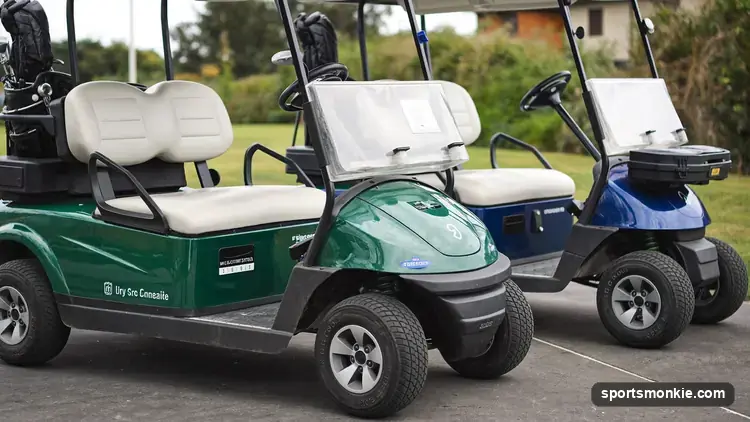
How Much Do Golf Carts Cost? New & Used Prices 2026
New Club Car, EZGO and Yamaha carts cost $7,000-$14,000; used from $2,000; street-legal lithium models $10,000-$20,000+. Real 2026 prices by type.
McIlroy Says Yes to LIV Players Coming Back to the PGA Tour
Rory McIlroy, LIV's loudest critic since 2022, told a New Delhi forum he would vote to welcome its players back, called LIV half a good idea and said the threat is over.
McCumber Calls a Two-Shot Penalty on Himself That the Cameras Could Not Prove
Tyler McCumber was unsure he had replaced his ball marker at the WA PGA Championship, the footage was inconclusive, and he took a two-stroke penalty anyway while tied for second.
Wind Blows Zang's Missed Putt Back Into the Hole at St Andrews
Penn senior Madeleine Zang watched her missed bogey putt stop past the hole at St Andrews, then saw a gust roll it back in for the strangest five of the week.