
What Is Usage Rate in Basketball? USG% Explained
On this page4
Usage rate in basketball is the share of a team’s possessions a player finishes while he is on the floor — through his own field goal attempts, free throws, and turnovers. Because five players are out there at once and, over time, they use 100 percent of the team’s possessions between them, the mathematical average is 20 percent each. A player above 20 percent is shouldering more than his even share of the offense; a player at 30 percent is the engine the whole attack runs through. It is the stat that answers “how much of the load does this player carry,” which is a completely different question from “how well does he score.”
The formula
Usage rate estimates the fraction of team possessions a player ends while on court. Basketball Reference’s full version accounts for minutes and team pace:
USG% = 100 × ((FGA + 0.44 × FTA + TOV) × (Team MP ÷ 5)) ÷ (Player MP × (Team FGA + 0.44 × Team FTA + Team TOV))
- FGA = field goal attempts
- FTA = free throw attempts (0.44 estimates possessions used per attempt)
- TOV = turnovers
- MP = minutes played
It looks dense, but the idea underneath is simple: count the possessions a player personally ends, then measure them against the team’s total possessions during his minutes, scaled so playing time and pace do not distort the result. The minutes and pace adjustments are what make it fair to compare a starter to a reserve, or a fast team to a slow one.
A worked example (the simple version)
Strip away the pace scaling and the core is easy to see. In a game, a player takes 20 field goal attempts, shoots 6 free throws, and commits 4 turnovers.
- Possessions he ends: 20 + (0.44 × 6) + 4 = 20 + 2.64 + 4 = 26.64
Now suppose the team ends about 100 possessions during the minutes he is on the floor. His usage rate is roughly:
- 26.64 ÷ 100 = 26.6%
That mid-20s figure marks him as a clear primary scoring option — using better than a quarter of the offense himself. The full formula just scales this same logic by minutes and team pace so it holds up across different playing times.
What counts as high usage
| Usage rate | Role |
|---|---|
| 30% and up | Superstar, offense-carrying |
| 27% to 29.9% | Featured star, top option |
| 24% to 26.9% | Clear primary option |
| 20% to 23.9% | Above-average contributor |
| ~20% | League average |
| Below 18% | Role player, off-ball |
The highest single-season usage rates in history have climbed past 35 percent — a player finishing more than a third of every possession his team runs. That is a staggering offensive burden, and it only makes sense when paired with the efficiency to justify it.
Why usage means nothing without efficiency
Here is the trap: usage measures volume, not quality. A player can post a 30 percent usage rate while shooting poorly, which actively hurts his team — he is using possessions and wasting them. The number only becomes praise when it is paired with efficiency. High usage and a strong true shooting percentage is the signature of a genuine offensive star: he carries the load and scores well doing it. High usage with weak efficiency is a warning sign, not a badge.
That pairing is why analysts almost never quote usage alone. Read it next to true shooting or effective field goal percentage to see both the size and the quality of a player’s scoring load, and against player efficiency rating for the all-in summary — though remember PER tends to reward high-usage scorers, one of its known biases.
To see the stars who combine enormous usage with the efficiency to back it up, the greatest NBA players is a roll call of them, and the highest-scoring NBA game shows what a night of extreme usage looks like on the scoreboard.
Bottom line: usage rate is the slice of team possessions a player finishes, averaging 20 percent because five players share the ball — mid-20s for a primary option and 30-plus for a superstar — and it only tells the full story next to how efficiently he scores.
Frequently asked questions
Why is average usage rate about 20%?+
Because five players are on the floor at once and, over time, they collectively use 100 percent of the team's possessions. Split evenly, that is 20 percent each. So 20 percent is the mathematical average by definition, and a player above it is using more than his fair share of possessions.
What ends a possession for usage purposes?+
A field goal attempt, a trip to the free-throw line (counted as 0.44 of a possession per attempt), or a turnover. Those are the three ways a player 'uses' a possession by finishing it. Assists do not count, because the shooter, not the passer, ends that possession.
Does high usage mean a player is good?+
Not by itself. Usage measures volume, not quality. A player can post a 30 percent usage rate while shooting inefficiently, which hurts the team. The valuable combination is high usage paired with high efficiency — a star who carries the offense and scores well doing it.
What is a high usage rate?+
Around 20 percent is average. The mid-20s marks a clear primary option, the high 20s a featured star, and 30 percent or higher is superstar, offense-carrying territory. The highest single-season usage rates in history have pushed past 35 percent.
How is usage rate different from true shooting?+
They measure opposite things and belong together. Usage rate measures how much of the offense a player shoulders; true shooting measures how efficiently he scores. Reading them side by side tells you both how heavy a player's load is and how well he handles it.
Do assists count toward usage rate?+
No. Usage counts only possessions a player ends himself — shots, free throws, and turnovers. A pass that leads to a teammate's basket credits the shooter's usage, not the passer's. That is why elite playmakers can have lower usage than pure scorers despite dominating the ball.
Sources
Play & tools
Free browser games and tools — no account, no download.
- Play 82-0 — Draft five, one per position, and see if your lineup can go a flawless NBA season.
- Play Era Ball — Draft an all-time NBA roster from a single era, then simulate a season and chase a perfect run.
- Play 32-0 — Draft five college basketball legends, one per position, and chase a perfect 32-0 national title.
- Explore all our games →
- Get the printable bracket — Download and print a blank tournament bracket to fill out by hand.
- Open the TS% calculator — Calculate TS% from points, field goal attempts and free throw attempts — scoring efficiency in one number.
- Explore all our free sports tools →
Related basketball guides
View all →
What Is Player Efficiency Rating (PER) in Basketball?
PER is Hollinger's per-minute rating that sums a player's box-score value into one number, with league average set to 15. How it works and its limits.

True Shooting Percentage Explained (TS% Formula)
True shooting percentage measures scoring efficiency across 2s, 3s, and free throws in one number. Here is the TS% formula, an example, and what is elite.
What Is Effective Field Goal Percentage? eFG% Explained
Effective field goal percentage credits the 3-pointer's extra value. Here is the eFG% formula, a worked example, and how it differs from true shooting.
Double-Double and Triple-Double in Basketball, Explained
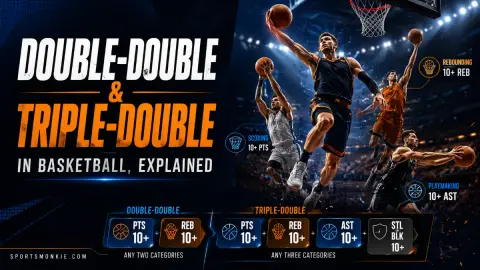
A double-double means double digits in two stat categories; a triple-double means double digits in three. Here is how they are counted and why they matter.
Liberty Say They Were Told No Reset Timeout, Officials Say No One Asked in 101-98 Loss
New York say officials told them no reset timeout remained in overtime, the pool report says the opposite, and the Liberty have filed an inquiry down 2-0 to Atlanta.

No, the WNBA Did Not Lose 70% of Its Viewers After Caitlin Clark's Exit: The Real Drop Is 44-47%
A viral post claimed WNBA playoff viewership fell 70-76% after Caitlin Clark's Fever were eliminated. The like-for-like numbers show a 44-47% drop.