
What Is Effective Field Goal Percentage? eFG% Explained
On this page5
Effective field goal percentage in basketball adjusts a player’s shooting to give the 3-pointer the extra credit it deserves. Plain field goal percentage treats a made 3 exactly like a made 2, which quietly punishes anyone who shoots from deep — even though a 40 percent 3-point shooter produces the same points per shot as a 60 percent 2-point shooter. eFG% fixes that with one small tweak, and it has become the standard way to compare shooters who take very different kinds of shots.
The formula
Effective field goal percentage counts every made 3-pointer as one and a half makes:
eFG% = (FGM + 0.5 × 3PM) ÷ FGA
- FGM = field goals made (all makes, 2s and 3s)
- 3PM = 3-pointers made
- FGA = field goal attempts (all attempts)
The 0.5 is doing the whole job. A made 3 is worth 1.5 times a made 2 — three points versus two — so adding half a make for each 3 captures that 50 percent bonus. A pure 2-point shooter’s eFG% equals their regular field goal percentage; the two only diverge once 3-pointers enter the picture.
A worked example
Take a wing who makes 500 field goals on 1,000 attempts, 200 of those makes being 3-pointers.
- 3-point bonus: 0.5 × 200 = 100
- Adjusted makes: 500 + 100 = 600
- eFG%: 600 ÷ 1,000 = .600
His raw field goal percentage is 500 ÷ 1,000 = .500 — merely average-looking. But because a third of his makes were 3s, his effective field goal percentage jumps to .600, an elite mark. That 100-point gap is exactly the value plain field goal percentage throws away.
What counts as a good eFG%
League-average effective field goal percentage sits around .530 to .540 in the modern game, pushed up by 3-point volume.
| eFG% | Rating |
|---|---|
| .600 and up | Elite |
| .560 to .599 | Very good |
| .540 to .559 | Above average |
| .520 to .539 | Roughly league average |
| .500 to .519 | Below average |
| Below .500 | Poor |
The highest marks tend to come from two very different profiles: efficient high-volume 3-point shooters, and rim-running big men who score almost entirely at the basket. Both are producing points cheaply per attempt, just by opposite routes.
eFG% versus true shooting
The one thing eFG% does not capture is free throws. A player who draws fouls and converts at the line is scoring efficiently in a way effective field goal percentage simply cannot see, because free throws never enter the formula. That is the gap true shooting percentage closes — it adds free-throw attempts into the denominator, making it the more complete measure of total scoring efficiency.
A quick way to keep them straight: use eFG% for shot-making from the field, and TS% for total scoring including the line. A slashing scorer who lives at the free-throw line will show a true shooting number well above his eFG%, and that gap tells you how much of his value comes from drawing fouls.
Where it fits
Like true shooting, effective field goal percentage is a pure efficiency rate — it ignores how many shots a player takes. Efficiency on a handful of open looks is not the same as carrying an offense, which is why it pairs naturally with usage rate to weigh efficiency against volume. If you also want free throws included, run the same box score through the true shooting percentage calculator. For the all-in-one summary that blends shooting with everything else, see our explainer on player efficiency rating.
To see the shooters and finishers who post the best marks, the greatest NBA players is full of them, and the highest-scoring NBA game shows what happens when efficient shot-making meets sheer volume.
Bottom line: effective field goal percentage is makes plus half your 3-pointers over attempts, the fair way to compare inside and outside shooters — .540 average, .600 elite — with true shooting the version that also counts free throws.
Frequently asked questions
Why is a 3-pointer worth 0.5 extra in the formula?+
Because a made 3-pointer is worth 1.5 times a made 2-pointer — three points versus two. Adding half a make for every 3 baked in captures that 50 percent bonus, so a 3-point shooter is not penalized for shooting a lower raw percentage from farther out.
How is eFG% different from true shooting?+
Effective field goal percentage adjusts for 3-pointers but ignores free throws. True shooting includes free throws too. So eFG% measures shot-making from the field, while TS% measures total scoring efficiency. A player who lives at the line will have a TS% well above their eFG%.
What is a good effective field goal percentage?+
League average sits around .530 to .540. A .550 eFG% is good, .560 or higher is very good, and elite shooters and rim-runners push past .600. Because 3s and dunks both help, the highest figures come from efficient 3-point shooters and players who score mostly at the basket.
Can effective field goal percentage exceed 100%?+
Yes, over small samples. A player who makes several 3s and misses nothing could top 1.000 for a game, because each 3 counts as 1.5 makes. Over a full season it settles well below that, with elite marks around .600 to .650.
Does eFG% include free throws?+
No. That is the key limit. A player who draws a lot of fouls and converts free throws is scoring efficiently in a way eFG% cannot see. To capture that, use true shooting percentage, which folds free-throw attempts into the denominator.
Why not just use regular field goal percentage?+
Because plain field goal percentage treats a 3-pointer the same as a 2, which unfairly punishes shooters. A player who hits 40 percent of his 3s produces the same points per shot as one hitting 60 percent of his 2s, and eFG% shows them as equal while raw FG% does not.
Sources
Play & tools
Free browser games and tools — no account, no download.
- Play 82-0 — Draft five, one per position, and see if your lineup can go a flawless NBA season.
- Play Era Ball — Draft an all-time NBA roster from a single era, then simulate a season and chase a perfect run.
- Play 32-0 — Draft five college basketball legends, one per position, and chase a perfect 32-0 national title.
- Explore all our games →
- Get the printable bracket — Download and print a blank tournament bracket to fill out by hand.
- Open the TS% calculator — Calculate TS% from points, field goal attempts and free throw attempts — scoring efficiency in one number.
- Explore all our free sports tools →
Related basketball guides
View all →
True Shooting Percentage Explained (TS% Formula)
True shooting percentage measures scoring efficiency across 2s, 3s, and free throws in one number. Here is the TS% formula, an example, and what is elite.
What Is Player Efficiency Rating (PER) in Basketball?
PER is Hollinger's per-minute rating that sums a player's box-score value into one number, with league average set to 15. How it works and its limits.
What Is Usage Rate in Basketball? USG% Explained
Usage rate is the share of team possessions a player uses while on the floor. Here is the formula, a worked example, and what counts as high usage.
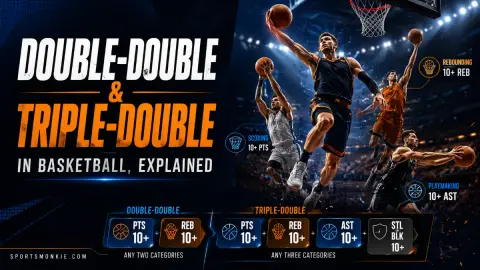
Double-Double and Triple-Double in Basketball, Explained
A double-double means double digits in two stat categories; a triple-double means double digits in three. Here is how they are counted and why they matter.
Liberty Say They Were Told No Reset Timeout, Officials Say No One Asked in 101-98 Loss
New York say officials told them no reset timeout remained in overtime, the pool report says the opposite, and the Liberty have filed an inquiry down 2-0 to Atlanta.

No, the WNBA Did Not Lose 70% of Its Viewers After Caitlin Clark's Exit: The Real Drop Is 44-47%
A viral post claimed WNBA playoff viewership fell 70-76% after Caitlin Clark's Fever were eliminated. The like-for-like numbers show a 44-47% drop.