
What Is a Clear in Lacrosse?
On this page5
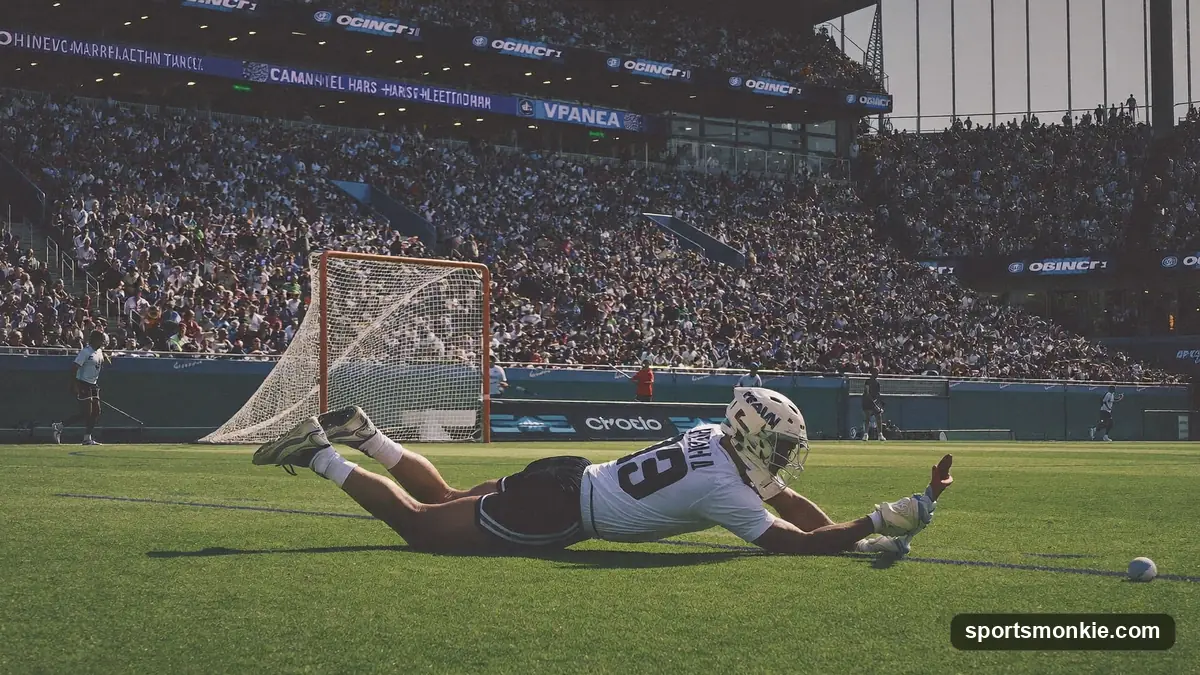
A clear in lacrosse is the act of moving the ball out of your defensive half and up the field to your offense after your team gains possession. It usually begins right after a goalkeeper save, a defensive ground ball or a turnover, and it ends when the ball is safely advanced past midfield into the attacking zone.
In other words, the clear is the moment defense turns into offense. It is one of the most decisive transition phases in the sport, because a clean clear launches an attack while a botched one hands the opponent the ball in prime scoring position. Here is how clearing works, the rules that govern it, and how it fits against its mirror image, the ride.
When a clear happens
A clear starts whenever the defending team suddenly has the ball in its own end and needs to get it up to the offense. The most common triggers are:
- The goalkeeper makes a save and now must distribute the ball out of the defensive zone.
- A defender scoops a ground ball after a missed shot or loose ball.
- The team forces a turnover, stripping the ball or intercepting a pass.
At that instant the roles flip. The team that was defending becomes the team trying to advance, and the team that just lost the ball scrambles to pressure them. That pressure has its own name, the ride, and clearing is essentially the effort to beat it.
How a clear is run
There is no single way to clear; teams choose based on how hard the opponent is pressing. The two broad approaches are the controlled clear and the fast break.
A controlled clear is methodical: players spread out to create wide passing lanes, the ball is moved with short, safe passes up the sideline, and the team walks it past midfield without taking big risks. This is the default when the opponent is not riding aggressively.
A fast-break clear is the opposite: the goalkeeper or a defender pushes the ball upfield quickly to catch the offense before the defense is set, trying to create a numbers advantage near the goal. Because the clearing team often has an extra player in transition (the goalie effectively becomes a field player once the ball is out), fast clears can produce odd-man rushes that lead to high-quality shots.
Good clearing depends on the same fundamentals every player learns early, especially secure stick work and smart spacing, which is why the basics of lacrosse put so much emphasis on scooping ground balls and clean passing.
The rules that add urgency
Clearing is not open-ended. In men’s field lacrosse, the team with the ball must advance it under the game’s count and shot-clock rules, meaning it has a limited time to get the ball out of the defensive area and across midfield rather than stalling. If the clearing team fails to advance in time, it loses possession.
These timing rules are what make a clear a genuine contest rather than a formality. The defending team cannot simply hold the ball in the back and wait; it has to make decisions and move the ball forward, and the riding team knows exactly how long it has to force a mistake. The number of players each side keeps on its half of the field also matters, tying clears into the broader question of how many players are on the field and where they are positioned.
Clear versus ride
The clear has a direct opponent: the ride. While the team that just won the ball is clearing, the team that just lost it is riding, applying pressure on the ball carrier and cutting off passing lanes to force a turnover before the clear can be completed.
Think of it as a tug-of-war in transition. The table below lines up the two roles side by side.
| Aspect | Clear | Ride |
|---|---|---|
| Which team | The team that just won possession | The team that just lost possession |
| Goal | Advance the ball past midfield to offense | Force a turnover before the clear succeeds |
| Started by | A save, ground ball or turnover | The opponent gaining the ball in your end |
| Success looks like | Ball safely into the attacking zone | A failed clear won back near the goal |
A hard ride that forces a failed clear is one of the most valuable plays in lacrosse, because it produces a turnover in a dangerous area. Our companion explainer on what a ride is in lacrosse covers that pressing side of the battle in detail.
Why clearing percentage matters
Because clears determine whether a team keeps or loses possession at a pivotal moment, teams track clearing percentage, the share of clear attempts that succeed. A high clearing percentage means a team reliably converts defensive stops into offensive possessions; a low one means it is repeatedly giving the ball back near its own goal.
For coaches and analysts, clearing percentage is a quiet but telling number. A team can play strong defense and still lose if it cannot clear, because every failed clear undoes the stop that preceded it. That is why clearing, though less flashy than a goal or a big hit, is one of the phases that most often separates winning teams from losing ones.
Frequently asked questions
What does clearing mean in lacrosse?+
Clearing means moving the ball from your defensive end up to your offensive end after your team gains possession. It typically starts when the goalkeeper makes a save or a defender picks up a loose ball, and it ends when the ball is advanced safely past midfield into the attacking zone. The defending team is trying to beat the opponent's ride (their pressure) and transition from defense to offense. A completed clear is a success; losing the ball during the attempt is a failed clear.
What is the easiest way to clear in lacrosse?+
The simplest clear is an unpressured outlet: after a save or a ground ball, the goalkeeper or a defender passes to an open teammate on the wing or at midfield, who carries the ball upfield when the other team is not aggressively riding. Spreading players wide to create passing lanes and using the extra man the defense often has in transition makes it easier. When the opponent does not press hard, teams can simply run the ball up the sideline with short, safe passes rather than forcing risky throws.
What is a failed clear in lacrosse?+
A failed clear happens when the defending team loses possession while trying to advance the ball out of its own end, either by throwing it away, getting stripped, stepping out of bounds, or failing to advance in time under the count and shot-clock rules. A failed clear is costly because it gives the opponent the ball close to the goal they are attacking, often leading to a quick scoring chance. Teams track their clearing percentage precisely because failed clears are high-value turnovers.
What is the opposite of a clear in lacrosse?+
The opposite of a clear is the ride. Clearing is what the team that just won possession does to move the ball upfield, while riding is what the team that just lost possession does to stop them, pressuring the ball carrier and passing lanes to force a turnover before the clear succeeds. Clearing and riding are two sides of the same transition battle: one side is trying to break out, the other is trying to trap them in their own end.
Sources
Play & tools
Free browser games and tools — no account, no download.
- Play today's Sports Connections — Today's Sports Connections — daily hints, answers, and play the grid.
- Play Guess the NFL Player — A new mystery NFL player every day. Eight guesses, with a clue on each — plus free unlimited mode.
- Explore all our games →
Related guides
What Is a Ride in Lacrosse?
A ride is when the attacking team, after losing the ball, pressures the defense to stop them clearing it upfield. The opposite of the clear, explained.
The Attackman Position in Lacrosse
An attackman is an offensive lacrosse player who stays on the attacking half to score and feed. The role, sticks and skills explained.

Box Lacrosse vs Field Lacrosse
Box lacrosse is a fast 5-on-5 indoor game; field lacrosse is a 10-on-10 outdoor sport. Rules, field, gear and physicality compared.

Why Lacrosse Is the Fastest Game on Two Feet
"The fastest game on two feet" is lacrosse's nickname. Where it comes from, what makes the sport so fast, and how quick the ball and shots really move.

How Long Is a PLL Lacrosse Game?
A PLL game is four 12-minute quarters, 48 minutes of game clock, plus halftime and stoppages, running about two to two-and-a-half hours in real time.
How Many Players Are on a Lacrosse Team?
Men's field lacrosse plays 10 per side, women's 12, and box lacrosse 6. How many players are on the field and on the roster, by format and level.