
What Is a Bullpen Game in Baseball?

On this page5
A bullpen game is a baseball game in which a team uses a chain of relief pitchers to cover all nine innings instead of a traditional starting pitcher who works deep into the game. Teams turn to it when no rested starter is available, during doubleheaders, or as a deliberate strategy, especially in the postseason, and the pitching is simply spread across several arms rather than resting on one.
Nothing else about the game changes. The rules, the innings and the scoring are all standard; a bullpen game is a staffing decision, not a different version of baseball. What follows is why teams do it, how it plays out, and the one quirk it creates around who gets the win.
What makes it a bullpen game
In a normal game, a starting pitcher is expected to throw five, six or more innings before handing off to the bullpen. In a bullpen game, there is no such workhorse. The team might “open” with a reliever who faces the top of the order for an inning or two, then cycle through a series of relievers, each throwing a short, high-intensity stint.
The line between a bullpen game and an “opener” strategy is blurry. An opener uses a reliever for the first inning or two before a longer arm (“the bulk guy”) takes over, whereas a pure bullpen game may never use anyone for more than a couple of innings. Both share the same idea: cover the game with relief pitching.
Why teams use them
There are a few common triggers for a bullpen game. Injuries or a thin rotation can leave a team without a healthy starter. Doubleheaders force teams to find extra innings from somewhere. And in the playoffs, managers sometimes choose a bullpen game on purpose, betting that a parade of fresh, hard-throwing relievers is tougher to solve than one starter a lineup sees repeatedly.
| Format | First pitcher | Typical use |
|---|---|---|
| Traditional start | Starter goes 5+ innings | Everyday rotation |
| Opener | Reliever for 1–2 innings, then bulk arm | Matchup vs top of order |
| Bullpen game | Reliever, then several short stints | No rested starter, doubleheaders, playoffs |
The “third time through the order” logic
A big reason bullpen games exist is the well-known drop in a pitcher’s results the third time he faces a lineup in a single game. By swapping in fresh relievers, a team keeps giving hitters a new look and avoids letting any one pitcher tire and get exposed. That thinking, combined with the modern rise of high-velocity relievers, is why bullpen games became far more common in recent seasons. Understanding pitching stats like ERA in baseball and WHIP in baseball helps explain why managers trust certain relievers in these spots.
The downsides
Bullpen games are demanding on a pitching staff. Using five or six relievers in one game can leave the bullpen depleted for the following day, and if the game goes to extra innings or an early reliever struggles, a manager can run out of trusted arms fast. There is also less margin for error: one bad matchup can unravel quickly when no long man is available to soak up innings.
That is why a bullpen game is rarely a team’s first choice for a normal game. It is a tool for specific situations rather than a week-in, week-out plan, though some pitching-poor teams lean on it more heavily.
Who gets credited with the win
The one scoring wrinkle is the pitching win. Normally a starting pitcher must complete at least five innings to qualify for a win. In a bullpen game, almost no one reaches five innings, so that requirement usually cannot be met. In that case the official scorer awards the win to the relief pitcher judged most effective among the candidates, as long as the team held a lead it never gave back. This is different from a quality start, which is a starter-only benchmark that a bullpen game does not produce.
The short version: a bullpen game replaces the traditional starter with a relay of relievers across all nine innings, used when a starter is not available or as a playoff gambit. The rules are unchanged, the strategy leans on fresh arms and matchups, and the win is decided by the official scorer rather than by a starter reaching five innings.
Frequently asked questions
Why do they call it a bullpen game?+
It is named after the bullpen, the area where relief pitchers warm up during a game. A 'bullpen game' relies on those relievers to pitch the whole game rather than a starter, hence the name. The origin of the word bullpen itself is debated, with theories ranging from old Bull Durham tobacco outfield signs to the sense of a pen where players wait, but in modern usage it simply means the group of relief pitchers.
Are bullpen games effective?+
They can be, especially in the playoffs, when fresh relievers throwing max effort for an inning each can be harder to hit than a tiring starter facing a lineup for the third time. The risks are that it burns through the entire pitching staff, leaves the bullpen thin for the next day, and exposes weaker relievers if the game runs long. Effectiveness depends on staff depth and how the manager matches pitchers to hitters.
What are the rules of a bullpen game?+
There are no separate rules. A bullpen game follows all the normal rules of baseball; it is simply a staffing choice where a team opens with a reliever and rotates several more through the game instead of using a conventional starter. The only rule that becomes relevant is how the win is credited, because the usual requirement that a starter pitch five innings often cannot be met.
Who gets the win in a bullpen game?+
Because a starting pitcher normally must complete five innings to earn a win and that rarely happens in a bullpen game, the official scorer awards the win to the relief pitcher judged most effective among those in line for it, provided the team took a lead it never surrendered while that pitcher was involved. It is a judgment call, which is why bullpen-game wins can go to a middle reliever rather than the first pitcher.
Sources
Play & tools
Free browser games and tools — no account, no download.
- Play 162-0 — Draft nine and see if your roster can survive a flawless 162-game MLB season.
- Explore all our games →
- Analyze a trade — Compare both sides of a fantasy baseball trade before you accept.
- Run the MLB predictor — Simulate the MLB postseason bracket down to a World Series champion.
- Open the ERA calculator — Work out earned run average from earned runs and innings pitched — handles the .1/.2 thirds convention.
- Explore all our free sports tools →
Related baseball guides
View all →
How Many Innings Are in a Baseball Game? (9 in MLB)
A baseball game has nine innings in MLB, the minors, and college. High school plays seven and Little League six. Here's every level, plus how long games last.
What Is the Designated Hitter (DH) in Baseball?
The designated hitter bats in place of the pitcher and never plays the field. Since 2022 the universal DH applies in both the American and National Leagues.

What Is a Cycle in Baseball? Rarity and Records
A cycle in baseball is one single, one double, one triple and one home run by the same batter in a single game. How rare it is, plus records.
What Is the Mendoza Line in Baseball?
The Mendoza Line is a .200 batting average, the informal benchmark for poor hitting in baseball. Its origin, meaning and use beyond sport, explained.
Ramirez Takes the Blame as Two Miscues Sink the Guardians in ALCS Game 2
Jose Ramirez left third base uncovered, then let a grounder through his legs on the turf edge as three unearned runs beat Cleveland 3-1 in ALCS Game 2.
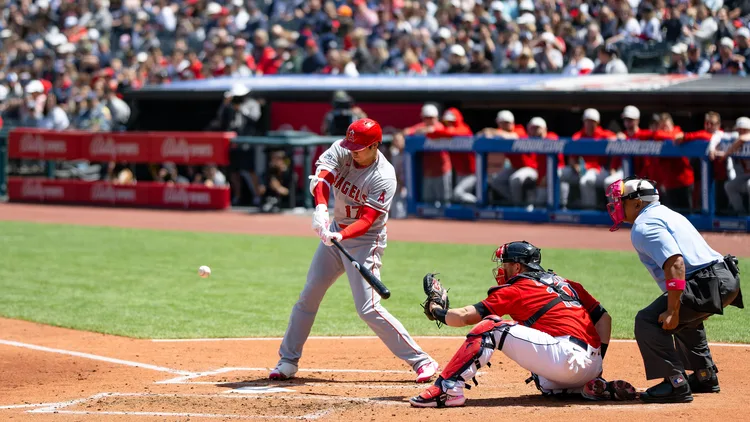
Ohtani Bats Sixth and Reaches Three Times as Dodgers Fall 6-2 to Trail 3-0
Shohei Ohtani batted sixth in NLCS Game 3 and reached base three times, but the Dodgers lost 6-2 to Milwaukee and now trail the series 3-0.