
Top-Rated Pickleball Paddles: How to Pick the Right One
On this page8
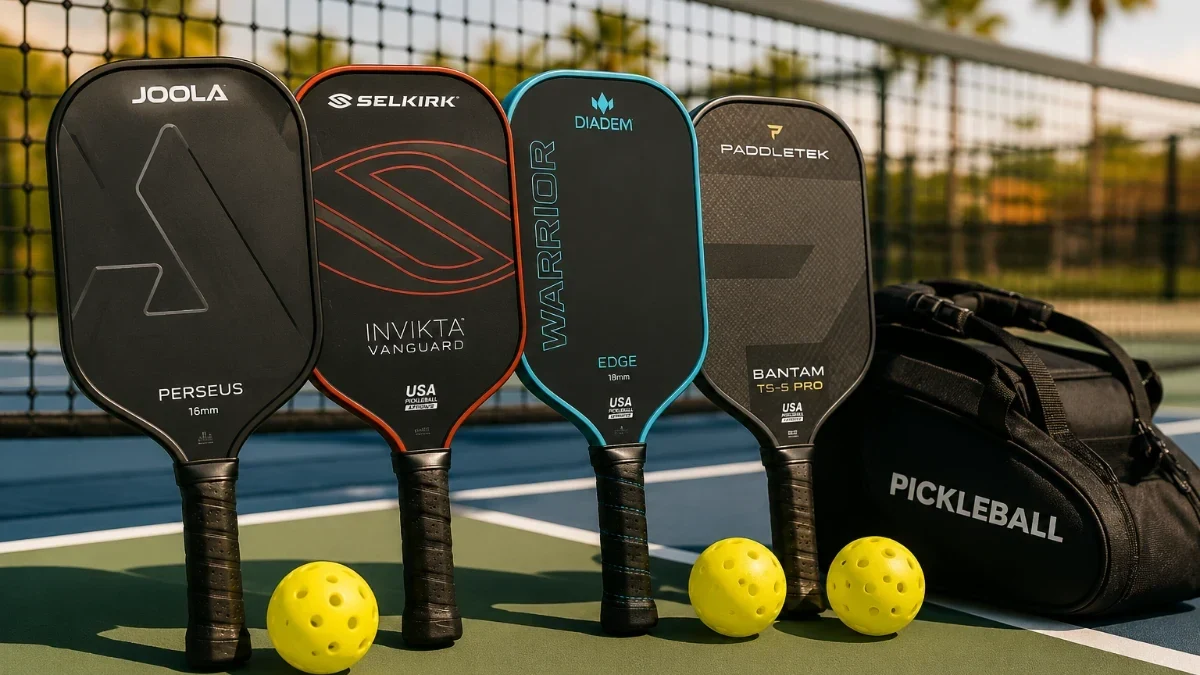
The top rated pickleball paddles in 2026 almost all share the same DNA: a raw carbon face (usually Toray T700), a honeycomb or foam core, and a spot on the USA Pickleball approved list. What separates a great paddle from the wrong one is not the brand on the throat. It is whether the core thickness, shape, weight and grip fit how you play. Choose 16mm for control and a large sweet spot, 14mm for power and fast hands, and you can land a genuinely top-tier paddle for $100 to $200 without paying $300 for marginal feel.
What makes a paddle “top-rated” in 2026?
Four specs decide almost everything about how a paddle plays. Get these right for your game and the logo barely matters.
- Core thickness — the single biggest lever on feel. Thicker cores dampen contact for control; thinner cores play firm and fast.
- Face material — raw carbon fiber for spin and touch, fiberglass for raw pop, or a hybrid that blends both. Raw Toray T700 carbon is the 2026 default on serious paddles.
- Shape — elongated for reach and power, widebody for a forgiving sweet spot, hybrid for a middle ground.
- Weight and grip — set your swing speed, arm comfort and how much wrist snap you get.
The other 2026 shift worth knowing: the market moved from thermoformed “Gen 3” paddles to full foam-core “Gen 4” builds this year. Foam cores resist the core-crushing that plagued some earlier thermoformed paddles and tend to spread the sweet spot wider, which is why several of the year’s standout paddles are foam-core.
Control vs power: which type is right for you?
This is the fork in the road, and it is a genuine trade-off — you cannot max both. A power paddle stores and returns more energy (the “trampoline” pop) so the ball leaves faster. A control paddle absorbs more energy, so the ball sits on the face a fraction longer and goes where you aim it.
My honest recommendation: most players, and nearly all beginners and intermediates, should buy control. A control paddle keeps more balls in play, forgives off-center hits and teaches the soft dinking-and-reset game that actually wins points. Reach for a power paddle only once your technique is dialed in and you are consistently losing hands battles at the net for lack of pace. If you genuinely play both styles, an all-court 16mm paddle splits the difference well.
How thick should the core be?
Thickness is where you should start, because it sets the feel every other choice hangs off.
| Core thickness | Feel | Best for |
|---|---|---|
| 14mm | Firm, fast, more pop | Power players, quick hands at the net |
| 16mm | Soft, large sweet spot, plush | All-court play, control, most buyers |
| 20mm | Extra-soft, maximum dwell | Touch specialists, dinkers, resets |
Sixteen millimeters is the safe, popular default in 2026 and what I steer most people toward. Go 14mm only if you want speed and can supply your own control; the sweet spot is smaller and mis-hits punish you more. The newer 20mm control builds, like Selkirk’s LUXX Control line, push touch even further but are a specialist’s choice.
What shape and weight should you pick?
Shape changes reach and forgiveness. An elongated paddle (around 16.5 inches long) adds leverage and reach for power and singles, at the cost of a narrower sweet spot. A widebody is shorter and wider with the most forgiving face — the friendliest for improving players. Hybrids sit between the two and are a sensible default if you are unsure.
Weight is mostly about swing speed and your arm. Midweight paddles in the 7.8 to 8.3 oz range suit most players; JOOLA lists its Hyperion Pro V at an average 8.1 oz, which is typical for a modern all-court paddle. Lighter paddles (under 7.8 oz) swing faster and help hand speed but give up plow-through power. Heavier paddles hit harder but are slower to reset and, if you have any elbow history, more likely to aggravate it.
What grip size should you get?
Grip circumference is the spec people ignore and then blame the paddle. Most paddles run a 4 to 4 1/4 inch grip; the Hyperion Pro V’s 16mm build uses 4.25 inches. A rough sizing check: hold the paddle and see if your index finger fits in the gap between your fingertips and palm. Too small feels twitchy and you over-grip; too big strains the forearm and kills wrist snap.
When in doubt, size down. You can always build a smaller grip up with an overgrip, but you cannot shrink one that is too big. A single overgrip adds roughly 1/16 inch of circumference.
How much should you spend?
Prices cluster into clear tiers, and the honest truth is that the jump from budget to mid-tier matters far more than the jump from mid to premium.
| Price tier | Typical price (USD) | What you get |
|---|---|---|
| Starter | $40–70 | Composite or basic graphite face, fine for casual rec play |
| Value | $90–120 | Raw carbon (T700) face, foam or honeycomb core — the sweet spot for most buyers |
| Premium | $150–250 | Pro-level tuning, refined feel, durable-grit surfaces, marginal gains |
| Halo | $250–300 | Flagship models and pro signatures; you pay for the last few percent |
For most people the $90 to $120 value tier is the smart buy. Vatic Pro’s V-Sol line, around $110, packs a raw T700 face and a Gen 4 foam core and competes with paddles priced far higher, proof you do not need to reach $300. UK and Australian buyers should expect to pay a premium over US pricing plus shipping and duty, so a $110 US paddle often lands nearer £110–130 or A$200–230 once it arrives.
Our top picks by playstyle
Prices move and 2026 models turn over quickly, so treat these as categories to shop rather than fixed forever:
- Best all-court / control: a 16mm raw-carbon paddle such as the JOOLA Hyperion Pro V (
$300 flagship) or, for far less, the Vatic Pro V-Sol Pro ($110). Both reward placement over brute force. - Best power: an elongated 14mm foam-core paddle. These deliver baseline pace but demand you supply the control.
- Best value: the Vatic Pro V-Sol Pro at roughly $110, the paddle I would hand most intermediate players who do not want to overspend.
- Best for beginners: a forgiving 16mm widebody or hybrid; see our dedicated guide below before you buy.
If you want to go deeper on why raw carbon dominates the top of every list, our carbon fiber pickleball paddle guide breaks down the material trade-offs, and new players should start with choosing a pickleball paddle for beginners before spending on a premium model. For more gear breakdowns across the sport, browse the racket sports hub.
What’s changing with the rules in 2026?
Here is the part most affiliate lists skip, and it can decide whether the paddle you buy stays legal. USA Pickleball’s Equipment Standards Manual already caps two things: surface roughness (a face over 30 micrometers is banned) and power, measured since 2025 by the PBCoR “trampoline” test. From October 1, 2026, USAP adds a dual-camera spin-rate test, and paddles certified after that date must come in under 2,100 RPM.
The practical takeaway: if you play sanctioned tournaments, buy from the approved list and know that some high-spin faces sold today may not pass the new standard. For rec players it changes nothing, but it is worth knowing before you spend $250 on a paddle you assume is future-proof.
Frequently asked questions
The picks and specs above should get you to the right paddle. Match thickness to your style first, confirm the model is USAP-approved, and resist the urge to overspend — the value tier is genuinely good in 2026.
Frequently asked questions
What is the most important spec on a pickleball paddle?+
Core thickness sets the feel more than any other spec. A thicker 16mm core softens contact for control and a bigger sweet spot, while a thinner 14mm core plays firmer and faster for power. Pick thickness first, then match shape, weight and grip to it.
Is a more expensive paddle actually better?+
Up to a point. Jumping from a $40 starter to a $100 raw-carbon paddle is a real upgrade in spin and control. Above roughly $150 you are paying for marginal gains in feel and durability, not a dramatic performance leap, so most players do not need to spend $250.
What thickness pickleball paddle should I buy?+
For all-around play and control, choose 16mm; it is the most forgiving and the most popular thickness in 2026. Go 14mm if you want faster hands and pop at the net and can supply your own control. New 20mm control paddles exist but suit touch-focused players.
How do I know if a paddle is tournament legal?+
Check the model against the USA Pickleball approved paddle list before buying for sanctioned play. USAP tests surface roughness and the paddle's power via PBCoR, and from October 2026 it adds a spin-rate cap. A paddle not on the list cannot be used in rated tournaments.
Should beginners get a control or power paddle?+
Control. A softer 16mm control paddle keeps more balls in play, enlarges the sweet spot and helps you learn placement and the soft game. Power paddles reward technique you have not built yet and punish off-center hits, so most new players progress faster with control.
How long does the spin on a raw carbon paddle last?+
Raw Toray T700 carbon grips well when fresh but its texture wears with use. Independent testing shows many faces lose noticeable spin after roughly 30 to 50 hours of play. Newer durable-grit and foam-core designs are built to hold friction longer before they smooth out.
Sources
Play & tools
Free browser games and tools — no account, no download.
- Play today's Sports Connections — Today's Sports Connections — daily hints, answers, and play the grid.
- Play Guess the NFL Player — A new mystery NFL player every day. Eight guesses, with a clue on each — plus free unlimited mode.
- Explore all our games →
Related racket sports guides
View all →
Best Pickleball Paddle: How to Choose the Right One
How to pick the best pickleball paddle: control vs power vs all-court, materials, price tiers, and the new testing rules that decide what stays legal.
Carbon Fiber Pickleball Paddles: What Actually Matters
A carbon fiber pickleball paddle wins on spin and durability, but raw vs painted, T700 grades, and build method decide if it's worth the price.
Pickleball Paddle for Beginners: How to Pick Your First
Choosing a pickleball paddle for beginners comes down to weight, grip, and a 16mm core. Here are the specs to check and budget vs mid picks with real prices.
Customizable Pickleball Paddles: Cost and Where to Buy
Where to get a customizable pickleball paddle in 2026, what gets personalized, real prices from $10 to $325, and if custom paddles stay tournament-legal.
Selkirk Pickleball Paddles: Which Model to Buy in 2026
Which Selkirk pickleball paddle to buy in 2026: Vanguard, Amped, Luxx, and SLK compared on price, core, weight, and who each is actually for.
How to Hold a Pickleball Paddle: Grips and Grip Pressure
How to hold a pickleball paddle: the continental and eastern grips, the neutral ready grip, and how much grip pressure to use for control.