
Carbon Fiber Pickleball Paddles: What Actually Matters
On this page7
- 01Is carbon fiber actually better than graphite or fiberglass?
- 02What does “raw carbon” mean, and why do players chase it?
- 03T700, 3K, Toray: which carbon fiber specs matter?
- 04Thermoformed vs cold-pressed: the durability trade-off
- 05How much does a carbon fiber pickleball paddle cost?
- 06Who should buy a carbon fiber paddle, and who shouldn’t?
- 07The bottom line
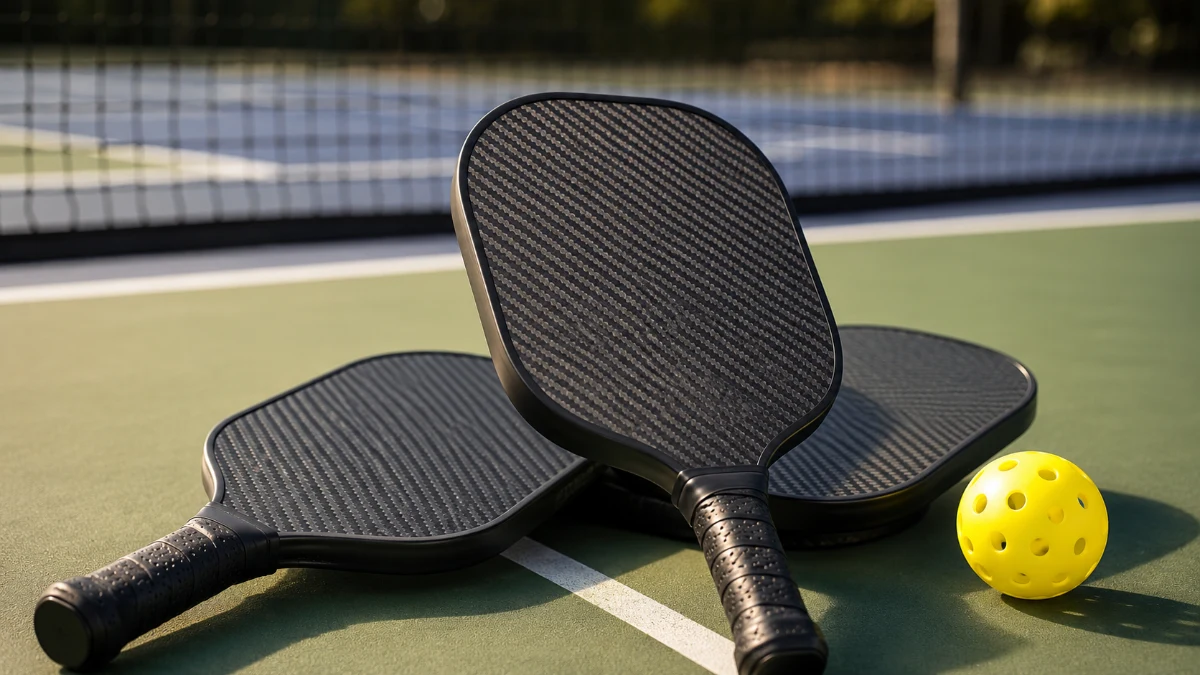
A carbon fiber pickleball paddle earns its premium on two things: spin and a hitting surface that stays consistent for a full season. That is what carbon does better than graphite or fiberglass. The catch is that “carbon fiber” now stretches from a $70 mass-market paddle to a $250 tournament build, and the label alone tells you almost nothing. What actually decides quality is whether the face is raw (unpainted) carbon, which core sits behind it, and how tightly the two are bonded.
Is carbon fiber actually better than graphite or fiberglass?
For spin and longevity, yes. Carbon fiber’s tightly woven face has a natural grit that bites the ball on contact, and that texture holds up over months of play. Graphite is technically a form of carbon too, but the thin graphite sheets used on paddle faces feel softer and wear smoother sooner. Fiberglass flexes more on impact, giving a lively, powerful pop, but it grips the ball less and generates noticeably less spin.
There is a real trade-off, though. That extra flex is why some players still love fiberglass for cheap power, and why raw carbon can feel firm, even harsh, if you buy a thin, stiff build. Here is how the three faces compare for the shots you actually hit:
| Face material | Spin | Feel | Power | Durability | Best for |
|---|---|---|---|---|---|
| Raw carbon fiber | Highest | Firm, controlled | Moderate | Excellent | Spin, control, consistency |
| Graphite | Moderate | Soft, responsive | Moderate | Good | Touch and soft-game players |
| Fiberglass | Lower | Poppy, lively | Highest | Fair | Beginners chasing free power |
According to Pickleheads, carbon’s uniform structure means fewer weak spots where spin drops off, which is the quiet reason it dominates the premium tier: it plays the same in month ten as it did on day one.
What does “raw carbon” mean, and why do players chase it?
Raw carbon leaves the woven surface exposed instead of burying it under paint or a clear coat. That bare weave has more usable grit, so it produces more spin and, because there is no coating to scuff off, it keeps its legal texture longer. Painted faces can look sharp out of the box but lose bite as the finish wears.
The cost of that grip is upkeep. An exposed weave traps dirt, ball residue, and skin oils, so a raw face needs a wipe-down with a damp microfiber cloth or a paddle eraser to stay grippy. If you are willing to spend thirty seconds cleaning it after sessions, raw carbon is the surface to want.
T700, 3K, Toray: which carbon fiber specs matter?
Premium paddles advertise “Toray T700” for a reason. T700 is genuinely stronger raw material than the older T300 standard: Toray’s own data sheets put T700’s tensile strength near 4,900 MPa versus about 3,530 MPa for T300, roughly 39% higher, at the same stiffness (Toray). Stronger fiber resists the dead spots that plague cheaper faces.
But do not overpay for the badge. “3K” refers to the weave (3,000 filaments per bundle), not the grade, and it is often marketing gloss rather than a performance guarantee. Two paddles can both claim “T700 3K” and play completely differently depending on how the face is textured and bonded. My rule of thumb: treat the fiber grade as a tiebreaker, not the headline. A well-built raw T300 face beats a poorly built T700 one every time.
Thermoformed vs cold-pressed: the durability trade-off
This is the spec most buyers miss. Cold-pressed paddles glue the face, core, and edge together at room temperature. Thermoformed paddles use heat to mold everything into one stiff, unibody shell, which stiffens the whole paddle and pushes energy into the ball more efficiently, often around 8 to 12% more ball speed on drives.
The catch surfaced during the 2023-24 thermoforming boom: the heat can soften the polypropylene core cells, and under repeated hard hits some early models suffered permanent compression, nicknamed “core crush.” Regulators tightened up in response. USA Pickleball dropped its power ceiling, the PBCoR limit, to 0.43 effective November 2025, and its dedicated spin-rate test, capping spin near 2,100 RPM, is set to phase in from October 2026 (USA Pickleball; The Dink).
The takeaway is simple. Thermoformed gives you more power and a bigger sweet spot; cold-pressed gives you a balanced, often cheaper paddle that is easy on the arm. Either is fine, but buy a current model that clears today’s standards rather than a discounted 2023 build that may soften early.
How much does a carbon fiber pickleball paddle cost?
The best news in pickleball is that direct-to-consumer brands collapsed the price of a good raw carbon paddle. You no longer need to spend $200 for premium construction. Approximate 2026 pricing:
| Tier | Price (USD) | Price (UK) | What you get |
|---|---|---|---|
| Budget DTC raw carbon | $70-110 | £70-100 | Thermoformed raw T700 face, real spin, no-frills brand |
| Mid-range | $130-180 | £120-170 | Refined shapes, better QC, tuned weight and balance |
| Premium / tournament | $200-260 | £180-240 | Flagship builds, pro-tour models, longest warranties |
Here is the value math the listicles skip. A $100 budget carbon paddle played three times a week that lasts about 18 months costs you roughly $1.30 a week. A $240 flagship over the same span runs about $3.10 a week. Unless you compete seriously, the budget tier is the smarter buy, and it is the single biggest reason to shop by construction rather than by brand name.
If you want vetted picks across price points, our roundup of the top-rated pickleball paddles breaks down models by playing style, and beginners should start with our guide to choosing a first pickleball paddle before spending on carbon at all.
Who should buy a carbon fiber paddle, and who shouldn’t?
Buy carbon if you are an intermediate or advancing player who wins points with spin, dinks, and consistency, and who wants a face that plays the same all season. Raw carbon rewards technique, and the budget tier means the material is no longer gatekept behind a high price.
Hold off if you are a true beginner still learning to make contact. A softer, poppier fiberglass paddle gives you free power and a forgiving feel while you build a swing, and it costs less to replace when your preferences change. There is no shame in starting there and upgrading once you know whether you are a control player or a banger.
For more gear breakdowns, court guides, and buying advice across the sport, browse our racket sports hub.
The bottom line
A carbon fiber pickleball paddle is the right pick for most improving players, but only because of what carbon does, not because of what the box says. Prioritize a raw (unpainted) face for spin and lasting texture, decide between thermoformed power and cold-pressed balance based on your arm and your style, and confirm the exact model is USA Pickleball approved. Do that and a $100 paddle will serve you as well as many people’s $240 one.
Frequently asked questions
Is a carbon fiber pickleball paddle worth the extra money?+
For intermediate and advanced players, yes. Carbon's textured face grips the ball for more spin and holds that texture longer than graphite or fiberglass, so you get consistent performance across a season. Casual beginners who mostly want free power can save money with a fiberglass face and upgrade later.
What is the difference between raw carbon and regular carbon fiber?+
Raw carbon leaves the woven surface exposed instead of hiding it under paint or clear coat. That bare weave has more natural grit, so it generates more spin and keeps its texture longer as the paint-free surface can't wear its coating away. The trade-off is that raw faces need regular cleaning to stay grippy.
Does T700 carbon fiber make a better pickleball paddle?+
T700 is a genuine upgrade over T300 in the raw material, with roughly 39% higher tensile strength per Toray's data, which is why premium paddles advertise it. In practice, how the face is textured and bonded to the core matters more than the grade label, so don't pay a premium for the T700 badge alone.
What does thermoformed mean, and is it better than cold-pressed?+
Thermoformed paddles are molded with heat into one stiff, unibody shell, which adds power and a bigger sweet spot. Cold-pressed paddles are glued together at room temperature and feel a touch softer. Thermoformed builds hit harder but some early models suffered 'core crush' over time, so buy a current, USA Pickleball-approved version.
How do I keep a raw carbon fiber paddle grippy?+
Wipe the face regularly with a damp microfiber cloth or a paddle-specific eraser to lift dirt, ball residue, and skin oils that clog the weave and kill spin. Avoid harsh solvents that can strip texture. Store it in a cover away from hot cars, since heat degrades the core and adhesives fastest.
Are carbon fiber pickleball paddles tournament legal?+
Most reputable carbon paddles are, but you must confirm the exact model appears on USA Pickleball's approved list. The rules already cap surface roughness and paddle power (PBCoR), and a dedicated spin-rate test capping spin near 2,100 RPM phases in from October 2026. A grittier face is not automatically legal, so check before you buy or enter an event.
How long does a carbon fiber pickleball paddle last?+
A regularly played performance paddle typically lasts one to two years before the core softens and it loses pop, sometimes called going 'dead.' Raw carbon faces hold legal texture longer than painted ones, but the core, not the face, usually decides lifespan. Occasional recreational players can keep one considerably longer.
Sources
Play & tools
Free browser games and tools — no account, no download.
- Play today's Sports Connections — Today's Sports Connections — daily hints, answers, and play the grid.
- Play Guess the NFL Player — A new mystery NFL player every day. Eight guesses, with a clue on each — plus free unlimited mode.
- Explore all our games →
Related racket sports guides
View all →
Top-Rated Pickleball Paddles: How to Pick the Right One
A spec-driven guide to the top rated pickleball paddle: core thickness, shape, weight, grip and price tiers, plus 2026 control and power picks.
Best Pickleball Paddle: How to Choose the Right One
How to pick the best pickleball paddle: control vs power vs all-court, materials, price tiers, and the new testing rules that decide what stays legal.
Customizable Pickleball Paddles: Cost and Where to Buy
Where to get a customizable pickleball paddle in 2026, what gets personalized, real prices from $10 to $325, and if custom paddles stay tournament-legal.
Pickleball Paddle for Beginners: How to Pick Your First
Choosing a pickleball paddle for beginners comes down to weight, grip, and a 16mm core. Here are the specs to check and budget vs mid picks with real prices.
Selkirk Pickleball Paddles: Which Model to Buy in 2026
Which Selkirk pickleball paddle to buy in 2026: Vanguard, Amped, Luxx, and SLK compared on price, core, weight, and who each is actually for.
How to Hold a Pickleball Paddle: Grips and Grip Pressure
How to hold a pickleball paddle: the continental and eastern grips, the neutral ready grip, and how much grip pressure to use for control.