
Shortest Test Matches in Cricket History

On this page7
- 01Why the shortest Test is measured by balls bowled
- 02The 642-ball Cape Town Test: the modern record
- 03The 656-ball 1932 Melbourne Test that stood for 92 years
- 04Two-day Tests that shaped the record: 1888, 1935 and beyond
- 05The 2025 Ashes opener: a modern short Test
- 06Shortest Tests at a glance
- 07The takeaway
The shortest Test match in cricket history, measured by balls bowled, is the January 2024 clash between India and South Africa at Newlands in Cape Town, which lasted just 642 balls before India won by seven wickets. It broke a record set at Melbourne in 1932 that had stood for 92 years. Records use balls, not days, because a delivery is a constant unit across every era.
Why the shortest Test is measured by balls bowled
Test cricket is scheduled over five days, so calling a match “short” by days alone is a blunt tool. A rain-hit game can crawl to a two-day finish with far more cricket than a bone-dry pitch that collapses in a single session. Because of that, the accepted measure for the shortest Tests is balls (or overs) bowled to a result.
Balls are the fairest yardstick because over rates, tea and drinks intervals, bad-light stoppages and rain delays all vary wildly. A ball is a ball whether it was bowled in 1888 or 2026. Every record below counts only completed Tests that produced a positive result, so weather-ruined draws that were abandoned early do not qualify.
The 642-ball Cape Town Test: the modern record
The current record holder, as of 2026, is the second Test of India’s 2023-24 tour of South Africa, played at Newlands from 3 to 4 January 2024. The match was done in 642 balls, folding up midway through the afternoon session on day two. India won by seven wickets to draw the series 1-1.
The scorecard tells the story of a wild pitch and a series of collapses. India made 153, then bowled South Africa out for just 55, with Mohammed Siraj taking 6 for 15. South Africa recovered to 176 in the second innings, powered almost entirely by Aiden Markram’s 106 off 103 balls, before Jasprit Bumrah’s 6 for 61 finished them off. India knocked off the small target for the loss of three wickets. Markram’s century accounted for over 60% of his side’s second-innings total, the highest individual share in a completed Test innings by a South African.
The 656-ball 1932 Melbourne Test that stood for 92 years
Before Cape Town, the record belonged to Australia’s demolition of South Africa at the Melbourne Cricket Ground in February 1932, which took just 656 balls. Australia won by an innings and 72 runs on a pitch that had been ruined by rain and sun.
South Africa were skittled for 36 in their first innings and 45 in their second, sandwiching Australia’s 153. The left-arm spinner Bert Ironmonger, then in his late forties, ran through them with 5 for 6 and 6 for 18 for match figures of 11 wickets. The total match aggregate of 234 runs remains one of the lowest ever in a completed Test. That record survived for 92 years, one of the longest-standing marks in the sport.
Two-day Tests that shaped the record: 1888, 1935 and beyond
Some of the briefest Tests come from cricket’s earliest decades, when uncovered pitches and lower scoring made two-day finishes common. The 1888 Lord’s Test between England and Australia lasted only 788 balls, with Australia winning by 61 runs; it remains one of the shortest results in Ashes history. Bridgetown in January 1935 saw West Indies host England in a 672-ball Test that England won by four wickets chasing a modest target.
More recently, the 2021 Ahmedabad pink-ball Test became the poster child for a modern short game. India beat England by 10 wickets in 842 balls, the shortest completed Test since 1935 and the shortest since World War II at the time. Axar Patel took 11 wickets and, remarkably, no pace bowler delivered a single ball in the third and fourth innings; only spin was used to force the result on a turning surface.
The 2025 Ashes opener: a modern short Test
The trend of dramatic quick finishes continued into the 2025-26 Ashes. The series opener at Perth in November 2025 lasted just 847 balls and ended inside two days, with Australia winning. It was the first Ashes Test to finish within two days since the 1921 opener at Nottingham, more than a century earlier.
The Perth pitch offered steep bounce and lateral movement, and wickets tumbled in clusters. Mitchell Starc produced career-best figures of 7 for 58, and Travis Head answered with a century off 69 balls, the second-fastest in Ashes history. By balls bowled it ranks among the shortest Tests of the 21st century, and it earned an official ICC pitch review for how dramatically it favoured the bowlers.
Shortest Tests at a glance
The table below lists the shortest completed Tests by balls bowled, with the modern record at the top. Figures are for the number of balls delivered to reach a result.
| Match | Venue | Year | Balls bowled | Result |
|---|---|---|---|---|
| India v South Africa | Cape Town | 2024 | 642 | India won by 7 wickets |
| Australia v South Africa | Melbourne | 1932 | 656 | Australia won by innings & 72 runs |
| West Indies v England | Bridgetown | 1935 | 672 | England won by 4 wickets |
| England v Australia | Lord’s | 1888 | 788 | Australia won by 61 runs |
| India v England | Ahmedabad | 2021 | 842 | India won by 10 wickets |
| Australia v England | Perth | 2025 | 847 | Australia won |
The takeaway
The shortest Tests are a study in how quickly the format can unravel when a pitch turns hostile and batting nerve fails. From Ironmonger’s 1932 masterclass to the 642-ball Cape Town record and the two-day 2025 Ashes opener, the common thread is not weather but collapse: four innings squeezed into barely two days of play. Measured honestly by balls bowled, these matches show that Test cricket, for all its reputation for patience, can occasionally be over almost before it begins.
Frequently asked questions
What is the shortest Test match in history?+
As of 2026, the shortest completed Test by balls bowled is India versus South Africa at Newlands, Cape Town, in January 2024, which lasted just 642 balls (107 overs). India won by seven wickets inside two days, beating a record that had stood since 1932.
How is the length of a Test match measured for records?+
The official record for the shortest Tests is measured by balls (or overs) bowled, not by days or by clock time. This is the fairest measure because over rates, rain breaks and light stoppages vary hugely across eras, whereas a delivery is a constant unit of play.
How long was the 1932 Melbourne Test that held the record for 92 years?+
Australia beat South Africa at the Melbourne Cricket Ground in February 1932 in just 656 balls, winning by an innings and 72 runs. Bert Ironmonger took 11 wickets. That match held the record for the shortest completed Test for 92 years until Cape Town in 2024.
How short was the 2021 Ahmedabad pink-ball Test?+
The day-night third Test between India and England at Ahmedabad in February 2021 lasted 842 balls and finished inside two days, with India winning by 10 wickets. It was the shortest completed Test since 1935 and the shortest since World War II at the time it was played.
Was the 2025 Ashes opener at Perth one of the shortest Tests?+
Yes. The first Test of the 2025-26 Ashes at Perth lasted 847 balls, ending inside two days, with Australia winning. It was the first Ashes Test to finish inside two days since 1921 and, by balls bowled, one of the shortest Tests of the 21st century.
Why do some short Tests end so quickly?+
Rapid finishes usually come from a combination of a bowler-friendly pitch, low team totals and clusters of cheap wickets. Green or cracked surfaces, aggressive batting under pressure, or spin-dominated pitches can all cram four innings into a small number of overs, as seen at Cape Town, Melbourne and Ahmedabad.
What is the lowest match aggregate in a completed Test?+
The 1932 Melbourne Test between Australia and South Africa produced a total of just 234 runs across four innings, among the lowest in a completed Test. The 2021 Ahmedabad Test set the record for the lowest completed-Test aggregate in Asia with 387 runs.
Has any Test ever been decided in a single day?+
No completed Test has ever finished in a single day. The shortest by balls bowled still required two playing days to reach a result. The 642-ball Cape Town Test of 2024 came closest in modern times, ending on the afternoon of day two.
Sources
Play & tools
Free browser games and tools — no account, no download.
- Play today's Sports Connections — Today's Sports Connections — daily hints, answers, and play the grid.
- Play Guess the NFL Player — A new mystery NFL player every day. Eight guesses, with a clue on each — plus free unlimited mode.
- Explore all our games →
Related cricket guides
View all →
Most Successful Cricket Teams in History: The All-Time Rankings
Every major cricket nation ranked by ICC titles: Australia's 10 trophies, the West Indies dynasty, India's seven, and South Africa's 2025 WTC breakthrough.
Most Successful Cricket Captains of All Time
The 12 most successful cricket captains ever, ranked by ICC trophies won and win records — from MS Dhoni's white-ball treble to Graeme Smith's Test mark.
Fastest 50s in Cricket: World Cups, ODIs, Tests & T20Is
AB de Villiers's 16-ball ODI fifty, Yuvraj Singh's 12-ball T20I fifty, and Misbah-ul-Haq's 21-ball Test fifty lead the way. Full leaderboards for every format, with sources.
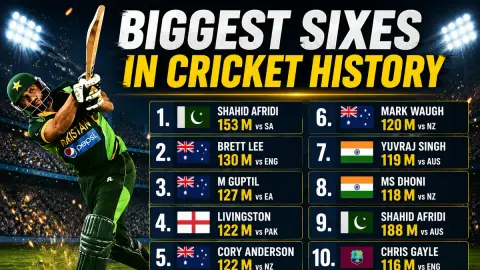
Biggest Sixes in Cricket History: The Longest Hits Ever Recorded
Shahid Afridi's 153m strike in Johannesburg tops most lists of the biggest sixes in cricket history. See the full leaderboard, the disputed measurements, and who's still chasing the record in 2026.
Longest Six in Cricket History: Shahid Afridi's Disputed 153m Claim, Ranked
Shahid Afridi's 153–160m six at the Wanderers in 2013 is the most-cited longest six in cricket history, but independent remeasurement puts it closer to 100–120m. Every major claim from 1856 to 2026, ranked and fact-checked.
Most Test Wins as Captain in Cricket: The All-Time Leaders
Ricky Ponting, Graeme Smith, and Steve Waugh lead the way for most Test wins as captain. See the all-time leaders in Test match victories as skipper.