
How Are Soccer Balls Made? Construction Explained Step by Step
On this page5
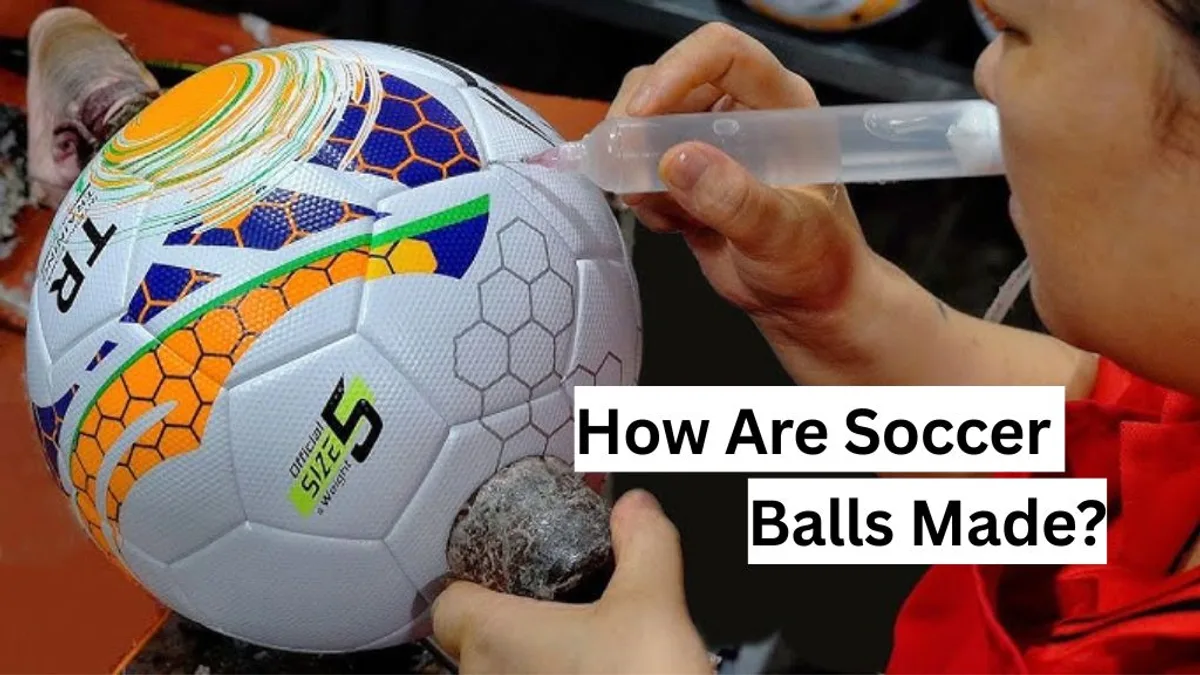
Most of the footballs used in professional matches worldwide still pass through the hands of workers in Sialkot, Pakistan, who stitch panels together the same way it’s been done for decades, alongside newer factories that weld panels with heat instead of thread. Both methods start from the same three parts: an outer casing, several inner lining layers, and a rubber bladder that holds the air.
The three core components
Every soccer ball, from a five-dollar playground ball to a World Cup match ball, is built around the same structure.
1. The outer casing
The visible exterior is synthetic leather, either polyurethane (PU) or polyvinyl chloride (PVC). PU costs more but gives a softer touch, resists water better, and performs more consistently, so match-quality balls use it. PVC is harder and cheaper, which is why it shows up in training and recreational balls.
2. The lining layers
Between the casing and the bladder sit several layers of polyester or cotton fabric. They do three jobs: hold the ball’s shape, determine how it responds to a kick, and keep it spherical under pressure. Higher-end match balls stack more of these layers than budget ones.
3. The bladder
This is the inflatable core. Most bladders are butyl rubber, which holds air longer, or latex, which feels softer off the foot but loses pressure faster and needs topping up more often. Some players notice the difference immediately; most don’t.
Panel designs and aerodynamics
| Design | Panels | Used in |
|---|---|---|
| Classic 32-panel | 20 hexagons + 12 pentagons | Traditional match and training balls |
| Modern reduced-panel | 6–14 thermally bonded panels | FIFA World Cup match balls (2006+) |
| Synthetic seamless | Continuous bonded surface | Some training and futsal balls |
Adidas moved away from the 32-panel design with the +Teamgeist in 2006, switching to fewer, larger panels to make the ball’s flight more aerodynamically consistent. Not everyone welcomed it: several goalkeepers argued the new balls actually moved less predictably in the air.
Step-by-step: how a ball is made
- Cutting — outer casing material is cut into panel shapes with die-cut tools or lasers
- Printing — panels get colors, logos, and patterns before assembly
- Laminating — lining layers are bonded to the inside of each panel
- Stitching or bonding — panels are joined by hand (nylon thread through pre-punched holes) or by thermal bonding (heat-welded, no thread)
- Bladder insertion — the rubber bladder goes in through the last opening
- Inflation and quality check — the finished ball is inflated and checked for shape, circumference, weight, and pressure retention
FIFA quality standards
FIFA certifies balls at two levels. FIFA Quality covers training and lower-level competition. FIFA Quality Pro is the standard for professional matches, tested for weight, circumference, rebound, water absorption, shape retention, and pressure loss. Only balls carrying the Pro certification can be used in FIFA-sanctioned competitions.
Where soccer balls are manufactured
Sialkot, Pakistan has supplied a large share of the world’s hand-stitched footballs for decades, and it remains the center of that trade. Automated, thermally bonded production has grown fastest in China, where the process needs fewer skilled hands per ball.
Frequently asked questions
What materials are used to make a soccer ball?+
Modern soccer balls use a polyurethane (PU) or PVC outer casing, multiple layers of polyester or cotton lining, and an inner rubber or latex bladder. Top-match balls use high-quality PU for better touch and durability.
How many panels does a traditional soccer ball have?+
The classic soccer ball design uses 32 panels — 20 hexagons and 12 pentagons — arranged to form a near-perfect sphere. Modern balls sometimes use fewer panels with different geometries to influence aerodynamics.
Are soccer balls still hand-stitched?+
Many balls, including those used in professional matches, are still hand-stitched for quality and consistency. Some manufacturers also use machine-stitched or thermally bonded (seamless) construction for match balls.
Sources
Play & tools
Free browser games and tools — no account, no download.
- Play 38-0 — Sign a 4-4-2 of all-time football legends and chase a perfect 38-0 league season — perfect, not just unbeaten.
- Explore all our games →
Related football guides
View all →
11v11 Soccer Formations: The Full-Sided Guide to Every Shape
11v11 soccer formations explained: how full-sided lineups work, the most common shapes (4-4-2, 4-3-3, 4-2-3-1, 3-5-2, 5-3-2), and how to pick one.
7v7 Soccer Formations: Best Youth Shapes for U9/U10 Explained
The best 7v7 soccer formations for youth teams are 2-3-1, 3-2-1, 2-1-2-1, 3-1-2, and 1-3-2 — each suited to a different style of U9/U10 play.
9v9 Soccer Formations: Best Youth Shapes for U11/U12 Explained
The best 9v9 soccer formations for youth teams are 3-3-2, 3-2-3, 2-4-2, 3-4-1, and 2-3-3 — here's how each one lines up and which fits your squad.
High Press in Soccer: What It Is and How It Works
High press in soccer explained: how teams trap opponents deep, key triggers, man vs zonal systems, and why Klopp, Guardiola and Bielsa built careers on it.
Inverted Fullback Explained: What It Means in Soccer Tactics
What is an inverted fullback in soccer? Learn how the role works, why Pep Guardiola popularized it, and which players do it best.
Low Block in Soccer Explained: Meaning, Setup, and Examples
A low block in soccer is a defensive shape where a team drops deep into its own third, staying compact to deny space near goal. Setup, examples, how to beat it.