
How to Juggle a Soccer Ball: Step-by-Step for Beginners
On this page8
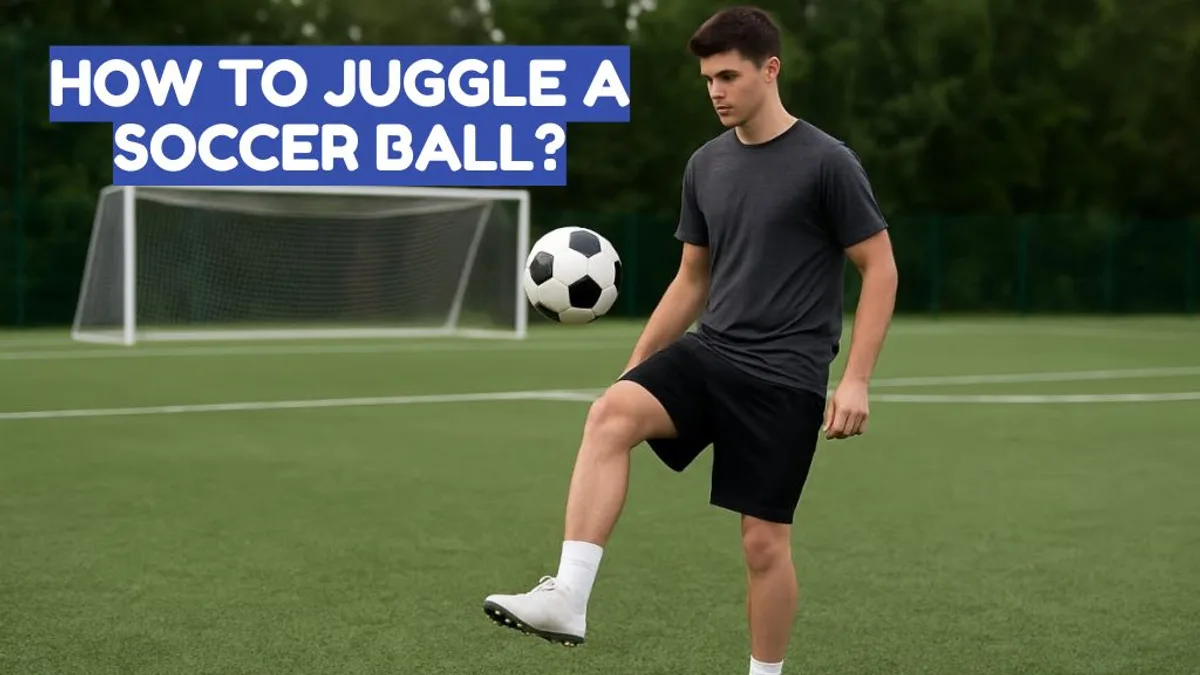
Most kids who grow up chasing a ball around a yard learn to juggle by accident, kicking it up against a wall, chasing it down, doing it again until something clicks. If you’re picking it up on purpose, you can skip a lot of that trial and error by starting with a bounce instead of a drop, and by resisting the urge to string touches together before your first one is reliable.
What You Need
- A size 4 or 5 soccer ball, properly inflated
- Flat ground, ideally with a wall nearby
- Soccer cleats or flat-soled shoes (bare feet on grass works fine too)
Step 1: The Drop-and-Catch Method
This is where every beginner should start.
- Hold the ball at waist height with both hands.
- Drop it and let it bounce once.
- As it rises, strike it with the laces of your dominant foot, sending it back up to waist-to-chest height.
- Catch it.
- Repeat until the motion feels natural and consistent.
Keep your foot flat, toes up slightly, ankle locked, so the ball pops straight up instead of squirting sideways.
Step 2: No-Bounce Juggling
Once you can reliably pop the ball up off a bounce, take the bounce away:
- Hold the ball at waist height.
- Drop it directly onto your foot without letting it bounce first.
- Kick it up and catch it.
The timing here is tighter than it looks. Don’t rush past this stage just to say you’ve moved on.
Step 3: Two Touches in a Row
Try two touches before you catch. The second one is almost always harder than the first, since you have less say over where the ball lands the second time. Keep your eyes on the ball the whole way.
Step 4: Alternate Feet
Once you can string together 5 to 10 touches on your dominant foot, start mixing in your weaker one. A simple pattern to build from is dominant, weaker, catch. Reliable two-footed juggling is a real milestone, not a small one.
Step 5: Add Thigh and Head
Bringing in other body parts is what makes juggling actually useful on the field, not just a party trick.
| Body Part | Technique | Common Mistake |
|---|---|---|
| Laces (foot) | Flat, locked ankle; toes pointed slightly up | Toe-poking the ball, causing it to fly |
| Thigh | Flat thigh surface, absorb on contact | Letting thigh drop too fast, ball dies |
| Chest | Lean back slightly, let ball rebound off chest | Stiffening up, no cushioning |
| Head | Forehead, eyes open, use neck muscles | Closing eyes on contact |
Common Juggling Mistakes and Fixes
Ball flying sideways: your foot is angled wrong. Keep the striking surface pointing straight up.
Ball going too high: you’re kicking too hard. Use a lighter touch; the goal is controlled repetition, not height.
Losing the ball quickly: you’re not tracking it with your eyes. Watch the ball, not your feet.
Weak foot feels impossible: that’s normal for almost everyone. Give it its own practice sessions instead of treating it as an afterthought.
A Simple Weekly Practice Plan
- Days 1 to 3: drop-and-catch method, 50 reps per session
- Days 4 to 7: no-bounce juggling, aim for 5 in a row before catching
- Week 2: push for 20 consecutive touches on your dominant foot
- Week 3 onward: alternate feet, bring in the thigh, track your personal best daily
Frequently asked questions
How long does it take to learn to juggle a soccer ball?+
Most beginners can achieve 10 consecutive juggles within a few weeks of daily practice. Reaching 100 or more consistently can take a few months, depending on how often you train.
What part of the foot should you use to juggle?+
The laces (instep) area is most common for juggling because it provides a large, flat surface. Thighs, chest, and head are also used once you are comfortable with basic foot juggling.
Does juggling a soccer ball improve your game?+
Yes. Juggling builds first-touch sensitivity, foot-eye coordination, and comfortable ball control under pressure — all of which translate directly to match performance.
Sources
Play & tools
Free browser games and tools — no account, no download.
- Play 38-0 — Sign a 4-4-2 of all-time football legends and chase a perfect 38-0 league season — perfect, not just unbeaten.
- Explore all our games →
Related football guides
View all →
What Is Trapping in Soccer? Ball Control Techniques Explained
Trapping in soccer means using part of the body to receive and bring a moving ball under close control. Learn the main techniques and why they matter.
How to Shoot a Soccer Ball: Technique, Power & Accuracy
To shoot a soccer ball with power and accuracy, plant your standing foot beside the ball, strike through the laces, and follow through to your target.
How Are Soccer Balls Made? Construction Explained Step by Step
Soccer balls are made by stitching or bonding panels around an inflatable bladder, using layered synthetic materials for the right shape, feel, and flight.
Soccer Ball Weight and Pressure: Official FIFA Standards
A FIFA-approved match ball must weigh 410 to 450 grams and be inflated to 0.6-1.1 atmospheres (8.5-16 psi) at sea level under the Laws of the Game.
Callum Osmand Scores Twice in Two Minutes on First Start as Celtic Beat Hearts 7-1
Callum Osmand scored twice in two minutes on his first Celtic start in a 7-1 win over Hearts, then came off at half-time with a hamstring precaution.

Bernal Headbutts Yamal Twice and Faces a 12-Match Ban as Barcelona Beat Betis 5-2
Facundo Bernal was sent off for headbutting Lamine Yamal twice in Barcelona's 5-2 win at Real Betis, and the referee's report puts him under a 4-to-12 match tariff.