
The Hardest Golf Courses in the World, Measured
On this page7
- 01Three ways to measure hard, and why they conflict
- 02Oakmont: the strongest evidence in golf
- 03The Ocean Course: hardest on paper
- 04Carnoustie: hard in a way no rating captures
- 05Bethpage Black: the hardest one you can just book
- 06Ko’olau: hard in a way professionals never test
- 07Hard is not the same as great
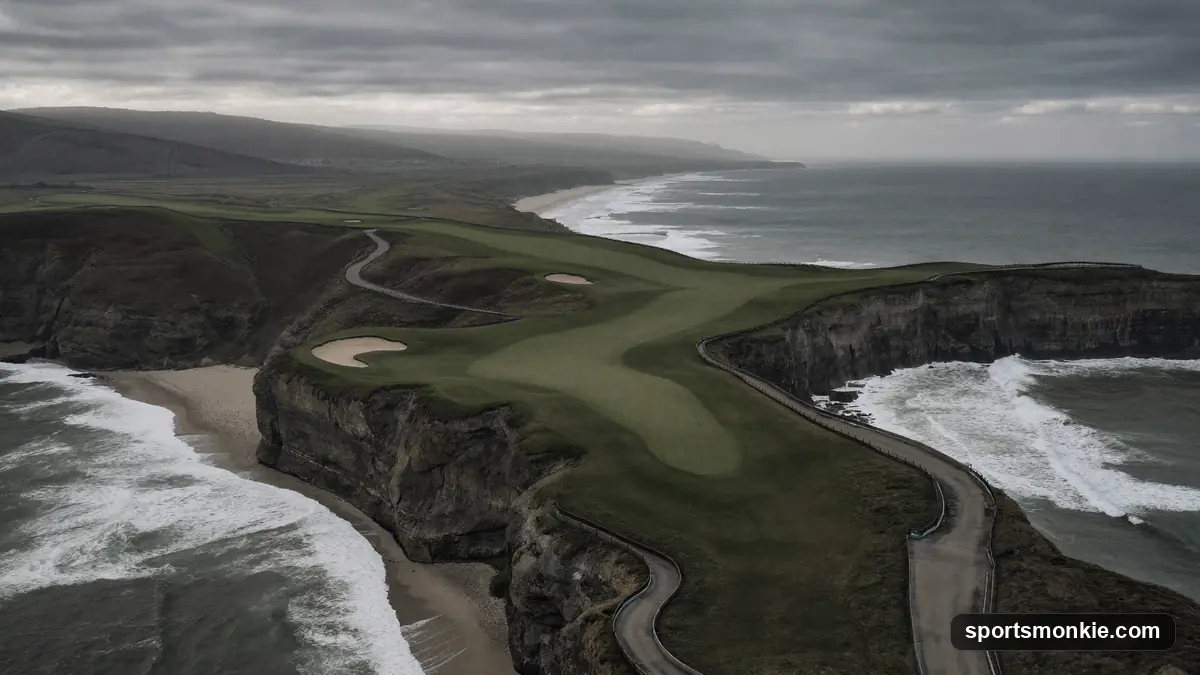
The hardest golf courses in the world are Oakmont, the Ocean Course at Kiawah Island, Carnoustie, Bethpage Black, Pine Valley and Ko’olau — but which one tops the list depends entirely on which measure of “hard” you use, and most lists never say.
There are three defensible measures, they disagree with each other, and the honest approach is to run all three.
Three ways to measure hard, and why they conflict
1. USGA Course Rating and Slope. The official difficulty assessment, done by trained rating teams. The problem: Slope Rating is capped at 155, so the very hardest courses all bunch at the ceiling and become indistinguishable. Ratings also assume normal conditions, which flatters links courses whose defence is wind.
2. Championship scoring evidence. How professionals actually score, in tournaments, with the course set up at its most severe. This is the most objective measure available, but only a few dozen courses in the world have ever hosted an event that generates the data.
3. What it does to an ordinary golfer. Forced carries, blind shots, lost balls, unplayable rough. This is what most people mean by “hard” and it correlates poorly with the other two — a course can be brutal for a 20-handicapper and a birdie-fest for a professional.
The table below scores each course against all three.
| Course | Country | Rating evidence | Championship evidence | Amateur brutality |
|---|---|---|---|---|
| Oakmont | USA | High | Strongest in golf | Severe |
| Ocean Course, Kiawah | USA | 79.6 / 155 | 2012 & 2021 PGA Championships | Severe, wind-dependent |
| Carnoustie | Scotland | Moderate (wind excluded) | +6 won the 1999 Open | Severe in wind |
| Bethpage Black | USA | High | 2002 & 2009 U.S. Opens, 2025 Ryder Cup | Severe, and public |
| Pine Valley | USA | Very high | Amateur events only | Severe |
| Ko’olau | USA (Hawaii) | ~75.7 / 152 | None | Extreme — lost balls |
Oakmont: the strongest evidence in golf
If one course has to be first, Oakmont has the receipts.
At the 2025 U.S. Open, J.J. Spaun won at 1-under 279 and was the only player in the field to finish under par. The opening round played to a scoring average of 74.64 on a par 70 — more than four shots over par, the toughest opening day at a U.S. Open since Shinnecock Hills in 2018.
Why Oakmont does this to the best players in the world comes down to three things working together. The greens are enormous, severely contoured and run faster than the players see anywhere else, which turns a routine 20-footer into a genuine three-putt risk. The rough is grown to a length that removes any option except a wedge back to the fairway. And the bunkering, including the famous church-pew formation between the third and fourth fairways, is positioned exactly where a good drive that leaks slightly finishes.
The key detail is that Oakmont needs no gimmick. No forced carries over water, no island greens. It is simply a course where every single shot has a correct answer and a large penalty for any other one.
The Ocean Course: hardest on paper
Pete Dye’s Kiawah Island layout carries a Course Rating of 79.6 and a Slope Rating of 155 from the championship tees — one of the highest combinations in the United States, and 155 is the maximum the system allows.
The design decision that makes it: Dye raised the entire course so that every hole sees the ocean, which also means every hole feels the wind. It is a genuinely different golf course depending on whether the wind blows off the sea or off the land, and the rating reflects the hard version. It hosted the 1991 Ryder Cup and the 2012 and 2021 PGA Championships.
For an amateur, the punishment is specific: sandy waste areas everywhere, no defined boundary between fairway and trouble, and a series of long forced carries into wind that a 90s-shooter cannot make.
Carnoustie: hard in a way no rating captures
Scotland’s Carnoustie has the single most damning scoring line in modern major golf. At the 1999 Open Championship, Paul Lawrie won at six over par, 290 — the highest winning total at an Open in half a century — after Jean van de Velde took seven at the 72nd hole from three shots clear.
Its Course Rating does not look extraordinary, and that is the point. Carnoustie’s defence is wind, gorse, out-of-bounds down the right of the closing stretch, and the Barry Burn crossing the 18th fairway twice. None of those things register properly in a rating done on a calm day.
The lesson generalises to every great links: Royal County Down, Royal Portrush, Muirfield and Royal Birkdale all rate more modestly than they play. Wind is the variable that no difficulty system handles well.
Bethpage Black: the hardest one you can just book
The first tee at Bethpage Black in New York carries a sign that has become the most photographed piece of signage in golf: “WARNING — The Black Course Is An Extremely Difficult Course Which We Recommend Only For Highly Skilled Golfers.”
It means it. When Tiger Woods won the 2002 U.S. Open there he finished at three under and was the only player in the field under par — the same signature as Oakmont. It hosted the U.S. Open again in 2009, the PGA Championship in 2019 and the Ryder Cup in 2025.
What makes it unusual is that it is a New York State public course. No membership, no resort package, a public tee sheet and a famous overnight queue for walk-up times. Every other course on this list requires money or an invitation. This one requires patience.
Ko’olau: hard in a way professionals never test
Ko’olau Golf Club on Oahu, cut into rainforest at the foot of the Ko’olau range, is rated around 75.7 / 152. It has never hosted a professional championship and it does not need to. Its reputation rests on ravines: shots that miss the corridor are not in the rough, they are gone, and the received wisdom among locals is to bring more balls than you think you can lose.
This is the third measure in isolation — a course that would probably not trouble a tour field enormously but which is close to unplayable for a mid handicapper. Worth including precisely because it shows how different the three measures are.
Hard is not the same as great
Two closing judgements, offered as opinion rather than fact.
First, difficulty is mostly a setup choice. Oakmont for a member game with sensible pins and normal rough is a hard but reasonable golf course. Oakmont in U.S. Open configuration is a different animal. Almost every course on this list has a version that a good club golfer could enjoy from the right tees, and our guide to what tees you should play from makes the case for choosing them.
Second, the world’s best courses are not on this list, and that is deliberate. Australia’s Melbourne sandbelt — Royal Melbourne, Kingston Heath — regularly ranks among the finest golf on earth while being entirely playable for an amateur, because its defence is angles and greens rather than length and rough. Hard and good are different axes. Anyone building a bucket list from difficulty alone will have a miserable and expensive trip.
If you want the mechanics behind the ratings quoted here, our explainer on slope rating and course rating sets out how the numbers are produced and why 155 is a ceiling rather than a measurement.
Freshness note: championship scoring figures are fixed historical results; Course Rating and Slope figures are re-issued periodically by regional rating bodies and were checked in July 2026.
Frequently asked questions
What is the hardest golf course an ordinary golfer can actually book?+
Bethpage Black is the strongest answer. It is a New York State public course with a public tee sheet, a genuine U.S. Open and Ryder Cup venue, and no membership requirement. The Ocean Course at Kiawah is harder on paper but sits behind resort pricing, which changes who can realistically play it.
Does bad weather make a course harder than its rating suggests?+
Enormously, and ratings barely capture it. Course Rating and Slope are assessed under normal conditions, so a links course rated in still air plays several strokes harder in a 30 mph wind. This is why Scottish and Irish links courses rate lower than their reputations and still ruin scorecards.
Which is the hardest hole in championship golf?+
There is no single agreed answer, but scoring data at the majors consistently points to long par fours into prevailing wind rather than famous par threes. Tournament organisers publish hole-by-hole scoring averages each round, which is the only defensible way to rank individual holes rather than reputation.
Are the hardest courses also the best courses?+
Rarely the same list. Course ranking panels weight strategy, variety and setting, and several of the highest-ranked courses in the world are eminently playable for a mid handicapper from the correct tees. Difficulty is a setup choice; quality is a design property. Australia's sandbelt courses are the clearest example of hard-but-fair.
Why do so many courses share a slope rating of 155?+
Because 155 is the maximum the World Handicap System allows. Any course whose calculated figure exceeds the cap is simply recorded at 155, so the scale compresses at the top. That is why slope alone cannot separate the hardest handful and why tournament scoring evidence has to do the work.
Sources
Play & tools
Free browser games and tools — no account, no download.
- Play today's Sports Connections — Today's Sports Connections — daily hints, answers, and play the grid.
- Play Guess the NFL Player — A new mystery NFL player every day. Eight guesses, with a clue on each — plus free unlimited mode.
- Explore all our games →
Related golf guides
View all →
Slope Rating Explained: Course Rating vs Slope
Slope rating measures how much harder a course plays for a bogey golfer than a scratch golfer. The 55-155 scale, the 113 baseline and a worked example.
Why Do Golf Courses Have 18 Holes?
Why do golf courses have 18 holes? It traces back to St Andrews, not a whisky bottle. The real history of golf's 18-hole standard, explained.
Why Golf Courses Aerate Greens (and When)
Golf courses aerate greens to relieve soil compaction, remove thatch and get air and water to the roots. Here is why it is done, how often, and when.
The Longest Golf Courses in the World
The longest golf course in the world is Australia's Nullarbor Links at 1,365 km. The longest conventional 18-hole course is Jade Dragon in China at 8,548 yards.
The Oldest Golf Courses in the World
The oldest golf courses in the world sit in Scotland: Musselburgh Old Links has documented play from 1672, while St Andrews traces golf to the 1400s.

McIlroy Says Yes to LIV Players Coming Back to the PGA Tour
Rory McIlroy, LIV's loudest critic since 2022, told a New Delhi forum he would vote to welcome its players back, called LIV half a good idea and said the threat is over.