
Why Do Golf Courses Have 18 Holes?
On this page5
Golf courses have 18 holes largely because of the Old Course at St Andrews in Scotland, the most influential course in the sport’s history. In 1764 St Andrews reformed its layout into 18 holes, and because it was golf’s leading authority, other clubs followed suit until 18 became the accepted standard for a full round.
In other words, there is nothing magic about the number 18. It is a historical convention, not a law of the game, and it spread by the example of one course rather than by any grand design. And no, it has nothing to do with the number of shots in a bottle of whisky, that is a well-worn myth. Here is the real story of how golf settled on 18 holes.
The St Andrews origin
St Andrews did not always play 18 holes. In its early days the course ran over a different number, with players heading “out” along the linksland and then back again. In 1764 the club reorganized the layout, combining several short holes, and arrived at the 18-hole configuration we would recognize today.
That decision might have stayed a local quirk, except that St Andrews was no ordinary course. As the game’s most prestigious home, its practices carried enormous weight, and when St Andrews played 18, other clubs took that as the model to imitate. Over time, 18 hardened from one course’s choice into the sport’s default. Our guide to the oldest golf courses in the world sets St Andrews in the wider history of how the game took shape.
Why other courses copied it
Standards spread through authority, and in early golf the authority was St Andrews. As formal competition grew and clubs looked for a consistent format, following the recognized home of golf was the natural thing to do. There was never a single worldwide rule declaring “all courses shall have 18 holes”; instead, the number became universal because the sport’s most respected institution used it and everyone else fell in line.
This is why 18 feels inevitable today even though it began as a convention. Once the leading tournaments and clubs settled on 18, the format locked in, and a “full round” came to mean 18 holes almost everywhere.
Busting the whisky-bottle myth
You will often hear that golf has 18 holes because a bottle of Scotch contains enough for one shot per hole, so a golfer finished the bottle as he finished the round. It is a charming story and completely untrue. There is no historical evidence for it, and the real reason is the far more mundane St Andrews reorganization of 1764. The myth persists because it is memorable, but it is folklore, not fact.
18 holes is a standard, not a rule
It is worth stressing that 18 is a convention, not a requirement of the game. Plenty of golf is played over other hole counts.
| Format | Holes | Notes |
|---|---|---|
| Standard full round | 18 | The accepted norm for competition |
| Nine-hole course | 9 | Played once for a short round, or twice for 18 |
| Executive / par-three course | Varies | Shorter layouts for quicker play |
| Casual short game | 9 or fewer | Common when time is limited |
Many courses have just nine holes, which golfers play once for a quick round or twice to complete a full 18. So while 18 is the standard, it is entirely normal to play nine. Our guides to how long 18 holes of golf takes and how long nine holes takes cover the time commitment for each.
What 18 holes means for players
Settling on 18 shaped almost everything about how golf is played and measured, from par totals to round times to how far you cover on foot. A standard 18-hole round is a serious walk, our explainer on how far you walk in 18 holes of golf puts real distance to it, which is part of why the format feels like a complete athletic outing rather than a quick game.
Understanding that 18 is a St Andrews inheritance also helps explain golf’s deep respect for tradition: the number endures not because it is optimal, but because the game chose to honor the way its founding course was laid out.
The short version: golf courses have 18 holes because the Old Course at St Andrews reformed its layout into 18 in 1764, and as the game’s leading authority its example was copied until 18 became the universal standard. It is a historical convention, not a rule of nature, and it has nothing to do with a whisky bottle.
Frequently asked questions
Has anyone ever birdied all 18 holes?+
No golfer has ever recorded a birdie or better on all 18 holes in a top professional round. The closest anyone gets is shooting a 58 or 59, scores that involve a huge number of birdies but still not one on literally every hole. Birdieing all 18 would require perfection across an entire round against par, which has never happened at the elite level. It remains one of golf's theoretical limits rather than an achieved feat.
How did they decide on 18 holes for golf?+
The 18-hole standard traces back to the Old Course at St Andrews. The course was reformed into 18 holes in 1764, and because St Andrews was the game's most influential club, other courses gradually adopted the same number until it became the norm. There was no formal worldwide decree; it spread by the example and authority of St Andrews. So the answer is essentially that golf standardized on 18 because its leading course did, not because 18 is inherently special.
What is a poor golfer called?+
A poor or unskilled golfer is often called a 'hacker' or a 'duffer' in casual golf slang. These are informal, good-natured terms rather than official designations, and they describe someone who struggles with the game rather than any specific handicap number. Golf has a rich vocabulary of nicknames like these, and 'hacker' in particular is widely used to describe a high-scoring recreational player who is out mainly to enjoy the round.
Is a full round of golf always 18 holes?+
A standard full round is 18 holes, but it is a convention, not a rule of the game. Many courses have only nine holes, which players either play once for a short round or twice to make 18. Executive and par-three courses may have different hole counts entirely. So while 18 holes is the accepted standard for a 'full' round and for most competitions, plenty of golf is played over nine holes or other formats depending on the course and the time available.
Sources
Play & tools
Free browser games and tools — no account, no download.
- Play today's Sports Connections — Today's Sports Connections — daily hints, answers, and play the grid.
- Play Guess the NFL Player — A new mystery NFL player every day. Eight guesses, with a clue on each — plus free unlimited mode.
- Explore all our games →
Related golf guides
View all →
The Oldest Golf Courses in the World
The oldest golf courses in the world sit in Scotland: Musselburgh Old Links has documented play from 1672, while St Andrews traces golf to the 1400s.

How Long Does 18 Holes of Golf Take? Real Times
How long does 18 holes of golf take? About 4 to 4.5 hours for a foursome, 3 to 3.5 for a twosome. Real times by group size, walking vs riding, and traffic.

Wind Blows Zang's Missed Putt Back Into the Hole at St Andrews
Penn senior Madeleine Zang watched her missed bogey putt stop past the hole at St Andrews, then saw a gust roll it back in for the strangest five of the week.
Adrian Meronk Cries After Dunhill Win That Secures His 2027 Card as LIV Future Stays Uncertain
Adrian Meronk broke down after winning the Dunhill Links at St Andrews, a first title since 2023 that secures his DP World Tour card for 2027.
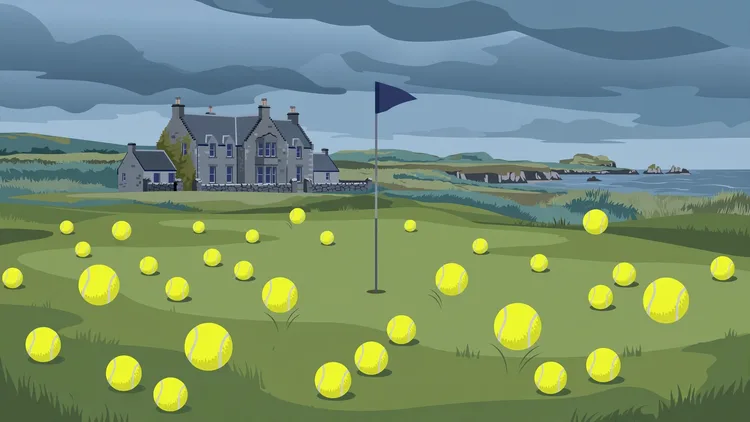
Celtic Fans Throw Tennis Balls at Owner Dermot Desmond During Dunhill Links at St Andrews
Celtic fans threw dozens of tennis balls at club owner Dermot Desmond at the Alfred Dunhill Links in St Andrews, and Celtic have severed ties with the fan group.

How Long Does 9 Holes of Golf Take? Times by Group Size
Nine holes of golf takes about 2 to 2.5 hours for a foursome, and closer to an hour on your own. See how long 9 holes take by group size and cart use.