
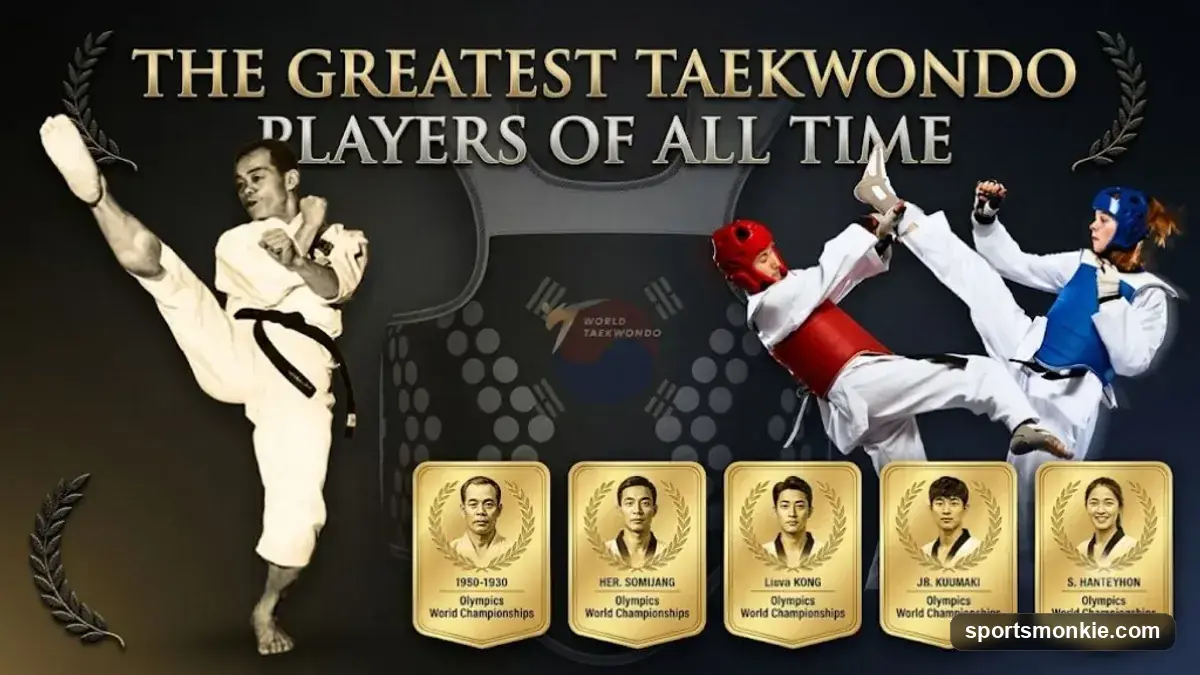
Greatest Taekwondo Players of All Time
On this page16
- 01Greatest taekwondo athletes of all time at a glance
- 02Steven Lopez (USA)
- 03Hadi Saei (Iran)
- 04Jade Jones (Great Britain)
- 05Wu Jingyu (China)
- 06Hwang Kyung-seon (South Korea)
- 07Chen Zhong (China)
- 08Panipak Wongpattanakit (Thailand)
- 09Milica Mandić (Serbia)
- 10Servet Tazegül (Turkey)
- 11María Espinoza (Mexico)
- 12How We Ranked the List
- 13At a Glance: Medal Counts
- 14How Olympic Taekwondo Is Scored
- 15Why Back-to-Back Golds Are So Rare
- 16The Athletic Profile Behind the List
Placement is earned by Olympic gold medals first, then World Championship titles, then longevity — how many Olympic cycles an athlete stayed on top through rule changes. Back-to-back golds break ties, because defending a title is far rarer than winning one.
Greatest taekwondo athletes of all time at a glance
| Rank | Athlete | Olympic record | Strongest ranking argument |
|---|---|---|---|
| 1 | Steven Lopez | 2 gold, 1 bronze | Record five men's World Championship titles |
| 2 | Hadi Saei | 2 gold, 1 bronze | Back-to-back Olympic champion and two-time world champion |
| 3 | Jade Jones | 2 gold | First British athlete to defend an Olympic taekwondo title |
| 4 | Wu Jingyu | 2 gold | Back-to-back Olympic champion in the lightest division |
| 5 | Hwang Kyung-seon | 2 gold, 1 bronze | Medalled at three consecutive Olympics |
| 6 | Chen Zhong | 2 gold | Won the first two Olympic heavyweight titles |
- Career leader
Steven Lopez (USA)
Lopez is the first taekwondo fighter to win five World Championship golds (2001, 2003, 2005, 2007, 2009), and he did it while also taking Olympic gold at Sydney 2000 and Athens 2004 plus bronze at Beijing 2008. That combination of five world crowns and two Olympic titles is why he ranks above Hadi Saei, who matched the Olympic golds but won two world titles to Lopez's five.
He competed at five straight Olympics, from Sydney 2000 through Rio 2016 — a span almost no combat athlete sustains. The Lopez family ran it as a unit, with brother Jean coaching and siblings Diana and Mark also fighting internationally.
Country: USA · Olympic: 2 gold, 1 bronze (2000, 2004, 2008) · World golds: 5 · Divisions: 67kg / 80kg
- Iran's benchmark
Hadi Saei (Iran)
Saei is Iran's most decorated Olympian in any sport, and his case rests on winning consecutive individual Olympic golds — Athens 2004 and Beijing 2008 — after a bronze at Sydney 2000. Repeat individual golds are the hardest feat in the sport, and he is one of only a handful of men to manage it. See how that stacks up on our most decorated Olympian list.
He added two World Championship golds (1999, 2005) across a career that ran more than a decade. His run built Iran into a permanent non-Korean power; an Iranian man has reached an Olympic taekwondo final in nearly every Games since.
Country: Iran · Olympic: 2 gold, 1 bronze (2000, 2004, 2008) · World golds: 2 · Division: 68kg
- Two-time defender
Jade Jones (Great Britain)
Jones is the only British taekwondo athlete to defend an Olympic title, winning the women's under-57kg gold at both London 2012 and Rio 2016. She added a World Championship title in 2019, giving her the crown Lopez and Saei each own to confirm she was more than an Olympic specialist.
Her game was built for the electronic scoring era: fast, precise head kicks that the sensors reward, rather than the forward pressure the old hand-judged system sometimes favored. That stylistic fit is what separates her from earlier British medal hopefuls who never converted at the Games.
Country: Great Britain · Olympic: 2 gold (2012, 2016) · World gold: 1 (2019) · Division: 57kg
- Flyweight wall
Wu Jingyu (China)
Wu owns one of the sport's cleanest title defenses: back-to-back flyweight (under-49kg) golds at Beijing 2008 and London 2012, then a bronze at Rio 2016 for three straight Olympic medals. She backed the Olympic run with two World Championship golds (2007, 2011), which edges her ahead of Hwang Kyung-seon on peak flyweight dominance.
For most of a decade she was the fighter every other flyweight built a game plan to beat. Her defensive range and counter timing at 49kg set the template modern flyweights still study.
Country: China · Olympic: 2 gold, 1 bronze (2008, 2012, 2016) · World golds: 2 · Division: 49kg
- Podium ever-present
Hwang Kyung-seon (South Korea)
Hwang was the first woman to win three Olympic taekwondo medals: bronze at Athens 2004, then welterweight (under-67kg) gold at Beijing 2008 and London 2012. Two World Championship golds (2005, 2007) sit alongside that.
What earns her this spot over pure two-Games champions is the span — she stayed on the Olympic podium across eight years and the switch from hand-scored judging to electronic protectors, adapting to a scoring system that rewrote how the sport is fought mid-career.
Country: South Korea · Olympic: 2 gold, 1 bronze (2004, 2008, 2012) · World golds: 2 · Division: 67kg
- First mover
Chen Zhong (China)
Chen won China's first Olympic taekwondo gold, taking the women's over-67kg title at Sydney 2000 and defending it at Athens 2004 — the sport's first two Games as a full medal event. A 2007 World Championship gold followed.
She ranks here rather than higher because her dominance predates the deep global fields of the 2010s, when Serbia, Great Britain and Thailand started producing champions. Winning the first two Olympic heavyweight titles, though, opened taekwondo as a real medal target for China.
Country: China · Olympic: 2 gold (2000, 2004) · World gold: 1 (2007) · Division: +67kg
- Modern back-to-back
Panipak Wongpattanakit (Thailand)
Panipak produced the standout recent run in the sport: under-49kg gold at Tokyo 2020 and Paris 2024, sealing the Paris final with a double head-kick. She became the first Thai athlete to win two Olympic golds and added a World Championship title in 2019.
She retired after Paris 2024, citing knee, ankle and hip injuries. Winning both golds against progressively deeper flyweight fields — the division Wu Jingyu once ruled — is what places her among the era's best rather than a one-Games winner.
Country: Thailand · Olympic: 2 gold (2020, 2024) · World gold: 1 (2019) · Division: 49kg
- Eight-year gap
Milica Mandić (Serbia)
Mandić won over-67kg Olympic gold at London 2012 and again at Tokyo 2020 — eight years apart, with a completely different set of opponents each time and a 2017 World Championship title in between. Her 2012 win was independent Serbia's first-ever Olympic gold.
That eight-year gap is what lifts her above single-golds like Servet Tazegül and María Espinoza below her: she beat one generation of heavyweights, then came back and beat the next. She retired straight after the Tokyo win.
Country: Serbia · Olympic: 2 gold (2012, 2020) · World gold: 1 (2017) · Division: +67kg
- Technical striker
Servet Tazegül (Turkey)
Tazegül won Turkey's first Olympic taekwondo gold at London 2012 in the under-68kg division, beating Iran's Mohammad Bagheri Motamed 6-5 in the final. He backed a single Olympic title with two World Championship golds (2011, 2015) and five European titles.
He sits below the two-gold champions above him because he converted only once at the Games, but his technical range — footwork and cut kicks rather than raw pressure — made him a defining stylist of the early electronic-scoring years.
Country: Turkey · Olympic: 1 gold (2012) · World golds: 2 · Division: 68kg
- Three-Games run
María Espinoza (Mexico)
Espinoza is the first Mexican woman to medal at three straight Olympics: over-67kg gold at Beijing 2008, bronze at London 2012 and silver at Rio 2016, plus a 2007 World Championship title.
One gold keeps her at the foot of this list, but three medals in three different colors across eight years is harder to sustain than a single peak, and no other Mexican taekwondo athlete has come close. She is Mexico's most decorated female Olympian.
Country: Mexico · Olympic: 1 gold, 1 silver, 1 bronze (2008, 2012, 2016) · World gold: 1 (2007) · Division: +67kg
Reader interaction
Build your ranking
Drag the names into the order you think is right — or use the arrows — then submit to see how your list compares with everyone else's.
- Steven Lopez (USA)
- Hadi Saei (Iran)
- Jade Jones (Great Britain)
- Wu Jingyu (China)
- Hwang Kyung-seon (South Korea)
- Chen Zhong (China)
- Panipak Wongpattanakit (Thailand)
- Milica Mandić (Serbia)
- Servet Tazegül (Turkey)
- María Espinoza (Mexico)
Audience ranking
How everyone ranked them
Built from reader rankings using position-based points.
A back kick to the head lands in roughly a third of a second. What separates taekwondo’s greatest from everyone else who stepped onto the mat isn’t a single kick — it’s landing them across multiple Olympic cycles, through rule changes and new generations of opponents, and still finishing on the top step.
How We Ranked the List
Elite taekwondo greatness comes down to a few measurable things, and we weight them in this order:
- Olympic gold medals — the sport’s most contested prize, awarded since Sydney 2000.
- World Championship titles — held every two years, the best proxy for dominance between Games.
- Back-to-back Olympic golds — the tiebreaker, because defending is far harder than winning once; opponents get four years to study the champion.
- Longevity — how many Olympic cycles a fighter stayed on top, especially across the early-2010s shift to electronic scoring.
That order is why a five-time world champion with two Olympic golds (Steven Lopez) edges a two-time Olympic champion with two world titles (Hadi Saei), and why a two-gold fighter with an eight-year gap (Milica Mandić) ranks above single-gold champions. Weight categories and scoring have both changed over the decades, so cross-era comparison takes some caution — but every athlete here cleared the bars the sport put in front of them.
At a Glance: Medal Counts
| Rank | Athlete | Country | Olympic Gold | World Titles | Era |
|---|---|---|---|---|---|
| 1 | Steven Lopez | USA | 2 | 5 | 2000–2008 |
| 2 | Hadi Saei | Iran | 2 | 2 | 2000–2008 |
| 3 | Jade Jones | Great Britain | 2 | 1 | 2012–2016 |
| 4 | Wu Jingyu | China | 2 | 2 | 2008–2012 |
| 5 | Hwang Kyung-seon | South Korea | 2 | 2 | 2004–2012 |
| 6 | Chen Zhong | China | 2 | 1 | 2000–2004 |
| 7 | Panipak Wongpattanakit | Thailand | 2 | 1 | 2020–2024 |
| 8 | Milica Mandić | Serbia | 2 | 1 | 2012–2020 |
| 9 | Servet Tazegül | Turkey | 1 | 2 | 2012 |
| 10 | María Espinoza | Mexico | 1 | 1 | 2008–2016 |
How Olympic Taekwondo Is Scored
Points are awarded for legal kicks and punches to the trunk and head, with more points for head kicks and spinning techniques. Since the early 2010s, electronic body protectors and headgear — the Protector and Scoring System (PSS) — detect valid contact automatically, replacing much of the ringside judging that defined the hand-scored era. That change rewarded speed and precision over forward pressure, which is why several fighters on this list, from Jade Jones to Servet Tazegül, were built for the sensor era. For where the sport sits globally, see our ranking of the most popular Olympic sports.
Why Back-to-Back Golds Are So Rare
Only a handful of taekwondo athletes have defended an Olympic title, and the reason is structural. A reigning champion becomes the most-studied fighter in the division: opponents spend four years breaking down tape, and the field resets with hungrier, younger challengers who have nothing to lose. Making weight for a second four-year cycle grinds bodies down, too — several champions here retired the moment they won their second gold. That is why our medal-weighted most Olympic gold medals and most Olympic medals lists skew toward athletes who found a way to repeat.
The Athletic Profile Behind the List
Every fighter above trained three things at once: flexibility for head-height kicks, explosive speed for reactions measured in fractions of a second, and the tactical discipline to manage points under electronic scoring. Many cross-trained in gymnastics, sprinting or other combat disciplines — the same pattern that shows up across combat-sport rankings like our greatest judo players and greatest boxers lists. The mat rewards a rare mix of gymnast’s mobility and sprinter’s burst, which is why elite taekwondo careers tend to be short and the ones that last stand out this sharply.
Frequently asked questions
Who is the greatest taekwondo player of all time?+
Steven Lopez has the strongest resume: he is the first fighter to win five World Championship golds, and he added Olympic gold at Sydney 2000 and Athens 2004 plus a Beijing 2008 bronze across five straight Games. Hadi Saei matched the two Olympic golds but won two world titles, and Jade Jones is the modern women's benchmark. Lopez's blend of peak dominance and longevity is why he tops most lists.
Has any taekwondo athlete won three Olympic gold medals?+
No individual fighter has won three. Several have won two: Steven Lopez, Hadi Saei, Chen Zhong, Wu Jingyu, Hwang Kyung-seon, Jade Jones, Milica Mandić and Panipak Wongpattanakit. Three is so hard because opponents get a full four-year cycle to study tape on the reigning champion, and weight-making across a decade grinds fighters down. Hwang and Wu got closest, each adding a bronze to two golds for three total Olympic medals.
Who is the greatest female taekwondo player ever?+
The case usually comes down to Jade Jones, Wu Jingyu and Hwang Kyung-seon. Jones is the only Briton to defend an Olympic title (2012, 2016); Wu won back-to-back flyweight golds (2008, 2012) plus two world titles; Hwang was the first woman to win three Olympic taekwondo medals. Panipak Wongpattanakit's Tokyo-and-Paris double now puts her firmly in that conversation as well.
Why are weight divisions hard to compare across taekwondo eras?+
The Olympic program uses four weight classes per gender, but the exact limits and the scoring system have both shifted. Steven Lopez fought at 67kg and 80kg under hand judging; today's fighters compete under electronic body protectors that reward different techniques. A head kick worth two points in 2004 can be worth three now. So comparing a 2004 heavyweight to a 2024 flyweight means weighing different rules, not just different opponents.
What is the difference between WT and ITF taekwondo?+
World Taekwondo (WT) governs the Olympic, full-contact sparring format built around kicks to the body and head, scored electronically. ITF taekwondo follows a separate ruleset with lighter, semi-contact sparring and more emphasis on hand techniques and patterns. The two split from the sport's early organizational history and never reunified. Every athlete on this list competed under the Olympic WT system, which is the version most people watch at the Games.
Which country has produced the most Olympic taekwondo champions?+
South Korea, as the birthplace of the sport, has produced the most Olympic and World champions historically and still leads the all-time count. But the medals have spread out: Iran, China, Great Britain, Turkey, Serbia, Mexico and Thailand have all produced Olympic gold medalists this century. That widening map is exactly why cross-era comparison is tricky — modern champions beat far deeper international fields than the pioneers of 2000 did.
Sources
Play & tools
Free browser games and tools — no account, no download.
- Play today's Sports Connections — Today's Sports Connections — daily hints, answers, and play the grid.
- Play Guess the NFL Player — A new mystery NFL player every day. Eight guesses, with a clue on each — plus free unlimited mode.
- Explore all our games →
Related records & rankings guides
View all →
Greatest Lacrosse Players of All Time
From Jim Brown to Paul Rabil, these are the greatest lacrosse players in history — ranked by dominance, legacy, and impact on the sport.

Best Pool Players of All Time: The Greatest in Billiards
The greatest pool players of all time include Efren Reyes, Earl Strickland, Ralph Greenleaf and Shane Van Boening — ranked by world titles, U.S. Open wins and longevity at the top of the pro game.
Best Volleyball Players of All Time: The Greatest Ever
A ranked look at the greatest volleyball players in history, covering legendary setters, outside hitters, and blockers who defined the sport across decades.

Greatest Judo Players (Athletes) of All Time
The greatest judo players of all time, including Teddy Riner, Yasuhiro Yamashita, and Ryoko Tani, who dominated World and Olympic podiums for decades.

Greatest Badminton Players of All Time: The Definitive List
The greatest badminton players ever, from Lin Dan and Lee Chong Wei to Susi Susanti and An Se-young, ranked by Olympic golds, world titles, and sustained dominance.
Best VNL Players: The Top Stars of the Nations League
The best VNL players, named and ranked: Wilfredo León, Yuji Nishida, Paola Egonu, Tijana Bošković, Gabi and more — with why each one made the list.