
What Is a Driving Iron? Who Should Carry One
On this page6
A driving iron is a low-lofted long iron — usually a 1-, 2- or 3-iron, around 17–20° — built stronger and more forgiving than a standard set iron and designed mainly for controlled tee shots. It produces a low, penetrating ball flight that holds its line in wind and finds tight fairways where a driver brings too much risk. Most cover 3-wood distance but fly lower and run out more.
Here is what a driving iron actually does, what it is equivalent to, and whether you should carry one.
What a driving iron is for
The driving iron solves a specific problem: hitting a long tee shot that stays in play. On a narrow hole, a doglegged hole, or a blustery links, a driver’s distance can be a liability. A driving iron trades some yards for a lower, straighter flight that is far easier to control.
It doubles as a long approach club too. Into a par-5 or a long par-4, its low trajectory lands hot and runs toward the green — useful on firm turf. The lower spin that makes it fly flat also makes it hold up in wind where a hybrid balloons.
Driving iron vs a normal iron
The key difference is construction, not just loft. A modern driving iron is usually hollow-bodied with internal weighting or tungsten in the sole, which lowers the centre of gravity and adds forgiveness a thin-bladed long iron never had. Clubs like the Titleist U-Series and TaylorMade UDI are built exactly this way.
A standard mid-iron is higher-lofted, thinner-soled and made for precise approach shots into greens, where stopping power matters more than raw distance. The driving iron is the opposite end of the set — low loft, low spin, built to launch a runner.
What is a driving iron equivalent to?
In distance, a driving iron sits alongside a 3-wood or a strong hybrid. The difference is flight and roll. This table compares the three long-club options a golfer typically chooses between.
| Club | Typical loft | Ball flight | Best for |
|---|---|---|---|
| Driving iron (2-iron) | 17–20° | Low, penetrating, runs out | Wind, tight fairways, firm ground |
| Hybrid | 19–22° | High, soft-landing | Forgiveness, holding greens |
| 3-wood | 13.5–15° | High, long carry | Maximum distance off the tee/deck |
A 2-iron and a driving iron are often the same club — but a hollow driving iron is far more forgiving than an old bladed 2-iron. For how these lofts fit the rest of the bag, see our golf club lofts chart.
Driving iron vs hybrid: which suits you?
This is the real decision for most golfers, and it comes down to swing speed and ball-striking. A hybrid launches higher and is much more forgiving on mishits, which is why the average player scores better with one. Our full hybrid vs iron breakdown covers that trade-off in detail.
A driving iron rewards the player who already strikes it well and wants a lower, more controlled flight. If you tend to hit hybrids too high, or fight a hook with them in wind, a driving iron can be the better tool. But it is less forgiving — thin it and the shot goes nowhere.
Who should carry one
Be honest about your game. A driving iron makes sense if you have a swing speed above roughly 95 mph with the driver, strike your long clubs cleanly, and play courses where control off the tee matters — links, tight tree-lined layouts, or windy conditions.
If you struggle to get long irons airborne, skip it. You will get more from a hybrid or a lofted fairway wood. The PGA of America’s fitting advice is a sensible place to confirm whether your speed suits a driving iron before you buy one.
How it fits the modern bag
Tour players brought driving irons back into fashion for firm, fast setups, and manufacturers responded with forgiving utility versions. For a skilled amateur, one driving iron can replace a 3-wood or a long hybrid at the top of the bag, giving a reliable low tee shot for the holes that demand accuracy.
Just mind the 14-club limit when you slot one in — something else has to come out. Our guide to how many clubs are allowed in a golf bag covers the rule. If you strike your long irons well and want a stinger you can trust off the tee, a driving iron earns its spot; if not, the hybrid remains the smarter carry.
Frequently asked questions
Why would you use a driving iron?+
For a lower, more controlled ball flight off the tee on tight or windy holes, and for long approach shots where you want the ball to run out. A driving iron pierces the wind better than a driver or hybrid and keeps the ball in play when accuracy matters more than maximum distance. It suits confident ball-strikers.
What is the difference between a driving iron and a normal iron?+
A driving iron is a long iron, usually a 1-, 2- or 3-iron, but built stronger and more forgiving than a standard set iron. It has a lower loft, a thicker or hollow head, and often internal weighting to launch a low-spinning shot. A normal mid-iron is higher-lofted and built for approach shots into greens.
What is a driving iron equivalent to?+
Most driving irons cover roughly the same distance as a 3-wood or a strong hybrid — often 210 to 250 yards for faster swingers — but with a lower, more penetrating flight. In loft terms a typical driving iron sits around 17–20°, close to a 2-iron and a 4- or 5-wood, though it flies lower than either.
Is a 2-iron the same as a driving iron?+
A driving iron is often a 2-iron, but not every 2-iron is a driving iron. Modern driving irons are hollow-bodied utility clubs engineered for forgiveness and low spin off the tee. A classic 2-iron from a bladed set has a thin head and is far harder to hit. The label describes the purpose, not just the number.
Sources
Play & tools
Free browser games and tools — no account, no download.
- Play today's Sports Connections — Today's Sports Connections — daily hints, answers, and play the grid.
- Play Guess the NFL Player — A new mystery NFL player every day. Eight guesses, with a clue on each — plus free unlimited mode.
- Explore all our games →
Related golf guides
View all →
What Is a Hole-in-One in Golf?
A hole-in-one is a score of one stroke on a par-three, par-four or par-five hole, although the hole's official par and format still matter.

Average Driving Distance by Age: Where Do You Stand?
The average male amateur drives it around 225 yards, peaking in the 20s and 30s and dropping roughly 30 yards by the 60s. See the full breakdown by age and handicap.
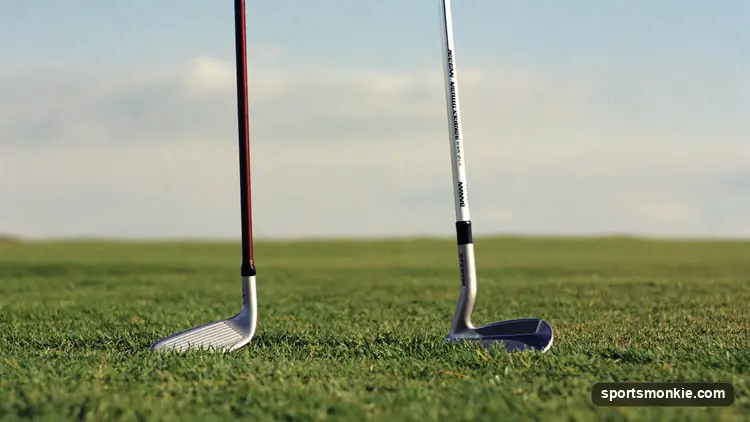
Hybrid vs Iron: When to Make the Switch
Hybrid vs iron: hybrids launch higher and are easier to hit than long irons. Here's the equivalence chart and exactly when to swap an iron for a hybrid.

Interlock vs Overlap Grip: Which Should You Use?
Interlock locks the pinky and index finger together; overlap rests the pinky on top. Interlock suits smaller hands, overlap suits most players. Here is how to choose.

Low Compression Golf Balls: Who Should Play Them and Why
Low compression golf balls (roughly 70 and under) suit slower swing speeds, seniors and beginners with a softer feel. See who should play them and top models.

What Tees Should You Play From? A No-Ego Guide
What tees should you play from? Match the total yardage to how far you hit your driver. Here is the USGA Tee It Forward chart to pick right.