
How to Win NFL Player Guessing Games: A Strategy Guide
On this page6
The fastest way to get good at any NFL player guesser is one rule: your opening guess should eliminate as many players as possible, not confirm a player you already suspect. Everything else is detail. Open with a forgettable, average player rather than a star, read the number arrows before the team, and you’ll routinely solve in four guesses instead of sweating the eighth.
This works the same on Weddle, on Griddle, and on our own Guess the NFL Player, because they all hand you the same shape of information: a hidden player, and a comparison table that tells you which direction to move after every wrong guess. Here’s how to use it properly.
Think of every guess as a question, not a shot
The mistake that keeps people on eight guesses is treating each guess as an attempt to win. It isn’t. Early on, a guess is a question you’re asking the puzzle, and a good question is one where every possible answer teaches you a lot.
This is the same idea 3Blue1Brown used to solve Wordle with information theory: the best opening isn’t the word most likely to be right, it’s the one whose result splits the remaining pool most evenly whatever the answer turns out to be. Player guessers work identically. You want the guess that, whether it comes back “taller” or “shorter,” leaves you with roughly half the field either way.
A concrete consequence: guessing Patrick Mahomes is a bad opening. He’s a distinctive, one-of-a-kind player, so “wrong team, younger, taller, more experienced” rules out almost nobody, because almost nobody looks like him anyway. A 27-year-old, six-foot-one receiver on a middling team is a far better first guess. He sits near the middle of every attribute range, so each clue that comes back genuinely halves what’s left.
Read the clues in the right order
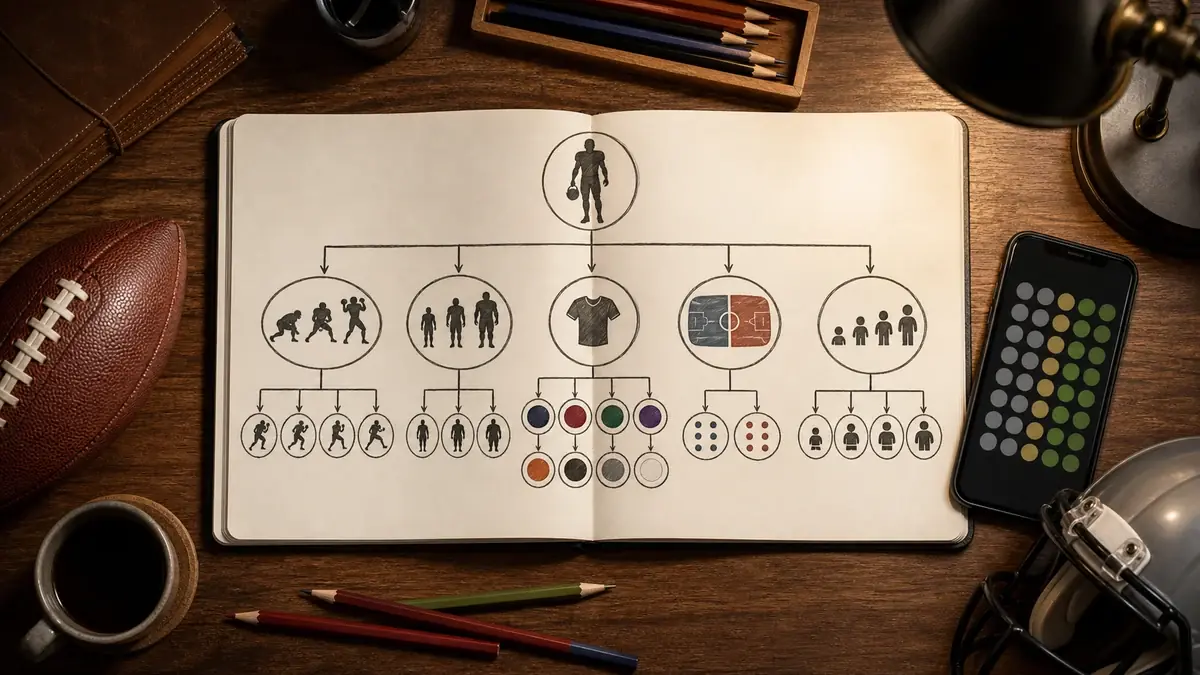
Not all clues are worth the same. Here’s what each one actually buys you, ranked by how much of the field it clears, using the attributes our game reveals.
| Clue | What it does | How much it cuts |
|---|---|---|
| Position | Drops you from every player to one position group | The biggest single cut, often ~90% |
| Height | Arrow halves the remaining pool each time | ~50% per guess |
| Age | Arrow halves it again, near-independent of height | ~50% per guess |
| Experience (years) | Another halving arrow, and it’s the one most games don’t have | ~50% per guess |
| Conference / division | ”AFC, not AFC North” clears about a third of the league | ~25–35% |
| Team | 1 of 32, so a bare “wrong team” barely moves the needle | ~3% |
The order to trust them: position first, then the numeric arrows, then conference and division, and treat the raw team clue as almost worthless on its own. Beginners fixate on the team because it feels like the most “football” clue. It’s the weakest. Thirty-two teams means “not the Bengals” removes 3% of everyone. The numeric arrows are where solving actually happens, because each one cuts the pool in half regardless of what came before.
Our game adds a column Weddle and Poeltl leave out: years of NFL experience. It behaves like a second age axis but tracks something different, because a 28-year-old can be a rookie or a seven-year veteran. Used well, it’s a free halving that the other games don’t give you.
A worked example
Say the hidden player is a veteran interior lineman. Here’s how a disciplined four-guess solve looks, versus the flailing eight-guess version.
Guess 1: an average receiver. Comes back: wrong position, shorter than target, younger than target, less experienced. You’ve just learned the answer is a taller, older, more experienced player at a different position. That one “wasted” guess eliminated most of the league.
Guess 2: a mid-tier offensive tackle. Now you’re testing the big-man hypothesis. Comes back: wrong position again but close on the arrows, right conference. You’re now inside the trenches, right side of the ball or the line, in the right conference.
Guess 3: a starting guard on a team in that conference. Right position, arrows tightening, wrong division. You’re down to a handful of names.
Guess 4: the veteran guard on the remaining division. Solved.
The flailing version guesses four favourite players in a row, learns almost nothing because they’re all distinctive, and arrives at guess seven still holding thirty candidates. Same puzzle, same clues, completely different outcome, and the only difference is that the disciplined solver spent early guesses buying information instead of taking shots.
Endgame discipline
Once you’re down to a few candidates, the strategy flips. Now you do want to guess a likely answer rather than a splitter, because there’s little field left to divide.
Keep one guess in reserve as a deliberate probe. With eight tries you can afford exactly one “wasted” guess that you know is wrong but that isolates a clue you’re missing. You cannot afford three wrong hunches back to back, which is how most busted games end.
And don’t overthink a clue the game has already handed you. If it says “older” and “more experienced,” stop reconsidering the rookies. The single most common way to lose from a winning position is re-guessing a player whose attributes you’ve already ruled out.
Where to practise this
The method above pays off most on a game with more clue columns, because every extra attribute is another halving arrow to exploit. That’s the case for Guess the NFL Player: eight attribute clues including experience, a free unlimited mode so you can drill the technique instead of waiting a day between reps, no account, and open nflverse data behind the clues so the arrows are actually correct. The unlimited mode is the part that makes practice possible, since strategy only sticks with repetition.
If you want the wider view of which games are worth your time, our NFL Wordle explainer ranks the whole genre, and for the grid-style version, which rewards recall rather than deduction, our NFL Immaculate Grid guide covers that strategy separately. They’re different skills: this one is about narrowing a field, the grid is about digging up obscure names.
The one-line version
If you remember nothing else: open average, not famous. A forgettable mid-range player asks the puzzle the most useful question, and the number arrows do the rest. The players who solve in three aren’t guessing better players, they’re guessing more informative ones.
Sources
Play & tools
Free browser games and tools — no account, no download.
- Play 17-0 — Draft nine and chase a flawless NFL regular season — the perfect 17-0 run, no playoffs.
- Play 20-0 — Draft nine and chase a perfect NFL season — regular season and playoffs, undefeated.
- Play 16-0 — Draft nine and chase a perfect 16-0 — the classic 16-game NFL regular season, no playoffs.
- Play Flawless Six — Draft five players and a head coach, then chase a perfect NFL season with the right chemistry.
- Play Guess the NFL Player — A new mystery NFL player every day. Eight guesses, with a clue on each — plus free unlimited mode.
- Play NFL Wordle — A Wordle for football — guess the daily NFL player in eight tries, with green-amber-grey feedback on every clue.
- Play NFL Connections — Sort sixteen football tiles into four hidden groups of four. A new daily puzzle, four mistakes allowed, plus unlimited mode.
- Explore all our games →
- Open the schedule simulator — Pick every 2026 NFL game and watch the standings and playoff seeds update live.
- Open the squares generator — Generate a randomized, printable Super Bowl squares grid for your party — free, no sign-up.
- Open the trade calculator — Weigh any fantasy football trade instantly — clear winner and value gap.
- Run the NFL predictor — Simulate the NFL bracket and see who your picks send to the Super Bowl.
- Open the passer rating calculator — Calculate the official NFL passer rating (0–158.3) from any passing line, with the formula shown.
- Explore all our free sports tools →
Related nfl guides
View all →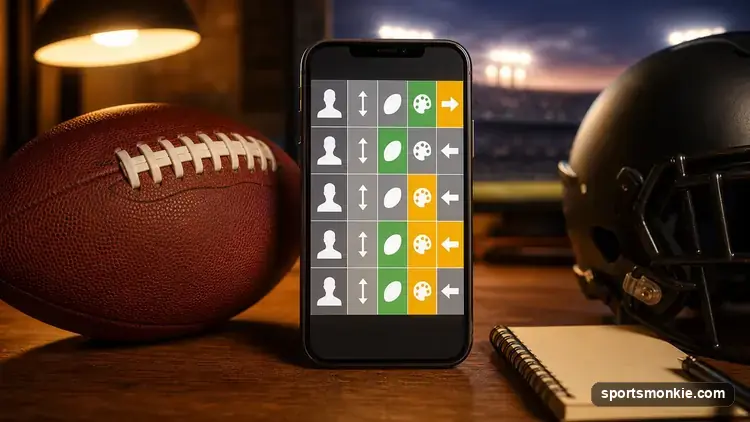
Free NFL Player Guessing Games: No Sign-Up, Unlimited
Which NFL player guessing games are actually free, need no account, and let you play unlimited? Checked live, including which ones let you replay past puzzles.
NFL Wordle: Every Real Game in the Genre, Ranked
NFL Wordle isn't one game, it's a genre label. We checked every real one live: Weddle, Griddle, Word Fumble, NFLdle. Here's which one is worth playing.

NFL Suspends Jeff Seeman for Two Games and Adrian Hill for One After Player Incidents
The NFL suspended line judge Jeff Seeman for two games and referee Adrian Hill for one game for unprofessional conduct toward players on Sunday.
NFL Immaculate Grid: Rules, Rarity Score and Real Strategy
NFL Immaculate Grid gives you nine guesses to fill a 3x3 grid. How the rarity score really works, when the grid actually resets, and how to score lower.

17-0 Alternatives: NFL and Cross-Sport Roster Games
If you've played 17-0, here's how Ball IQ's NFL mode, play20-0, First Down Studio, and the wider perfect-season genre actually compare — and what to try next.

17-0 Strategy Guide: How to Build a Roster That Actually Wins
How to approach 17-0's draft: why the quarterback-and-line combination matters more than any single skill pick, and when to spend a reroll.