
NFL Immaculate Grid: Rules, Rarity Score and Real Strategy
On this page8
- 01Who actually runs it, and where it lives now
- 02What time does the grid actually reset? Sources conflict, and here’s the truth
- 03The rules, stated plainly
- 04How the rarity score really works
- 05Why the football grid is harder than the baseball one
- 06Strategy that actually lowers your score
- 07If you like this, the adjacent format worth trying
- 08The honest verdict
NFL Immaculate Grid is a daily 3x3 puzzle where every square sits at the intersection of a row and a column, and you name one NFL player who satisfies both. Nine squares, nine guesses, no player used twice. It’s run by Sports Reference, the company behind Pro-Football-Reference, and it’s free. The part most people get wrong is the scoring: you’re not trying to score high, you’re trying to score low.
Who actually runs it, and where it lives now
The grid was built by Brian Minter, an Atlanta software engineer, and the first one went live on April 4, 2023 as a baseball puzzle. Sports Reference bought it on July 11, 2023, and the football version launched nine days later, on July 20. Basketball, hockey, women’s basketball and a soccer edition called Immaculate Footy followed within weeks, according to Wikipedia’s record of the game.
Two things changed since, and both are worth knowing because stale guides still get them wrong.
First, the address moved. In September 2025 Sports Reference folded the game into its own domain. The old immaculategrid.com URLs now 301-redirect to sports-reference.com/immaculate-grid/football, which we verified directly. Old links still work. They just don’t land where they used to.
Second, the ownership rumour. In October 2025 Religion of Sports, the production company co-founded by Tom Brady and Michael Strahan, picked up rights to develop a TV game show from the format. That is a licensing deal for a show, not a sale. Sports Reference still runs the game, and it’s still free and still daily.
What time does the grid actually reset? Sources conflict, and here’s the truth
This is the single most-argued detail about the game, so it’s worth being precise.
Grids originally premiered at midnight. On July 20, 2023, Sports Reference announced that from July 26 new grids would launch at 9:00 a.m. ET instead, with a refreshingly human reason: so staff wouldn’t have to pull all-nighters to fix problems. That announcement is the last primary statement from the operator that we can find, and no later announcement of another change exists.
So where does “6 a.m. ET” come from? It’s everywhere, and it doesn’t trace back to Sports Reference. The guides repeating it are either dated before the July 2023 change or are describing a different game entirely. Unofficial grid clones each set their own reset times, and their reset times get copied into articles about the official one. Sports Reference’s own pages block automated checking, so we can’t read today’s live time off the page, and we’d rather say that than pretend.
The practical version: if you’re in the UK or Australia, don’t set an alarm off a number you read in a blog. Load the grid, note the grid number, and see when it increments. That’s the only reset time that’s true for you.
The rules, stated plainly
- Nine guesses total. One per square. A wrong guess burns a guess and the square stays empty.
- No player twice. Each name can only be used once per grid.
- Eligibility is one game. For a team header, the player needs to have appeared in at least one regular-season or playoff game for that franchise. Not a start, not a snap count, one game.
- Career stats are career-wide. If a square asks for a team plus a career statistical threshold, the player needs the stat at some point in his career and one game for that team. The two don’t have to have happened together.
- Champion headers are season-specific. For a Super Bowl champion header paired with a team, the player has to have appeared for that team during the winning season. If you’re fuzzy on which seeds and rounds produce a champion, our guide to the NFL playoff format covers the bracket itself.
- Looking things up isn’t cheating. There’s no rule against it. The game is powered by Pro-Football-Reference, and half the fun is that the answer key is public.
Headers come in two flavours: the 32 franchises, and category headers such as career yardage thresholds, Pro Bowl and All-Pro selections, draft position, college, and Super Bowl champions. A team-versus-team square is a career-path question. A team-versus-category square is a roster-history question. They reward different memories.
How the rarity score really works
Sports Reference added the rarity score in late June 2023 with a one-line summary: the lower, the better.
Here’s the mechanic. When you fill a square correctly, the game tells you what percentage of everyone else who played that grid put the same player there. Your rarity score is the sum of those nine percentages. Every square you leave empty scores a flat 100.
That flat 100 is the whole game, and it’s the thing casual players miss. Consider the maths:
| Outcome | Rarity contribution |
|---|---|
| Correct, and 42% of players picked the same guy | 42 |
| Correct, and 3% picked the same guy | 3 |
| Empty square (wrong guess or no guess) | 100 |
| Worst possible grid (all nine empty) | 900 |
| Best realistic grid (nine deep cuts) | under 50 |
A perfect nine-for-nine grid of obvious answers can score worse than 400. A nine-for-nine grid of genuinely obscure answers can beat 100. Same “immaculate” result, wildly different score. Anything under 200 with all nine filled is a good day.
The design lesson is that this is golf, not trivia. Sports Reference borrowed the scoring shape from golf deliberately, and the reason it works is that it converts a puzzle with a ceiling into one without a floor. Once you’ve filled nine squares you’ve stopped competing against the grid and started competing against everyone else’s obviousness.
Why the football grid is harder than the baseball one
Baseball came first and it’s still the biggest version, roughly half the game’s traffic. It’s also easier, for a structural reason: baseball players move constantly, careers run twenty years, and a journeyman reliever can rack up eight franchises. Team-versus-team squares have deep answer pools.
NFL careers are short. The average is a handful of seasons, rosters turn over hard, and a player who appeared for both the Chargers and the Jaguars is a much thinner category than the baseball equivalent. That squeezes the answer pool on team-versus-team squares, which is why a two-team NFL intersection often has a handful of viable names and everyone lands on the same one.
Which has a consequence: on NFL grids, the rarity gap between the popular answer and the deep cut is bigger than it looks. If only six players ever suited up for both franchises and 60% of the field picks the famous one, the fifth-most-famous name is worth roughly 55 points to you.
Strategy that actually lowers your score
Fill first, optimise second. A 100-point empty square costs more than almost any bad-but-correct answer. If you have one certain name and one clever name, take the certain one. Chasing rarity into a wrong guess is the most expensive mistake in the game.
Solve the hardest square first, while your guesses are cheap. Most people work left to right and arrive at the brutal intersection with one guess left and no room to be wrong. Scan all nine, identify the one square where you have exactly one candidate, and place it before your remaining flexibility is gone.
Practice squads and one-game cameos are free rarity. The one-game eligibility rule is the most under-used thing in the ruleset. Everyone thinks about who starred for a team. Almost nobody thinks about the veteran who was there for six weeks at the end of a career. Those are the 2% answers.
Backups over Hall of Famers on stat headers. A “team plus 10,000 career passing yards” square makes everyone think of the franchise legend. The backup quarterback who passed through for one season and earned his yardage elsewhere satisfies exactly the same criteria for a fraction of the percentage.
Don’t spend rarity on a square that has no depth. Some intersections have three valid answers in history. Take the one you’re sure of and bank the guess. Save your ambition for the squares with a hundred candidates, where the rarity spread is wide enough to be worth hunting.
Know your headers’ era. Category headers such as Pro Bowl selections and draft rounds span the entire history of the league. Team headers do too. If you only think about the last decade, you’re playing with 10% of the answer pool and picking from the same names as everyone else.
If you like this, the adjacent format worth trying
The grid tests breadth: who was where, across the whole history of the league. The other big daily NFL format tests deduction instead, and it’s a genuinely different exercise.
We run Guess the NFL Player, which is not a grid and doesn’t try to be. You get eight guesses at one hidden player, and each guess returns attribute clues, so you narrow the field by inference rather than by recall. There’s a daily puzzle and a free unlimited mode with no account, which is the one thing the grid deliberately doesn’t offer. It won’t scratch the same itch as a 3x3, but if what you actually enjoy is the daily-NFL-puzzle habit, it’s the same habit in a different shape. The rest of our free sports games live in the same place.
The honest verdict
NFL Immaculate Grid is the best-built game in this category, and the reason is boring: Sports Reference owns the database. The answer validation is right because Pro-Football-Reference is right. No clone can match that, and most of them don’t try.
Its real weakness is the one it chose. One grid a day, no unlimited mode, and a reset time that even its own fans argue about. That’s a deliberate scarcity play, and it’s why an entire ecosystem of unofficial grids grew up around it. If you want more than one puzzle a day, the official game has never been the place to get it.
If you found this useful, our breakdown of How to Win NFL Player Guessing Games covers related ground.
Frequently asked questions
What time does the new NFL Immaculate Grid come out?+
The last public statement from the game's operators put it at 9:00 a.m. ET, announced in July 2023 when grids moved off their original midnight release. The '6 a.m. ET' figure repeated across a lot of guides has no primary source behind it that we could find. Unofficial grid clones set their own reset times, which is where much of the confusion comes from.
Is there an unlimited NFL Immaculate Grid?+
Not from Sports Reference. The official game is one grid per day, and that scarcity is the point. Sports Reference does keep its old grids online at numbered URLs, so the archive functions as a de facto unlimited mode. The various 'unlimited' grid sites you'll find in search results are unaffiliated clones, not Sports Reference products.
Where can I find today's NFL Immaculate Grid answers?+
The game shows you every valid answer for each square once your nine guesses are used up, including how many other players picked each one. That's the most complete answer list available, and it comes from the same Pro-Football-Reference database the puzzle is built on. SportsMonkie doesn't publish a daily answers page.
What is a good rarity score on the NFL grid?+
Anything under 200 with all nine squares filled is a genuinely strong day, and under 100 is excellent. Because every empty square adds a flat 100, a nine-for-nine grid full of obvious picks will usually land somewhere between 250 and 450. The worst possible score is 900.
What is a reverse Immaculate Grid?+
An inverted format built by third parties, not by Sports Reference. Instead of being shown the row and column headers and asked for players, you're shown players already sitting in the squares and asked to work out which team or category each header must be. It tests the same knowledge from the opposite direction.
Sources
- Sports Reference — Immaculate Grid Expands To Football & New Grid Launch Timing
- Sports Reference — Sports Reference Acquires Immaculate Grid
- Sports Reference — Immaculate Grid & Stathead Are Moving to Sports-Reference.com
- Immaculate Grid — rarity score announcement
- Wikipedia — Immaculate Grid
- Pro-Football-Reference — the database the football grid is built on
Play & tools
Free browser games and tools — no account, no download.
- Play 17-0 — Draft nine and chase a flawless NFL regular season — the perfect 17-0 run, no playoffs.
- Play 20-0 — Draft nine and chase a perfect NFL season — regular season and playoffs, undefeated.
- Play 16-0 — Draft nine and chase a perfect 16-0 — the classic 16-game NFL regular season, no playoffs.
- Play Flawless Six — Draft five players and a head coach, then chase a perfect NFL season with the right chemistry.
- Play Guess the NFL Player — A new mystery NFL player every day. Eight guesses, with a clue on each — plus free unlimited mode.
- Play NFL Wordle — A Wordle for football — guess the daily NFL player in eight tries, with green-amber-grey feedback on every clue.
- Play NFL Connections — Sort sixteen football tiles into four hidden groups of four. A new daily puzzle, four mistakes allowed, plus unlimited mode.
- Explore all our games →
- Open the schedule simulator — Pick every 2026 NFL game and watch the standings and playoff seeds update live.
- Open the squares generator — Generate a randomized, printable Super Bowl squares grid for your party — free, no sign-up.
- Open the trade calculator — Weigh any fantasy football trade instantly — clear winner and value gap.
- Run the NFL predictor — Simulate the NFL bracket and see who your picks send to the Super Bowl.
- Open the passer rating calculator — Calculate the official NFL passer rating (0–158.3) from any passing line, with the formula shown.
- Explore all our free sports tools →
Related nfl guides
View all →
How to Win NFL Player Guessing Games: A Strategy Guide
A real strategy for NFL player guessing games. Which opening guess splits the field, how to read each clue, and the guess order that gets you there in four.
NFL Wordle: Every Real Game in the Genre, Ranked
NFL Wordle isn't one game, it's a genre label. We checked every real one live: Weddle, Griddle, Word Fumble, NFLdle. Here's which one is worth playing.

17-0 Strategy Guide: How to Build a Roster That Actually Wins
How to approach 17-0's draft: why the quarterback-and-line combination matters more than any single skill pick, and when to spend a reroll.

Flawless Six Strategy Guide: How to Draft a Perfect NFL Roster
Win Flawless Six by chasing the +8 Perfect Coach Fit bonus and avoiding the -7 Coach-System Conflict penalty — match your five skill picks to your coach's preferred archetypes before you ever touch reroll.
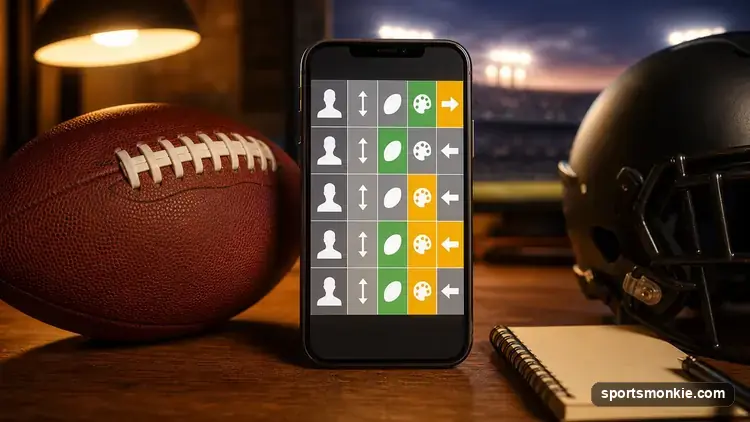
Free NFL Player Guessing Games: No Sign-Up, Unlimited
Which NFL player guessing games are actually free, need no account, and let you play unlimited? Checked live, including which ones let you replay past puzzles.
17-0 Alternatives: NFL and Cross-Sport Roster Games
If you've played 17-0, here's how Ball IQ's NFL mode, play20-0, First Down Studio, and the wider perfect-season genre actually compare — and what to try next.