
Kabaddi Rules Explained: How the Game Works
On this page5
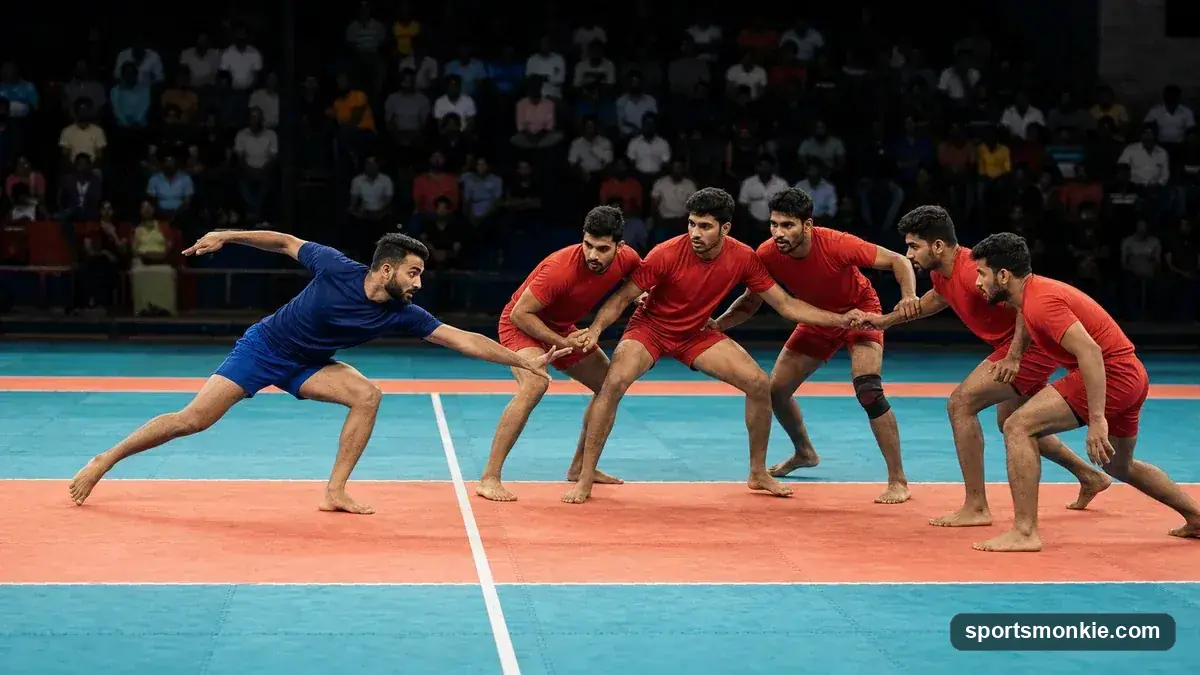
Kabaddi looks chaotic at first glance: one player charging into a crowd, everyone lunging, a whistle, a scramble. Underneath it is a tightly structured contact sport that rewards nerve and lung capacity as much as strength. The Pro Kabaddi League turned it into prime-time entertainment across India, and the sport now ranks among the most popular sports in India, so it helps to know exactly what you are watching.
The basic setup
Two teams of seven players face off on a court split into two halves by a midline. Each team defends its own half. The game alternates: your team sends a raider into the opposition half, then the opposition sends one into yours, and so on.
The raider’s job is to tag one or more defenders and get back safely. The defenders’ job is to stop him from returning. Every successful action, on either side, is worth points.
The raid: cant, bonus line, and getting home
When a raider crosses the midline, he must keep chanting “kabaddi” in a single breath. This chant is called the cant. It is the proof that he has not inhaled since entering. The moment the cant breaks, or 30 seconds pass, the raid is over.
To score, the raider touches one or more defenders and then crosses back over the midline before being tackled. Each defender he tags and escapes from is one point for his team, and those tagged defenders are sent out.
There is also a bonus line deeper in the defending half. If six or seven defenders are on the mat, a raider who crosses the bonus line with control earns a bonus point even without a tag.
How defenders score
Defending is not passive. If the seven defenders can grab the raider and stop him from getting back across the midline before his breath or time runs out, they score a tackle point and the raider is out.
Strong defensive units chain their holds, ankle grabs, and blocks together. A well-timed tackle in the dying seconds is one of the most valuable plays in the sport.
Out, revival, and the all-out bonus
Players who are put out sit off the mat, but they can be revived. Each point your team scores brings one of your out players back onto the court.
If a team manages to put the entire opposing side out, that is an “all out,” worth two bonus points, and all seven players on the scoring team return.
| Action | Points |
|---|---|
| Touch a defender and return | 1 per defender |
| Cross the bonus line (6 or 7 defenders present) | 1 |
| Tackle the raider | 1 |
| All out (whole team eliminated) | 2 |
Reading a match
A kabaddi contest is a rhythm of raids and defences over two halves. Momentum swings on all-outs and on “do-or-die” raids, which happen when a team has two empty raids in a row and the third must produce a point or the raider is out. Once you can track the cant, the bonus line, and the revival math, the sport’s tension makes a lot more sense.
For the wider context, we break down Marco Polo Game Rules separately.
Frequently asked questions
What is the 30-second raid rule?+
A raider has 30 seconds to complete a raid. He must cross the midline, attempt to touch defenders, and return to his own half within that time and in one breath. If he fails, he is out and the defending team scores a point.
Do you really have to hold your breath in kabaddi?+
Yes. During a raid the raider must continuously chant 'kabaddi' out loud, which proves he has not taken a fresh breath. If the chant, called the cant, breaks before he returns, the raid is void and he is declared out.
How long is a kabaddi match?+
A standard match has two halves of 20 minutes each for men, with a five-minute break, though youth and women's formats can differ. The team with more points at the end wins.
Sources
Play & tools
Free browser games and tools — no account, no download.
- Play today's Sports Connections — Today's Sports Connections — daily hints, answers, and play the grid.
- Play Guess the NFL Player — A new mystery NFL player every day. Eight guesses, with a clue on each — plus free unlimited mode.
- Explore all our games →
Related guides

Referee Hand Signals Explained: Every Major Sport's System
Referee hand signals let officials call fouls, scores, and timing decisions silently. See how NFL, NBA, MLB, NHL, and soccer signals compare.

Netball Rules: How the Game Works
Netball is a 7-a-side team sport where players can't dribble or run with the ball. Positions, zones, the 3-second rule and scoring, explained clearly.

How Snooker Scoring Works: Points, Breaks and Frames
How snooker scoring works: reds score 1, colours 2 to 7, a break is your total in one visit, and most points wins the frame. With a scoring table.
How Volleyball Scoring Works: Rally Scoring Explained
Volleyball uses rally scoring: a point on every rally, sets to 25, a fifth set to 15, win by two. How points, sets and matches are counted, with a table.

Gaga Ball Rules: How to Play the Pit Game
Gaga ball rules explained: a softer, faster dodgeball played in a pit. Hit opponents below the knee to get them out, and no double touches.

NLL Rules: How Box Lacrosse Works
The NLL plays indoor box lacrosse: six a side in an arena, a shot clock, boards and a physical, high-scoring style. The core rules explained.