
How Long Is the Kentucky Derby? Distance
On this page5
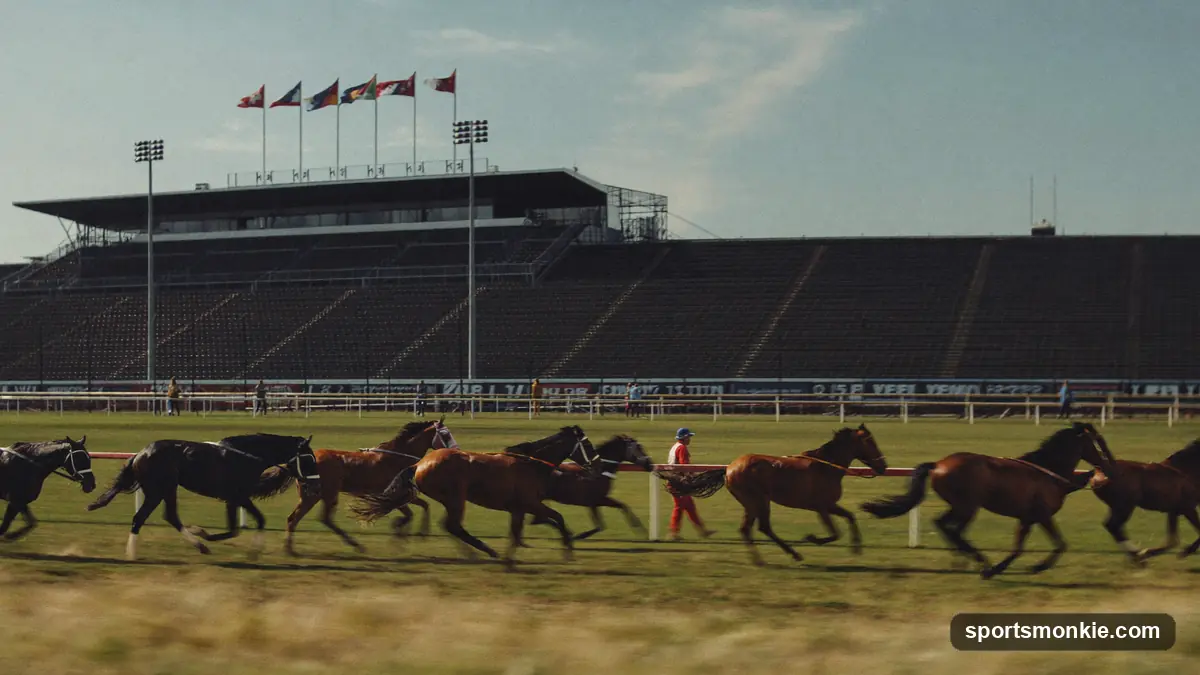
The Kentucky Derby is run over 1 1/4 miles, which works out to exactly 10 furlongs or about 2,012 meters. The horses cover that distance in roughly two minutes, which is why the race is known as “the fastest two minutes in sports.”
That short, brutal distance is the whole character of the Derby. It is long enough to demand real stamina from a three-year-old thoroughbred but short enough that a single stumble or a bad trip out of the gate can decide everything. Below is the exact distance in every unit, the fastest times ever recorded, and how the Derby stacks up against the other Triple Crown races.
The exact distance, in every unit
Racing measures distance in furlongs, where one furlong equals one-eighth of a mile. The Derby’s 10 furlongs is one of the most recognizable trip lengths in the sport.
| Unit | Kentucky Derby distance |
|---|---|
| Miles | 1 1/4 (1.25) |
| Furlongs | 10 |
| Meters | About 2,012 |
| Kilometers | About 2.01 |
| Yards | 2,200 |
The race is staged at Churchill Downs in Louisville, Kentucky, on the first Saturday in May. The track is a one-mile dirt oval, so the Derby field runs a lap and a quarter, starting on the backstretch chute and finishing under the twin spires.
How long the race takes
At the elite level, a fast Derby is run in just about two minutes. The winning time swings with track conditions: a fast, dry surface produces quicker clockings, while a sloppy or muddy track after rain can add several seconds. A time near 2:00 to 2:03 is typical for a strong renewal.
The all-time record still belongs to Secretariat, who won in 1:59.40 in 1973 on his way to the Triple Crown. Remarkably, he is one of only two horses ever to break two minutes in the race, and no one has beaten his mark in the decades since. That single run is part of why he is still treated as the benchmark for the distance.
It is worth separating the race from the event. The horses are on the track for only about two minutes, but “attending the Derby” is a full day out. Gates open in the morning, a long card of undercard races fills the afternoon, and the Derby itself is run in the early evening as the featured race. Between the traditions, the infield crowd and the pageantry, spectators are usually at Churchill Downs for many hours around that two-minute centerpiece.
Why 1 1/4 miles is a demanding test
Ten furlongs is a specific and unforgiving trip for a three-year-old thoroughbred, and it is longer than most of the horses have ever raced before the Derby. Their earlier prep races are often shorter, so the Derby asks many of them to stay a distance they have never attempted, against the largest field they have ever faced. That combination, an untested distance and a crowded twenty-horse field, is a big reason the race so often produces surprises and long-shot winners. A horse with blazing early speed can burn out in the final furlong, while a closer who saves ground can sweep past a tiring leader in the stretch.
Trainers spend the spring trying to have their horse peak on exactly this day over exactly this trip, which is what makes the winning time and the manner of victory so revealing about a horse’s stamina.
It is also why raw winning times can be misleading as a measure of greatness. A slow final time in a muddy, rain-soaked year does not mean the field was weak; it means the surface was slow. Handicappers judge a Derby performance by how the winner ran relative to the conditions and the pace of the race, not just the clock. That is part of why Secretariat’s 1:59.40 on a fast track in 1973 endures as the gold standard rather than simply being one time among many.
The takeaway for a casual viewer is simple. When you hear a winning time announced, note the track condition alongside it. A time in the low two-minute range on a fast, dry surface is genuinely quick, while anything slower after heavy rain may still represent an excellent effort over a demanding ten furlongs.
Kentucky Derby vs the other Triple Crown races
The Derby is the first and most famous leg of the American Triple Crown, but it is not the longest. Each of the three races sits at a different distance, which is exactly why sweeping all three is so hard.
| Race | Distance | Furlongs |
|---|---|---|
| Kentucky Derby | 1 1/4 miles | 10 |
| Preakness Stakes | 1 3/16 miles | 9.5 |
| Belmont Stakes | 1 1/2 miles | 12 |
A horse that wins the Derby has to back it up two weeks later in the slightly shorter Preakness, then stretch out for the longer Belmont a few weeks after that. The changing distances reward different running styles, which is a big reason Triple Crown winners are so rare.
Why the distance matters
Because the trip is fixed at 1 1/4 miles, breeders and trainers spend years trying to produce a horse with exactly the right mix of early speed and staying power for it. Too much sprinter in a pedigree and the horse fades in the stretch; too much distance runner and it gets left behind early. The Derby distance is the sweet spot the whole American racing calendar builds toward.
If you are curious about the animal athletes themselves, our guide to the cost to own a horse breaks down what stands behind these thoroughbreds, and horseback riding lessons is a starting point if the Derby has you wanting to get in the saddle. For a very different two-minute-to-two-hour test of endurance on foot, see what a good 5K time is.
The short version: the Kentucky Derby is 1 1/4 miles, ten furlongs, about 2,012 meters, run in roughly two minutes, with Secretariat’s 1:59.40 still the fastest ever.
Frequently asked questions
How long does the Kentucky Derby event last?+
The race is over in about two minutes, but the day at Churchill Downs runs for hours. Gates open in the morning, undercard races fill the afternoon, and the Derby itself is the featured race in the early evening. Fans typically spend a full day at the track around the two-minute main event.
What is the expensive mint julep at the Kentucky Derby?+
The mint julep is the Derby's signature drink, made with bourbon, sugar, water and fresh mint. Churchill Downs has sold ultra-premium versions for around 1,000 dollars, served in a commemorative cup with proceeds going to charity. Standard juleps at the track cost only a few dollars each.
How long is the Preakness compared to the Derby?+
The Preakness Stakes is 1 3/16 miles, or 9.5 furlongs, slightly shorter than the Derby's 1 1/4 miles. The Belmont Stakes, the third Triple Crown leg, is traditionally the longest at 1 1/2 miles. Each leg tests a slightly different blend of speed and stamina.
Has the Derby distance always been 1 1/4 miles?+
No. From its first running in 1875 through 1895 the Kentucky Derby was contested over 1 1/2 miles. It was shortened to the current 1 1/4 miles in 1896, and it has stayed at that distance ever since, making record comparisons before and after 1896 imperfect.
Sources
Play & tools
Free browser games and tools — no account, no download.
- Play today's Sports Connections — Today's Sports Connections — daily hints, answers, and play the grid.
- Play Guess the NFL Player — A new mystery NFL player every day. Eight guesses, with a clue on each — plus free unlimited mode.
- Explore all our games →
Related guides
How Old Are Kentucky Derby Horses?
Every Kentucky Derby horse is exactly three years old. The race admits only three-year-old Thoroughbreds, which makes it a true one-shot race.
Breeders' Cup 2026: Schedule, Tickets and TV Guide
Breeders' Cup 2026 is Oct. 30-31 at Keeneland. See all 14 races, current ticket availability, purses, entry status and TV details.
How Much Does a Racehorse Cost?
A racehorse can cost anywhere from a few thousand dollars to millions at auction, plus tens of thousands a year to train and keep. Full price breakdown.
Handicapping in Horse Racing, Explained
Handicapping has two meanings in horse racing: assigning weights to level the field, and the bettor's craft of picking winners. Both explained.
What Is a Furlong in Horse Racing?
A furlong is a unit of distance equal to one-eighth of a mile, 220 yards or about 201 metres. Why horse races are measured in furlongs, and the math, explained.
What Is a Maiden Race in Horse Racing?
A maiden race is a race restricted to horses that have never won a race. What 'maiden' means, maiden claiming vs special weight, and how horses graduate.