
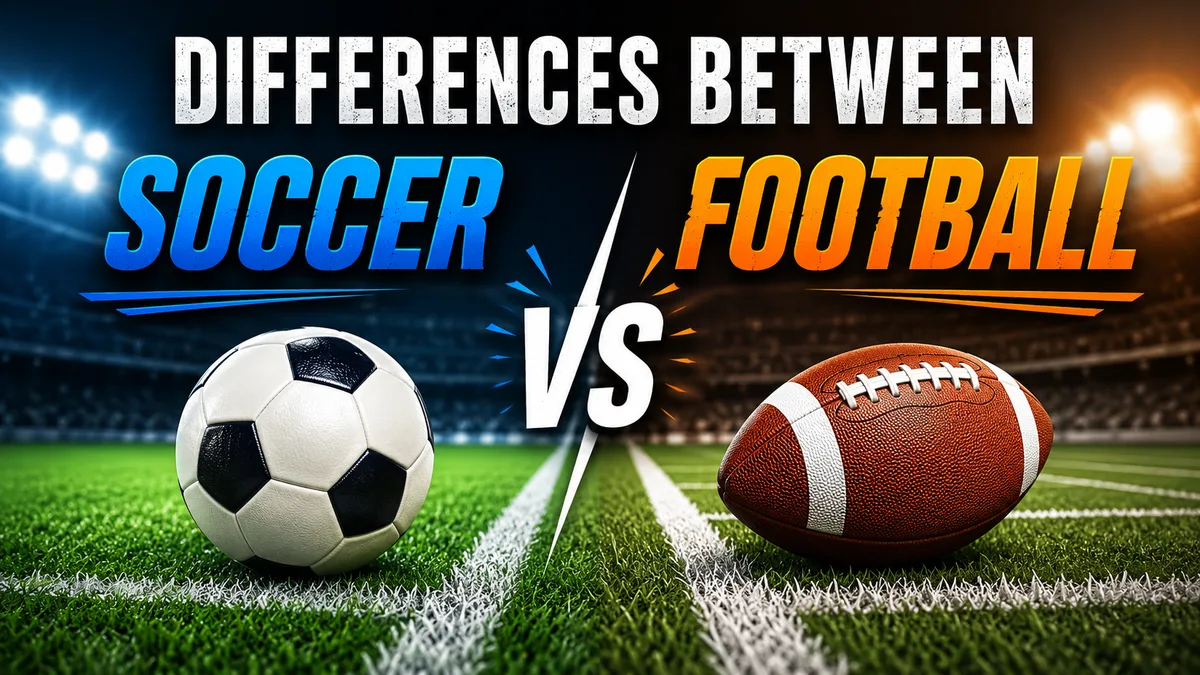
Differences Between Soccer and Football: Name, Rules, and Culture
On this page5
Ask a fan in Manchester and a fan in Miami what they watched last weekend, and they might describe the exact same sport using two different words. Neither is wrong. The argument over “soccer” versus “football” has been going for over a century, and it has almost nothing to do with the game itself.
The Same Sport, Different Names
Association football, the game FIFA governs, is called “football” in most of the world. In a handful of countries where another sport already claimed the “football” name, “soccer” stuck instead:
| Country / Region | What they call it | Their other “football” |
|---|---|---|
| United Kingdom | Football | (no major competing code) |
| United States | Soccer | American Football (NFL) |
| Canada | Soccer | Canadian Football (CFL) |
| Australia | Soccer | Australian Rules / Rugby League |
| Ireland | Soccer | Gaelic Football |
| New Zealand | Soccer | Rugby Union |
| South Africa | Soccer | Rugby Union |
Where the Word “Soccer” Came From
Oddly enough, “soccer” is a British word. It appeared in the 1880s as slang for “association,” shorthand for “association football,” used to separate it from rugby football at the time. “Assoc.” got clipped down to “soccer” in casual speech among English students.
The term faded in Britain once there was no longer any doubt which sport “football” meant. It survived in places where a rival code, rugby, Gaelic football, American football, kept the word “football” for itself.
Are the Rules Identical?
Yes, and there’s only one rulebook. The Laws of the Game are maintained by the International Football Association Board (IFAB) and apply everywhere. There’s no separate “soccer” version.
A few variations show up depending on level of play:
| Rule area | Standard | Common variation |
|---|---|---|
| Match length | 2 × 45 minutes | Youth: shorter halves |
| Pitch size | Within a defined range | Smaller pitches allowed for youth and indoor |
| Ball size | Size 5 for adults | Size 3–4 for younger age groups |
| Substitutions | Up to 5 in competitive matches (FIFA rule, adopted 2020) | Some competitions still use 3 |
Those are adjustments for age group or format. They have nothing to do with “soccer” versus “football.”
Cultural Differences in How the Game Is Discussed
The rules match, but the vocabulary around the game shifts a little between North American and international broadcasts:
| Topic | Global / European convention | North American convention |
|---|---|---|
| Result format | ”2–1” (goals first, hyphen) | Same, but sometimes “2-1 win” |
| Field term | Pitch | Field or pitch |
| Goalkeeper | Goalkeeper or keeper | Goalkeeper or goalie |
| Extra time | Extra time | Overtime |
| Fixture draw | Draw or nil-nil | Tie or 0-0 |
These are habits of language, not rule differences, but they trip people up when they follow commentary across different countries.
Why It Matters Less Now
As football’s audience grows in the US, MLS expansion, bigger Premier League viewership, the terminology gap is narrowing. Younger American fans move between “soccer” and “football” without much thought, and international audiences recognize both terms without confusion.
FIFA and UEFA use “football” as the official term regardless of what any given country calls it at home.
Frequently asked questions
Is soccer the same as football?+
Yes, soccer and football refer to the same sport — association football — in most contexts. 'Soccer' is primarily used in the United States, Canada, Australia, and a few other countries to distinguish it from their own dominant football codes. Everywhere else, the sport is simply called 'football.'
Why do Americans call it soccer and not football?+
The word 'soccer' derives from 'association' — as in the Football Association — and was actually coined in England in the late 19th century. It spread to North America, where it was adopted to distinguish association football from American football, which had become the dominant code.
What are the official rules of football called?+
The official rules are called the Laws of the Game, maintained by the International Football Association Board (IFAB). They govern all forms of association football worldwide, from amateur to international level.
Sources
Play & tools
Free browser games and tools — no account, no download.
- Play 38-0 — Sign a 4-4-2 of all-time football legends and chase a perfect 38-0 league season — perfect, not just unbeaten.
- Explore all our games →
Related football guides
View all →
What Is a Hat-Trick in Football (Soccer)?
A hat-trick is when one player scores three goals in a single match. Here is where the term comes from, the variations, and the match-ball tradition.
What Are Caps in Soccer? International Appearances Explained
A cap in soccer is an appearance for a player's national team. Each time a player represents their country in an international match, they earn one.
Soccer Tactics Explained: Football Tactical Systems, Formations & Styles
Soccer tactics explained: how formations, pressing, possession, and defensive systems shape football tactical systems, from 4-4-2 to tiki-taka and gegenpressing.
Futsal vs Indoor Soccer: Differences
Futsal is FIFA's 5-a-side game on a hard court with a low-bounce ball; indoor (arena) soccer is played with walls. The key differences, side by side.
What Is a Pick Six in Football? Meaning and Origin
A pick six is an interception returned for a touchdown, worth six points for the defense. Here is where the term comes from and why it swings games so hard.

Why Is Soccer So Popular? The Global Reach of Football Explained
Soccer is the world's most popular sport, played and watched by billions on every continent. Here's what makes it so universal, from access to culture.