
Connor Zilisch: Phoenix Dogleg Delivers a 10G Hit Every Lap
On this page5
Phoenix’s dogleg has a number now. Connor Zilisch, the 20-year-old rookie driving the No. 88 Chevrolet for Trackhouse Racing in his first full Cup season, told SiriusXM NASCAR Radio on Wednesday what his mouthpiece measured during Sunday’s race at Phoenix Raceway: “Yeah, I certainly have it in, and basically every time you go down there, it’s a 10G hit. It depends on how many times you run it. You get a lot of just 10G hits that don’t feel great.” The full account comes from MotorBiscuit, with Heavy carrying the same quotes.
What exactly measured the 10G?
A mouthpiece. A team at the Wake Forest University School of Medicine built the sensor to record head motion and impacts, and Cup drivers have been wearing it since the 2023 season, per MotorBiscuit. It records linear and rotational G-forces, giving teams a read on what drivers actually absorb inside the car.
This is the same kind of data program that already changed a racetrack once. After drivers’ mouthpieces logged nearly 1,000 impact events in the Bus Stop at Watkins Glen in 2023, that section was reconfigured with smoother curbing. That precedent is why Zilisch’s numbers matter beyond one radio hit. NASCAR now has a data point, from a current driver, tying a specific corner to repeated high-G head impacts. The question is what the sanctioning body does with it before the 2027 season.
What is the dogleg, and why do drivers keep running it?
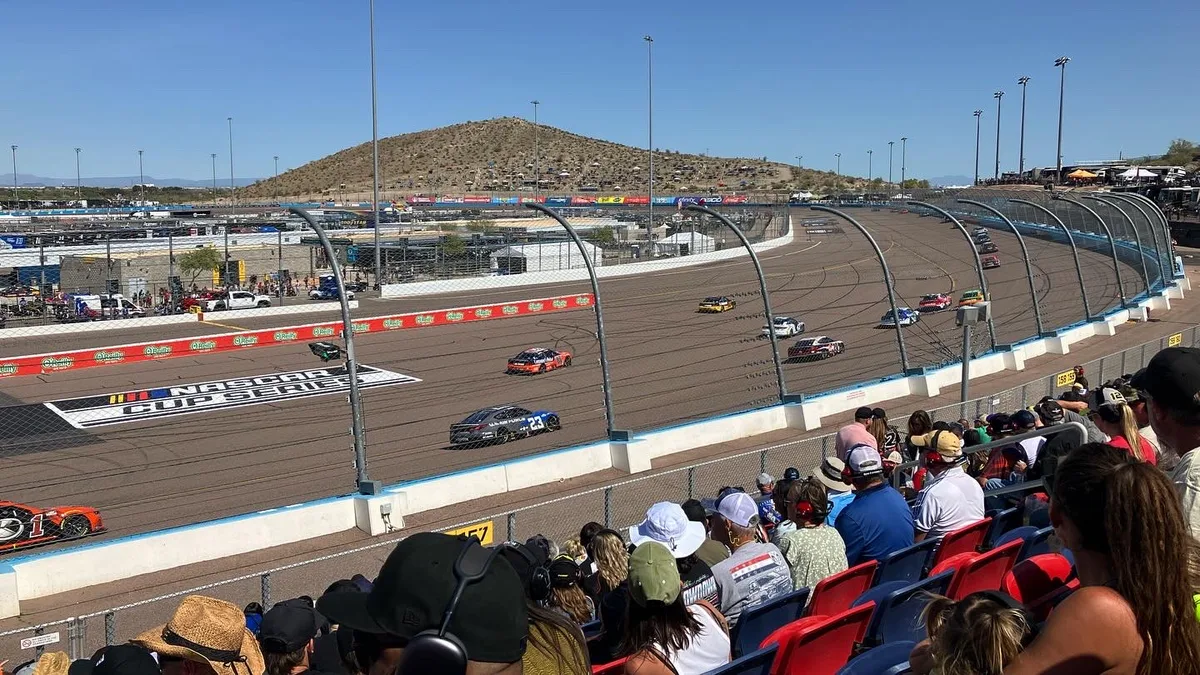
It is a bend on the Phoenix frontstretch, just past the start/finish line. Drivers cut low across the flat apron below it, ground that used to be grass, then climb back up onto the banked racing surface. The flat-to-banked transition is what does the damage, and it is also what makes the racing. The low line opens passing on restarts and side-by-side battles, and the dogleg is why Phoenix races the way it does.
Zilisch learned about the transition the hard way in the spring, when a qualifying run through the dogleg knocked his helmet crooked on his head. “I went into one and two, basically blind,” he said. Teams do not even practice the line, to protect the underside of the car. He has since made sure his helmet is set up correctly, but the physics did not change.
What could change at Phoenix?
Zilisch is honest about being stuck in the middle. “I struggle to want to let them change it,” he said. “But at the same time, you’ve got to do what’s safest for the drivers.” The dogleg is the passing zone; take it away and the racing suffers. His preferred direction is softer rather than removed: “I certainly think NASCAR could add turf and make it easier for us as drivers, and ease the burden of having to run the dogleg when you’re two or three wide or restarts or whatever it might be.”
The idea list since Sunday’s race, per On3 as cited by MotorBiscuit, runs from adding turf to enforcing a double-yellow-line rule that would keep cars out of the low line entirely. Zilisch’s bottom line: “Regardless, I’m sure NASCAR will make the right decision on that, and I just hope it doesn’t affect the racing at the racetrack because, you know, I feel like the dogleg is what allows for passing and helps kind of make the racing a little better.”
Why does this land hardest right now?
Because Phoenix has been a safety conversation all season, and this site has covered it. NASCAR is already letting teams change brakes at Phoenix after a season of wall hits, and the track produced two of the year’s flashpoints: Riley Herbst dumping Michael McDowell in stage one and Kyle Larson’s crash that cut his points lead from 49 to five. The dogleg data is the third Phoenix safety item of the year, and the first one measured in Gs. Zilisch’s Sunday confrontation with Zane Smith on the cool-down lap came on the same track, in the same weekend, for different reasons.
What happens next?
Nothing is decided. NASCAR faces a 2027 choice between turf, a double-yellow line, or leaving the dogleg alone, and the Glen precedent says data like Zilisch’s can force the issue. If another driver publishes sensor numbers, or if NASCAR announces a Phoenix change, this page updates.
Frequently asked questions
What is the dogleg at Phoenix Raceway?+
A bend on the frontstretch near the start/finish line. Drivers cut low across the flat apron below the banking, ground that used to be grass, then climb back onto the banked racing surface. The sharp transition between the flat apron and the banking is what sends hard impacts through the cars and the drivers.
What did Zilisch's mouthpiece actually record?+
Repeated 10G head impacts, basically every time he ran the dogleg during Sunday's Cup race at Phoenix. The sensor was developed with the Wake Forest University School of Medicine and records head motion and G-forces. Zilisch said the hits do not feel great, but that running the line is mandatory in a race.
What changes are being discussed for Phoenix?+
Adding turf to the low area, which Zilisch favors, or a double-yellow-line rule that would keep cars out of the dogleg entirely, per On3 via MotorBiscuit. Nothing has been decided. Zilisch said he trusts NASCAR to make the right call and hopes the racing does not suffer.
Has mouthpiece data changed a racetrack before?+
Yes. After drivers' sensors logged nearly 1,000 impact events in the Bus Stop at Watkins Glen in 2023, NASCAR reconfigured that section with smoother curbing. That precedent is why Zilisch's data matters: it is the same kind of evidence that forced a real change once already.
Who is Connor Zilisch?+
A 20-year-old rookie in his first full NASCAR Cup season with Trackhouse Racing's No. 88 Chevrolet, coming off a 10-win Xfinity Series season in 2025. He is scheduled to stay with Trackhouse through 2027 before moving to Hendrick Motorsports' No. 48 Chevrolet in 2028.
What does a 10G hit mean for a driver?+
Zilisch's own words are the record here: a hard jolt, repeated lap after lap, that 'doesn't feel great.' The sources do not attach a medical characterization to the number, and this page does not add one. The concern is frequency: the hit arrives basically every time a driver runs the line.
Sources
- MotorBiscuit: Should Phoenix Change Its Dogleg? Connor Zilisch Weighs In (the SiriusXM quotes, the mouthpiece program, the helmet incident, the Watkins Glen precedent, the On3 idea list)
- Heavy: NASCAR Faces Tough Decision After Connor Zilisch Reveals Painful 10G Hits at Phoenix (the quotes corroborated, the 2027 discussion, Zilisch's 2028 Hendrick move)
Play & tools
Free browser games and tools — no account, no download.
- Play 24-0 — Draft an F1 chassis and two drivers, then chase a perfect 24-0 — win every race on the 24-round calendar.
- Explore all our games →
Related motorsport guides
View all →
NASCAR Fines Zane Smith $50,000 for Ramming Hocevar on the Cool-Down Lap at Phoenix
NASCAR fined Zane Smith $50,000 on Tuesday for ramming Carson Hocevar after the flag at Phoenix, saying the pair had already been warned after Chicagoland. The replay shows Ross Chastain pushed Hocevar into him, and Smith was told before he hit him.
Herbst Dumps McDowell at Phoenix and Wrecks Himself in Stage One
Riley Herbst drove into Michael McDowell's bumper in Turn 3 at Phoenix, sent the No. 71 backwards into the wall and wrecked himself in the day's first caution.
Larson's 49-Point Lead Is Down to Five After His Phoenix Crash
Kyle Larson warned all week his car would be bad at Phoenix. He qualified 22nd, fell a lap down, blew a right front tire with 31 laps left and scored three points.
NASCAR Will Let Teams Change Brakes at Phoenix After a Season of Wall Hits
NASCAR will let Cup teams swap front brake rotors and pads after Saturday qualifying at Phoenix, a safety concession after failures at four short tracks.
Fred Lorenzen Diagnosed With Stage 3 CTE, the First Confirmed Case in a NASCAR Driver
Boston University researchers diagnosed Fred Lorenzen with stage 3 CTE, the first confirmed case in a NASCAR driver. His family gave $1 million and set up a helpline for drivers.
Hamlin Says He Would Have Defied the Pit Call Had He Known Larson Was a Lap Down
Denny Hamlin says he would never have turned down pit road at Las Vegas if he had known his stop would hand Kyle Larson the wave-around back onto the lead lap.