
Best Olympic Shooters: The Most Decorated Ever
On this page5
Ask who the best Olympic shooter is and you get three defensible answers, not one. Carl Osburn of the United States holds the most medals, eleven. Jin Jong-oh of South Korea is the only four-time individual champion. Vincent Hancock became, at Paris 2024, the first shooter ever to win four golds in a single event. Each is “the greatest” by a different, legitimate measure, and the reason no single name settles it is that Olympic shooting has changed its events and its scoring so many times that the eras barely compare.
The medal leaders
Start with the raw count, because it anchors every argument.
| Shooter | Nation | Games | Golds | Total medals |
|---|---|---|---|---|
| Carl Osburn | USA | 1912–1924 | 5 | 11 |
| Kim Rhode | USA | 1996–2016 | 3 | 6 |
| Jin Jong-oh | South Korea | 2008–2016 | 4 | 6 |
| Vincent Hancock | USA | 2008–2024 | 4 | 5 |
| Ralf Schumann | Germany | 1988–2004 | 3 | 5 |
Medal totals per TopEndSports’ all-time shooting rankings and each shooter’s Olympic record. Osburn’s eleven medals, won across three Games a century ago, remain the benchmark and are unlikely to fall, because no modern shooter contests enough events to accumulate that many.
The case for each “greatest”
Osburn wins on volume, but with an asterisk. His medals came from a rifle program that included team events and disciplines long since cut, so his tally reflects a broader early Olympics as much as individual brilliance.
Jin Jong-oh wins on individual dominance in the modern era. He is the only shooter to win four individual Olympic golds, and he took the 50 metre pistol three Games running, per his Olympic record. That streak is now permanent history: the 50 metre pistol was removed from the program after Rio 2016, so no one can match three straight in that event again.
Ralf Schumann has the purest specialist claim. He won the 25 metre rapid fire pistol at three Olympics, in 1992, 1996 and 2004, adding two silvers in the same event, per his competition record. Winning one technical discipline across twelve years, against three different generations of rivals, is a distinct kind of greatness from spreading medals across events.
Kim Rhode wins on longevity. She medalled at six consecutive Olympic Games from 1996 to 2016, taking three golds across double trap and skeet, and became the first athlete to win an individual medal at six straight Summer Games. Sustaining podium form across two full decades in a sport that rebuilt its rules underneath her is arguably the hardest feat on this list.
Vincent Hancock holds the newest and cleanest record. At Paris 2024 he won men’s skeet for the fourth time, in 2008, 2012, 2020 and 2024, the first shooter to win four golds in a single event and, across all sports, the sixth Olympian ever to do so, per Olympics.com. Four wins in one event is the most single-minded dominance shooting has produced.
My own read: if “greatest” means most dominant in the modern, comparable era, it is Jin Jong-oh on individual golds with Hancock closing fast on the single-event record. If it means most decorated, it is Osburn, with the caveat that his era was easier to accumulate in. Both answers are honest; anyone who tells you it is settled is ignoring one of them.
Why the eras don’t compare
This is the part rankings usually skip, and it is the whole difficulty.
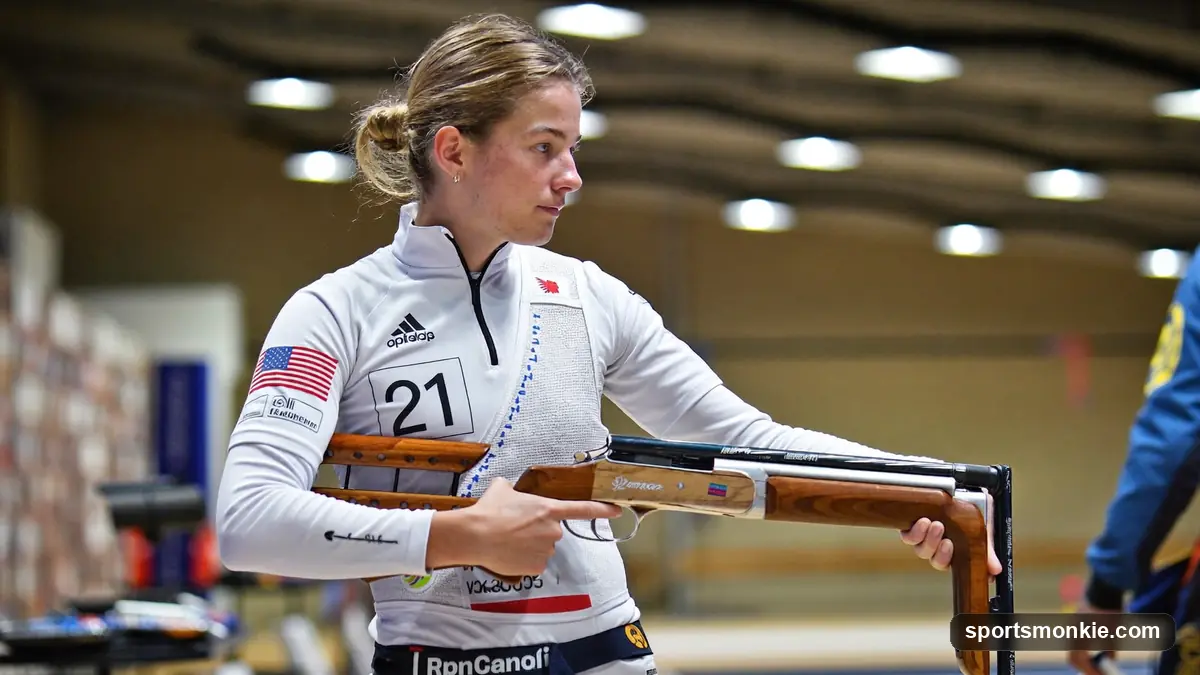
Olympic shooting also splits across three families of events, and greatness in one says little about the others. Rifle rewards stillness and control over 10 and 50 metres; pistol is its own world of precision and, in rapid fire, speed; shotgun disciplines such as skeet and trap test reaction to a moving clay. Osburn was a rifle shooter, Jin and Schumann pistol shooters, Rhode and Hancock shotgun shooters. Comparing them is partly comparing different sports that happen to share a medal table.
The event program has been rebuilt repeatedly. Team rifle events that padded early tallies are gone. Running target disappeared. The 50 metre pistol left after 2016. Women’s events were only added from 1984, and mixed-team events debuted at Tokyo 2020, which now gives a shooter two medal chances in one discipline where earlier generations had one.
The scoring changed too. Since the Tokyo 2020 cycle, qualification scores no longer carry into the final; the final is a fresh elimination round, so a shooter can top qualifying and still go out early. Air events are scored to tenths of a point on electronic targets. That is why Olympic records set at Paris 2024, such as the marks in air rifle and air pistol, sit under different rules from records set a decade earlier and cannot be laid side by side, a point the ISSF’s own review of Paris 2024 reflects in how it frames the new figures. For a sense of how shooting sits within the wider Games, our look at the most popular Olympic sports puts the discipline in context.
The current stars
Paris 2024 announced a young generation that will define the next comparison.
Sheng Lihao of China, still a teenager, won two golds, the 10 metre air rifle individual and the mixed team, and set an Olympic record of 252.0 in the individual final. Oh Ye-jin of South Korea took the 10 metre air pistol with an Olympic record 243.2. China finished top of the shooting medal table, extending a period of depth that, alongside South Korea, India and the United States, reflects where the sport is funded most seriously.
For an adjacent precision sport with its own long-range history, our profile of the greatest archers of all time makes an interesting companion, and the money side of Olympic success is covered in our guide to Olympic medal bonuses by country.
The verdict
There is no single best Olympic shooter, and pretending otherwise misreads the sport’s history. Osburn owns the medal count, Jin the individual golds, Schumann the specialist streak, Rhode the longevity and Hancock the single-event record. Watch Sheng Lihao and the Paris 2024 cohort over the next two Games: if any of them stacks golds under the current, harder finals format, the argument will finally have a modern favourite. Until then, the honest answer names five people, not one.
Frequently asked questions
Why isn't the athlete with the most medals automatically the greatest shooter?+
Because the events themselves changed. Carl Osburn's 11 medals came partly from team events and rifle disciplines that no longer exist, while modern shooters contest fewer events per Games. More medals from a broader early program is not directly comparable to fewer golds from a narrower modern one, so 'most decorated' and 'most dominant in one event' point to different names.
Which shooting events were dropped, and why does it matter for records?+
Several. The 50 metre pistol, in which Jin Jong-oh won three straight golds, left the program after Rio 2016, so that particular streak cannot be extended or matched. Running target and various team rifle events also disappeared over the decades. When an event is removed, its records are frozen, which distorts any all-time comparison.
Are men's and women's shooting records counted separately?+
Historically yes, and the program has shifted toward parity. Women's shooting events were added from 1984, and mixed-team events debuted at Tokyo 2020. Kim Rhode leads the women's all-time medal count with six; Osburn leads overall with eleven. The addition of mixed events now gives shooters two medal chances in a discipline where they once had one.
How is an Olympic shooting final scored today?+
Since the Tokyo 2020 cycle, qualification and final scores no longer carry over: the final is a fresh elimination round, so a shooter who qualifies first can still be eliminated. Air events use decimal scoring to tenths of a point. This is why recent Olympic records, such as those set at Paris 2024, are not directly comparable to pre-2020 marks scored under different rules.
Does hosting or funding explain why some nations dominate shooting?+
Partly. Nations with strong shooting federations and year-round funding, such as China, South Korea, the United States and India, consistently produce finalists because the sport rewards volume of high-quality practice with expensive equipment and ranges. Success clusters in countries that fund the discipline seriously rather than being spread evenly across all Olympic nations.
Sources
- TopEndSports — The greatest shooter at the Olympic Games (medal rankings)
- Olympics.com — Vincent Hancock wins fourth Olympic skeet gold at Paris 2024
- ISSF — Looking back to shooting at the Paris 2024 Olympic Games
- Wikipedia — Jin Jong-oh (Olympic pistol record)
- Wikipedia — Ralf Schumann (25m rapid fire pistol)
Play & tools
Free browser games and tools — no account, no download.
- Play today's Sports Connections — Today's Sports Connections — daily hints, answers, and play the grid.
- Play Guess the NFL Player — A new mystery NFL player every day. Eight guesses, with a clue on each — plus free unlimited mode.
- Explore all our games →
Related guides
Most Decorated Olympian of All Time
Michael Phelps is the most decorated Olympian ever, with 28 medals including a record 23 golds. Full all-time medal table and the golds record explained.
Oldest Olympic Gold Medalist Ever
Oscar Swahn is the oldest Olympic gold medalist, winning at 64 years and 258 days in 1912. Full ranked leaderboard of the 8 oldest gold medalists in history.
Most Olympic Gold Medals by Country
The United States has won more Olympic gold medals than any nation, over 1,100 at the Summer Games. The full country leaderboard, explained.
Most Olympic Gold Medals Ever
Michael Phelps won 23 Olympic gold medals, the most by any athlete. The full leaderboard of the most Olympic golds ever won, explained.
Most Olympic Medals of All Time
Michael Phelps won 28 Olympic medals, the most by any athlete. The full leaderboard of the most decorated Olympians in history, explained.

What Is a False Start in Track? Rules and Disqualification
A false start happens when a sprinter begins before the legal starting signal or reacts early enough to violate the competition’s reaction-time rule.