
Best Football Trios: The Most Devastating Attacking Thirds
On this page12
- 01The greatest football attacking trios at a glance
- 02MSN — Messi, Suárez, Neymar (Barcelona, 2014–17)
- 03BBC — Bale, Benzema, Ronaldo (Real Madrid, 2013–2018)
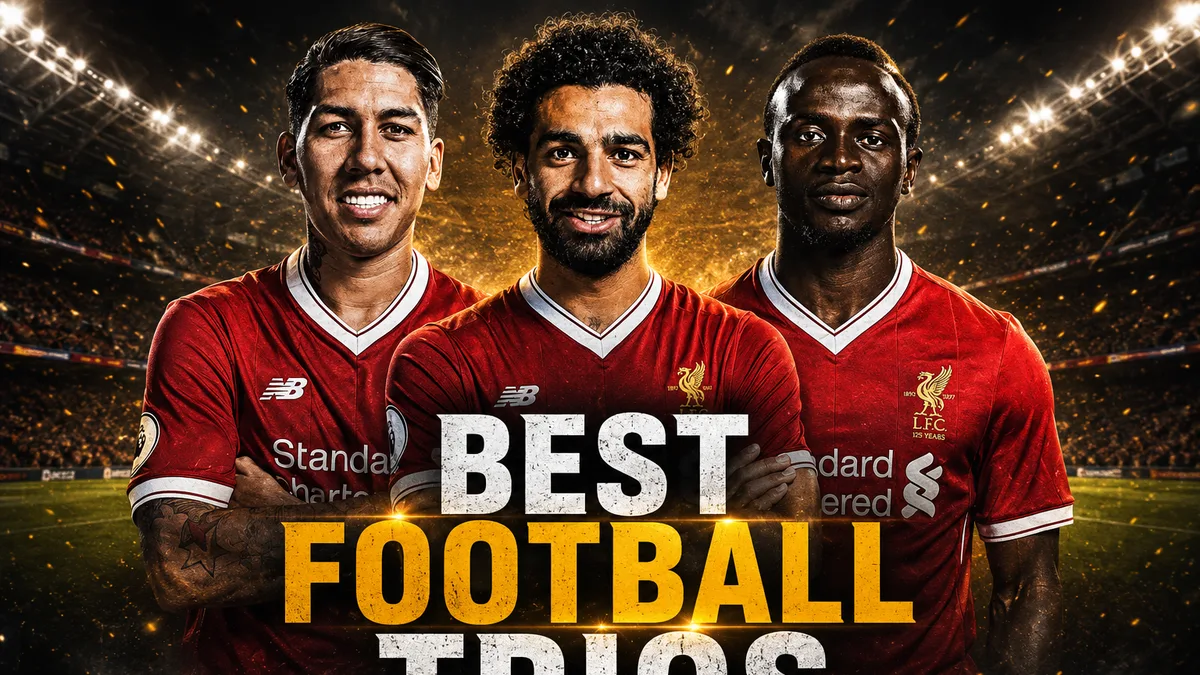
- 04Salah, Firmino, Mané (Liverpool, 2017–2022)
- 05Van Basten, Gullit, Rijkaard (AC Milan, late 1980s)
- 06Best, Law, Charlton (Manchester United, 1960s)
- 07Di Stéfano, Puskás, Gento (Real Madrid, late 1950s)
- 08How We Ranked These Trios
- 09What Makes a Front Three Click
- 10Current Elite Trios to Watch
- 11Era Caveats: Why Cross-Decade Comparison Is Hard
- 12Other Notable Trios
We rank on three measures: peak combined goals-and-assists in a single season, how many seasons the unit stayed dominant, and the trophies that output won. That rewards sustained, well-documented front threes over one-season flashes.
The greatest football attacking trios at a glance
| Rank | Trio | Club | Strongest legacy |
|---|---|---|---|
| 1 | Messi–Suárez–Neymar | Barcelona | 122 goals in a treble season |
| 2 | Bale–Benzema–Ronaldo | Real Madrid | Champions League trophy run |
| 3 | Salah–Firmino–Mané | Liverpool | Premier League and European titles |
| 4 | Van Basten–Gullit–Rijkaard | AC Milan | Late-1980s European dominance |
| 5 | Best–Law–Charlton | Manchester United | Original European template |
| 6 | Di Stéfano–Puskás–Gento | Real Madrid | European Cup dynasty |
- Production benchmark
MSN — Messi, Suárez, Neymar (Barcelona, 2014–17)
No front three has out-produced this one. In 2014-15 they scored 122 goals across all competitions and won the treble; the next season they pushed the mark to 131. The roles never overlapped — Messi drifted right and created, Suárez pressed and finished centrally, Neymar carried and cut in from the left — so defenders could not double one without freeing another.
They rank above BBC because their peak output was higher and came from open play they generated themselves, not just conversion of a supporting cast's chances. The unit dissolved when Neymar left for Paris Saint-Germain in 2017 for a still-standing world-record fee. For the scoring context, see our La Liga top scorers list.
Club: Barcelona · Peak: 122 goals (2014-15), 131 (2015-16) · Defining feat: 2015 treble
- Trophy machine
BBC — Bale, Benzema, Ronaldo (Real Madrid, 2013–2018)
BBC's case is silverware: four Champions League titles in five seasons, three of them in a row (2016–18). Cristiano Ronaldo was the engine, sitting atop the Champions League scoring charts while Karim Benzema did the linking work and Gareth Bale supplied pace and big-game goals.
They rank below MSN because injuries — mostly Bale's — meant the three were rarely on the pitch together for a full campaign, so the trio's raw combined numbers trail Barcelona's. Bale's bicycle kick in the 2018 final in Kyiv remains the unit's signature moment before Ronaldo's move to Juventus ended it.
Club: Real Madrid · Peak: 4 UCL titles (2014–18) · Defining feat: three straight European crowns
- System-built
Salah, Firmino, Mané (Liverpool, 2017–2022)
This is the most tactically dependent trio on the list, and that is a compliment. Roberto Firmino played a false nine that pressed and created rather than scored, freeing Mohamed Salah and Sadio Mané to attack the channels. Across five seasons they combined for 338 goals.
They edge historic trios below them on sustained output: the front three drove Liverpool's 2019 Champions League win and the club's first league title in 30 years in 2020. During the 2018-19 European run they scored 30 goals — 10 apiece. More context sits in our Premier League records rundown.
Club: Liverpool · Peak: 338 combined goals (5 seasons) · Defining feat: 2019 UCL, 2020 Premier League
- Pre-modern peak
Van Basten, Gullit, Rijkaard (AC Milan, late 1980s)
Milan's Dutch trio is the strongest attacking unit of the pre-Barcelona era. Marco van Basten scored the goals — his 1988 and 1989 Ballon d'Or seasons overlapped this spell — Ruud Gullit powered play from a free role, and Frank Rijkaard added control ahead of the defense.
They land here rather than higher because the sample is shorter and the goal records less complete than the modern trios above them. What is not in doubt: back-to-back European Cups in 1989 and 1990, the second sealed with a Rijkaard winner over Benfica.
Club: AC Milan · Peak: back-to-back European Cups (1989, 1990) · Defining player: Van Basten
- Original template
Best, Law, Charlton (Manchester United, 1960s)
United's "Holy Trinity" is the only trio here in which all three men won the Ballon d'Or — Denis Law (1964), Bobby Charlton (1966) and George Best (1968). Charlton struck from deep and distance, Law was the penalty-box finisher, and Best supplied the dribbling that broke defenses open.
They rank below the continental trios on trophy volume — the group's crowning achievement was a single European Cup in 1968, when United became the first English club to win it. But as a proof of concept for the modern front three, nothing predates it with the same individual pedigree.
Club: Manchester United · Peak: 1968 European Cup · Distinction: three Ballon d'Or winners
- Dynasty spine
Di Stéfano, Puskás, Gento (Real Madrid, late 1950s)
This trio's ranking rests on an achievement no modern unit can match: Alfredo Di Stéfano and Francisco Gento anchored all five of Real Madrid's consecutive European Cup wins from 1956 to 1960, with Ferenc Puskás joining in 1958 to make the line even more lethal.
They sit sixth, not higher, because era and record-keeping make a fair goals comparison impossible, and Puskás missed the first two of those five finals. As dynasty-builders, though, they are unmatched — the 1960 final win over Eintracht Frankfurt is still cited as a high point of the trio's peak.
Club: Real Madrid · Peak: five straight European Cups (1956–60) · Defining player: Di Stéfano
Reader interaction
Build your ranking
Drag the names into the order you think is right — or use the arrows — then submit to see how your list compares with everyone else's.
- MSN — Messi, Suárez, Neymar (Barcelona, 2014–17)
- BBC — Bale, Benzema, Ronaldo (Real Madrid, 2013–2018)
- Salah, Firmino, Mané (Liverpool, 2017–2022)
- Van Basten, Gullit, Rijkaard (AC Milan, late 1980s)
- Best, Law, Charlton (Manchester United, 1960s)
- Di Stéfano, Puskás, Gento (Real Madrid, late 1950s)
Audience ranking
How everyone ranked them
Built from reader rankings using position-based points.
Pep Guardiola once said you cannot coach the understanding between players — you can only put them in positions to find it. That is the gap between three good attackers and a front three that pulls leagues apart. The units ranked above cleared it; most trios never do.
How We Ranked These Trios
Three questions decided the order. First, peak combined output: the goals and assists a trio produced in its single best season. Second, staying power: how many seasons the three held that level together, since one hot campaign is easier than four. Third, what the output actually won — league titles and European Cups, weighted toward trophies the front three visibly drove rather than inherited.
That method favors modern trios, and deliberately so. Detailed goal and assist records exist for the Barcelona, Real Madrid and Liverpool units in a way they simply do not for the 1950s. Rather than guess at historic totals, we ranked older trios on documented trophies and individual honors, which is why Milan’s Dutch line and United’s Holy Trinity sit where they do.
What Makes a Front Three Click
Talent is the entry fee, not the difference-maker. These four traits separate a great trio from three good players:
| Quality | What it looks like in practice |
|---|---|
| Complementary roles | Different movement patterns that stop defenders doubling up |
| Chemistry | Instinctive positioning that anticipates a teammate’s run |
| Versatility | Interchange that makes the line impossible to mark man-to-man |
| Sustained output | Goals and assists across a full season, not a hot month |
MSN had all four. Salah-Firmino-Mané leaned hardest on the first, building the whole line around a striker who created instead of scored.
Current Elite Trios to Watch
The tradition is alive, though none of these has the seasons behind it to rank yet:
- Mbappé, Vinícius Júnior, Rodrygo (Real Madrid) — the most star-heavy front line in the game since Kylian Mbappé’s 2024 arrival, with Jude Bellingham often drifting forward to make it a functional four.
- Yamal, Lewandowski, Raphinha (Barcelona) — teenager Lamine Yamal, veteran finisher Robert Lewandowski and a resurgent Raphinha drove Barcelona’s 2024-25 La Liga title under Hansi Flick.
- Dembélé, Kvaratskhelia, Barcola (Paris Saint-Germain) — the fluid, pressing line behind PSG’s 2025 Champions League win; Ousmane Dembélé’s form that season earned him the 2025 Ballon d’Or.
Whether any of them joins the ranked list depends on the one thing no trio can shortcut: repeating it, season after season.
Era Caveats: Why Cross-Decade Comparison Is Hard
Comparing a 1950s trio to a 2015 one is not a like-for-like exercise. Squad rotation, substitute rules, the number of matches per season and the quality of record-keeping have all changed. Di Stéfano’s Real Madrid played far fewer games than Messi’s Barcelona, so raw goal totals understate the older units. Defensive tactics have also shifted — the offside trap, the deep block and pressing systems each reshaped what a front three had to solve. Treat the ranking as a weighing of documented evidence, not a claim that a 2015 player was better than a 1960 one.
Other Notable Trios
Strong units that fell short of the ranked six, usually on longevity:
| Trio | Club | Era |
|---|---|---|
| Ronaldo, Rivaldo, Ronaldinho | Brazil | 2002 World Cup |
| Ibrahimović, Eto’o, Henry | Barcelona | 2009 |
| Hazard, Costa, Willian | Chelsea | 2014–16 |
| Mbappé, Neymar, Cavani | Paris Saint-Germain | 2017–2019 |
| Kvaratskhelia, Osimhen, Politano | Napoli | 2022–23 Scudetto |
Brazil’s “three R’s” won a World Cup but played together for one tournament rather than years of club football. The rest hit a high season or two without the sustained run the top six strung together.
Frequently asked questions
Why is MSN ranked above Real Madrid's BBC?+
Both trios were elite, but MSN's peak output was higher and more self-generated. Messi, Suárez and Neymar scored 122 goals in 2014-15 and 131 in 2015-16, playing nearly every big match together. BBC won more Champions League titles, but Bale's recurring injuries meant the three rarely started a full season as a unit, so their combined totals trail Barcelona's despite the trophy haul.
Did any trio score more in one season than MSN's 122 goals?+
Yes — the same trio did it the very next year. In 2015-16, Messi, Suárez and Neymar combined for 131 goals in all competitions, with Suárez alone hitting 59. That 2015-16 total is the higher of the two Spanish records they set. No other club front three has matched either figure in Europe's major leagues, which is why MSN tops production-based rankings.
What broke up each of the top three trios?+
Transfers and time, mostly. MSN ended in 2017 when Neymar left for Paris Saint-Germain in a world-record deal. BBC dissolved after Ronaldo joined Juventus in 2018, following seasons of Bale injuries. Liverpool's front three wound down from 2022 as Mané moved to Bayern Munich and Firmino's role shrank. In every case the unit peaked for three to five seasons before departures ended it.
How do today's Real Madrid and Barcelona trios compare to these?+
They have the talent but not yet the track record. Real Madrid's Mbappé-Vinícius-Rodrygo line and Barcelona's Yamal-Lewandowski-Raphinha front three both feature Ballon d'Or contenders, and Barcelona won the 2024-25 La Liga title. But the trios ranked here are judged on multiple dominant seasons and major trophies. The current units need a longer sustained run before they belong in that group.
Why aren't the older trios ranked higher despite winning more European Cups?+
Trophy count is one of three measures, alongside peak single-season output and sustained multi-year production. Older trios like Di Stéfano-Puskás-Gento won more European Cups, but incomplete historical goal records and different competition formats make a fair output comparison impossible. Ranking them below the modern units reflects the evidence available, not a claim that they were less talented in their own era.
What formation gets the most out of a front three?+
The 4-3-3 is the classic fit, giving each attacker a defined lane while three central midfielders supply the ball. Variations like the 3-4-3 add width through wing-backs. What matters more than the shape is interchange: the best trios rotate positions so defenders cannot mark them man-to-man. Liverpool's pressing 4-3-3 and Barcelona's possession-based version both used the same base formation very differently.
Sources
Play & tools
Free browser games and tools — no account, no download.
- Play 38-0 — Sign a 4-4-2 of all-time football legends and chase a perfect 38-0 league season — perfect, not just unbeaten.
- Explore all our games →
Related football guides
View all →
Counter-Attacking Football Explained: How the Break Works
Counter attacking football is a rapid defense-to-attack transition that exploits disorganized opponents. Learn the principles, roles, and famous examples.

The Worst Transfers in Football History, Ranked
Ousmane Dembele, Philippe Coutinho, Antoine Griezmann, Paul Pogba and more — the biggest-money football transfer flops ever, with the fees and the reasons they failed.
Greatest South American Football Clubs
Ranked by Copa Libertadores titles: Independiente, Boca Juniors, Peñarol, Flamengo, River Plate, and the 12 clubs that define South American football.
Best Football Defenders Right Now: Ranked Top 12 (2025-26)
The 12 best football defenders in the world right now, ranked: William Saliba, Virgil van Dijk, Gabriel Magalhães, Achraf Hakimi and more, with the stats behind each spot.
Most Popular Football Goals of All Time, Ranked
Maradona's 1986 run, Zidane's 2002 volley, Roberto Carlos's impossible free kick, Bale's overhead kick and more: the 10 football goals fans never stop rewatching, ranked.
Most Successful Football Teams in the World
The most successful football clubs and nations, ranked by European Cups, league titles, and lasting dominance — from Real Madrid and AC Milan to Brazil's five World Cups.