
Zverev Says His Ball Bouncing Went to an Extreme as the Umpire Tells Him to Watch the Clock
On this page6
Alexander Zverev won his Shanghai quarter-final in 78 minutes on Thursday, and the slowest part of his week is still the time before the ball leaves his hand. After beating Alex de Minaur 6-4, 6-4, Zverev said the chair umpire had told him to look at the shot clock when he was serving, Tennis365 reports. The routine that produced a reported 12,000 ball bounces at the US Open is now drawing official attention in Shanghai, and Zverev, to his credit, is not arguing with the premise. He says the bouncing is a habit that grew this year, that part of it is unnecessary, and that he is trying to cut it down.
What exactly did the umpire warn Zverev about?
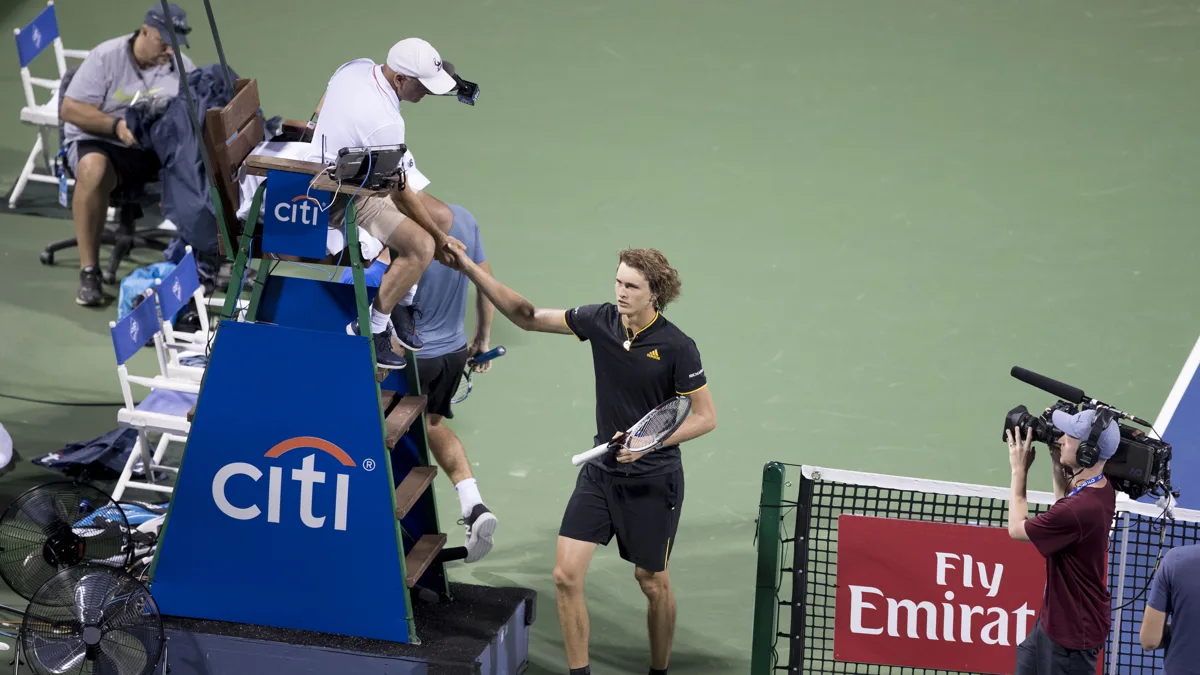
The clock, not a count. Zverev said the umpire told him to look at the shot clock when he was serving, and his explanation was about sequence rather than defiance: he felt he was getting to the line quickly between points, then waiting while de Minaur went for his towel, and only then starting a bouncing routine that ate the remaining seconds, Tennis365 reports. By his own account he would reach the line with about 10 seconds left, bounce, run through the routine, and finish close to running out of time. His fix, as he described it, is simply to start earlier. It is a milder scene than the one Wu Yibing described in Shanghai last week, but it comes from the same tournament-long theme: Zverev’s time between points keeps becoming the story around his matches.
How big did the bouncing get at the US Open?
Big enough to become a broadcast graphic. The count reported during the tournament put Zverev at about 12,000 bounces across his first five matches in New York, at an average of roughly 10 seconds of bouncing per serve over 899 serves, the New York Post reports. Added up, that is about two and a half hours of pre-serve bouncing inside a tournament where he spent 19 hours and 38 minutes on court. He was called for time violations against both Khachanov and Shelton during that run. Zverev says the scale passed him by at the time because his phone was off and he was not looking at social media, Tennis365 reports, and that he only understood what had happened afterwards.
Why does a legal routine annoy opponents so much?
Because the returner has to hold a ready position through all of it. Karen Khachanov said after his semi-final defeat that the bouncing annoys a lot of players, since the returner sets, split-steps, and then faces another dozen bounces without knowing when the serve is coming, the New York Post reports. He also conceded the legal point: inside the time rules, there is nothing to protest. That is the tension. The first serve is governed by a 25-second shot clock, but there is no equivalent limit before a second serve, which is why Shelton, beaten by Zverev in the final, suggested the sport needs some sort of rule for second-serve time. It is not the first rule argument to attach itself to Zverev this autumn; in Shanghai alone he has already dealt with spectators accusing him of taking Shelton and Hewitt’s practice court, a claim he dismissed as made up.
What is Zverev actually changing?
Less bouncing, earlier. He says there is no target number in his head and that he serves when it feels right, but that he is bouncing less than he did in New York, where he accepts it went to an extreme, Tennis365 reports. He framed the reason as fairness rather than pace: if opponents feel distracted by something he does, he does not want to do it, because he wants to win with his tennis. The self-awareness is doing real work here. This is a player who saved four set points on a bad ankle to beat Alexander Bublik earlier this week and has already secured the year-end No. 1 ranking, so the routine is attached to the best season of his career, not a slump he can blame it on.
Did any of this affect the de Minaur match?
Barely, on the evidence of the scoreboard. Zverev made 80 percent of his first serves, saved all five break points he faced and closed out a 6-4, 6-4 win in 78 minutes, AP reports, his ninth win in 13 meetings with de Minaur. The short match also helped the ankle he has been managing since the third round, since he said afterwards that playing quickly and avoiding long rallies left his serve feeling better. His semi-final is against Alejandro Davidovich Fokina, who reached the last four when Arthur Gea retired 22 minutes into their quarter-final.
What happens next with the bouncing debate?
A semi-final under the same clock, and then a rule question that will not go away. If Zverev keeps the routine short in Shanghai, the story dies as a curiosity of one strange US Open. If the bouncing creeps back up in a long semi-final or final, the Shelton proposal stops being a beaten finalist’s frustration and becomes a tour conversation, with Roddick among those who called for a rule change in New York. Either way, the number is now public property: 12,000 bounces is the kind of statistic a player does not get to retire, however quickly he serves from here.
Frequently asked questions
What did the umpire tell Zverev in Shanghai?+
To watch the shot clock while he was serving, Zverev said after his quarter-final win over Alex de Minaur. Zverev explained that he was often ready quickly but waited while de Minaur fetched his towel, then started his bouncing routine with about 10 seconds left and ended up close to running out of time, Tennis365 and TennisTemple report.
How many times did Zverev bounce the ball at the US Open?+
About 12,000 times across his first five matches, according to the broadcast graphic reported by the New York Post and Sports Illustrated. The graphic put his average at about 10 seconds of bouncing per serve across 899 serves, roughly two and a half hours of bouncing in a tournament where he spent 19 hours and 38 minutes on court.
Is there a time limit on ball bouncing before a serve?+
Only indirectly. A server has 25 seconds on the shot clock before a first serve, and bouncing has to fit inside it. Before a second serve there is no equivalent clock, which is the gap Ben Shelton pointed to after losing the US Open final, when he suggested the tour needs some sort of rule limiting second-serve time, the New York Post reports.
What have other players said about Zverev's bouncing?+
Karen Khachanov said after his US Open semi-final loss that the bouncing annoys a lot of players because the returner cannot time a split step when another dozen bounces may follow, while conceding it is legal if it stays inside the time rules. Shelton said the delays had nothing to do with his own flat performance in the final, the New York Post reports.
What does Zverev say about the habit?+
That it grew without him noticing. He says it started at the US Open, that he was unaware of the scale because his phone was off and he was not on social media, and that he only realised afterwards. He says he is now bouncing less than in New York, goes when it feels right rather than to a number, and calls part of it unnecessary from his end, Tennis365 reports.
Did the warning slow Zverev down against de Minaur?+
No. He won 6-4, 6-4 in 78 minutes, made 80 percent of his first serves and saved all five break points he faced, AP reports. It was his ninth win in 13 meetings with de Minaur and took him into a Shanghai semi-final against Alejandro Davidovich Fokina, who advanced when Arthur Gea retired.
Why does the bouncing matter beyond one player's routine?+
Because it sits in a rule gap the sport keeps arguing about. The first serve is policed by a clock and the second serve is not, so a long routine is legal and still costly to the returner, the crowd and the schedule. Zverev's case is the extreme version: a reported 12,000 bounces and two and a half hours of pre-serve time at one tournament, by the player who had already secured the year-end No. 1 ranking.
Sources
- Tennis365: Zverev curbing 'extreme' behaviour and issues ankle injury update after Shanghai win (the umpire's shot-clock message, the 12,000-bounce figure, the phone-off admission and the ankle context)
- TennisTemple: At the US Open, I went too far, Zverev opens up about his serving ritual (the same press-conference account, the towel-waiting explanation and the fair-play point)
- New York Post: Ben Shelton calls for 'some sort of rule' over bizarre Alexander Zverev maneuver (the broadcast bounce count, the 899 serves, Khachanov's complaint, the time violations in New York and Shelton's second-serve rule suggestion)
- AP via Sportsnet: Zverev beats de Minaur to advance to Shanghai Masters semis (the 6-4, 6-4 score, 80 percent first serves, five break points saved and the Davidovich Fokina semi-final)
- Sports Illustrated: The Tennis Community Takes Sides on Alexander Zverev's US Open Ball Bouncing (the two-and-a-half-hour estimate and the double-standard criticism from fans)
Play & tools
Free browser games and tools — no account, no download.
- Play today's Sports Connections — Today's Sports Connections — daily hints, answers, and play the grid.
- Play Guess the NFL Player — A new mystery NFL player every day. Eight guesses, with a clue on each — plus free unlimited mode.
- Explore all our games →
Related tennis guides
View all →
Wu Yibing Says Zverev's Shanghai Behaviour Was Unnecessary and Broke the Rhythm
Wu Yibing criticised Alexander Zverev's falls, lighting complaints and net-tape fiddling after their Shanghai match, calling them rhythm-breaking and unnecessary.
Fans Accuse Zverev of Taking Shelton and Hewitt's Practice Court in Shanghai
Spectators in Shanghai say Alexander Zverev arrived late to his practice court and stayed into Ben Shelton and Cruz Hewitt's slot. Zverev has now dismissed the claims on social media.
Jannik Sinner Pulls Out of Shanghai Masters as Knee Absence Hits Three Months and No. 1 Race Turns
Jannik Sinner has withdrawn from the Shanghai Masters with his knee still not ready. He has not played since July, and Alexander Zverev now leads the Race to Turin by 800 points.
Ben Shelton Wins on His 24th Birthday in Shanghai and Says He Hates Cake
Ben Shelton marked turning 24 by beating Daniel Altmaier in Shanghai, then said he hates cake, three years after being given two cakes at the same event.
Zverev Saves Four Set Points on a Troublesome Ankle to Beat Bublik in Shanghai
Alexander Zverev saved four set points and played through a recurring ankle problem to beat Alexander Bublik 7-6(6), 4-6, 7-6(1) in Shanghai.
Bergs Beats Alcaraz in Shanghai and Hands Zverev the Year-End No. 1
Zizou Bergs beat Carlos Alcaraz 7-5 7-6(4) in Shanghai on Monday, a result that confirmed Alexander Zverev as the ATP's year-end world No. 1.