
What Is Slugging Percentage in Baseball? SLG Explained
On this page4
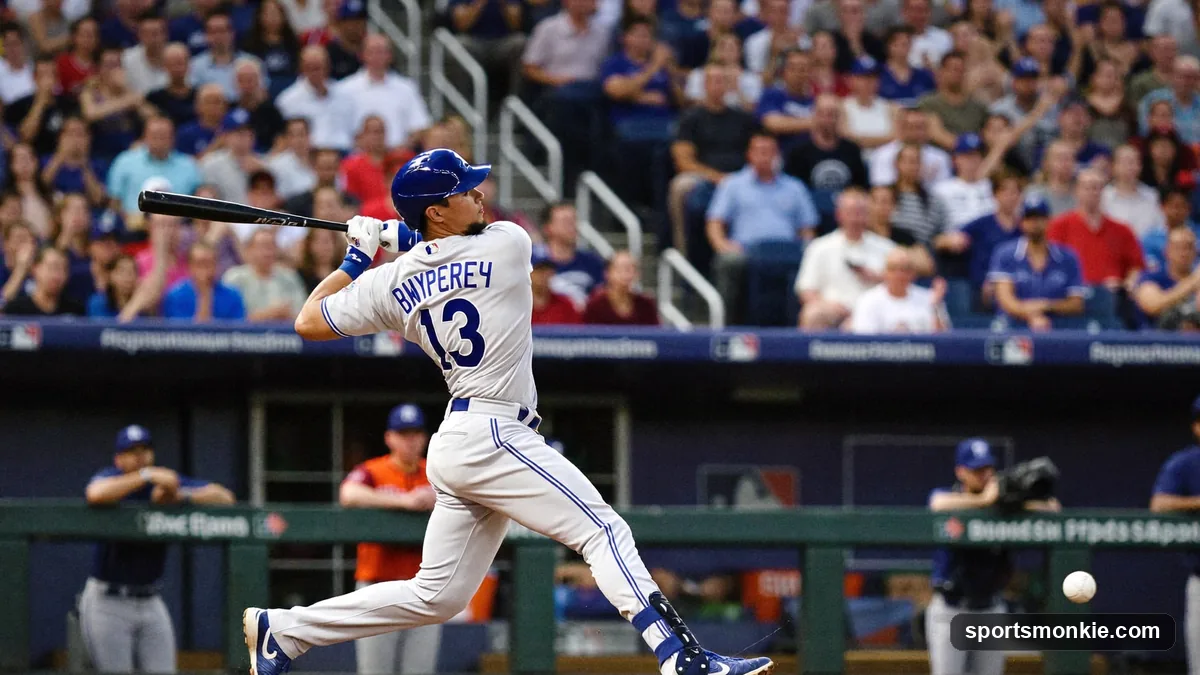
Slugging percentage in baseball is total bases divided by at-bats — a measure of power, not just contact. Where batting average counts a bloop single and a 440-foot home run as the same thing, slugging weights each hit by how many bases it produces. That single change turns a hit-frequency stat into a damage stat, and it is why “SLG” sits next to average and on-base percentage in the standard slash line.
The formula
Slugging starts by counting total bases, then divides by at-bats:
SLG = total bases ÷ at-bats
Total bases are the weighted sum of a hitter’s hits:
Total bases = (1B × 1) + (2B × 2) + (3B × 3) + (HR × 4)
So a double is worth twice a single and a home run four times as much. Walks, hit-by-pitches, and reaching on an error produce zero total bases and do not appear anywhere in the calculation — slugging is blind to them by design.
A worked example
Take a hitter with 500 at-bats and this hit breakdown over the season:
- 90 singles → 90 bases
- 30 doubles → 60 bases
- 3 triples → 9 bases
- 30 home runs → 120 bases
Total bases: 90 + 60 + 9 + 120 = 279
SLG: 279 ÷ 500 = .558
That .558 is elite power output. Notice the 30 home runs alone contribute 120 of the 279 bases — nearly 43 percent. Slugging rewards the long ball heavily, which is exactly the point: it is built to reflect the run-producing weight of each swing.
What counts as a good slugging percentage?
League-average slugging in modern MLB hovers around .400. Here is the scale analysts reach for.
| SLG | Rating |
|---|---|
| .600 and up | Historic, MVP-level power |
| .550 to .599 | Elite |
| .500 to .549 | Excellent, middle-of-the-order |
| .450 to .499 | Above average |
| .400 to .449 | Roughly league average |
| Below .400 | Below average for a regular |
The jump from .450 to .550 is bigger than the raw hundred points suggests — it is the difference between a useful bat and a hitter opposing managers plan their bullpen around. Season leaders routinely clear .600, and the all-time single-season records climb into the .800s, a level reached only in the sport’s most extreme power seasons.
Where slugging fits
Slugging is one half of a full picture, not the whole thing. It says nothing about how often a hitter reaches base, so a free-swinging slugger with a .560 SLG but a poor eye can still make too many outs. That is why it is read alongside on-base percentage, and why the two are added together to form OPS. If you want slugging with the ballpark and league scrubbed out, OPS+ handles that adjustment.
A quick companion stat is isolated power (ISO), which is simply slugging minus batting average — it removes singles to leave only extra-base punch. And for a fuller accounting of a hitter’s total value, WAR folds power in with defense and baserunning.
To see slugging at its historical peak, look at the most home runs in a season — those record holders posted some of the highest slugging figures the game has ever seen. And if you want to know whether the power bat you are eyeing is worth a fantasy deal, our fantasy baseball trade analyzer does the weighing for you.
Bottom line: slugging is total bases over at-bats, it prizes extra-base hits, and while .400 is average, .550 and up is where the true power hitters live.
Frequently asked questions
Why can slugging percentage go above 1.000?+
Because a hitter can average more than one base per at-bat. A home run alone is worth four bases, so a stretch of extra-base hits pushes the rate past 1.000. Over a full season it stays below that, but in a hot week or a single game, slugging over 1.000 is common.
What is the difference between slugging and batting average?+
Batting average treats every hit as equal — a single and a home run each count as one. Slugging weights hits by their bases, so a home run is worth four times a single. Average measures how often you hit; slugging measures how much damage the hit does.
Do walks affect slugging percentage?+
No. Walks are not at-bats and produce no total bases, so they are invisible to slugging. That is on-base percentage's department. A hitter with great plate discipline but little power can post a high OBP and a modest SLG at the same time.
What counts as total bases?+
A single is one base, a double is two, a triple is three, and a home run is four. Add those up across all a player's hits and you have total bases. Reaching on a walk, error, or hit-by-pitch produces zero total bases for slugging purposes.
Is slugging percentage the same as isolated power?+
No, but they are cousins. Isolated power (ISO) is slugging minus batting average, which strips out singles to show extra-base power alone. Slugging includes singles; ISO does not. A .300 hitter with a .550 slugging has a .250 ISO, a strong power figure.
What is a good slugging percentage for a full season?+
League average sits around .400. A .450 to .500 slugging is a solid regular, .500 to .550 is a real middle-of-the-order threat, and .550 or higher marks the elite power bats. The single-season records climb into the .800s, territory only a handful of hitters have reached.
Sources
Play & tools
Free browser games and tools — no account, no download.
- Play 162-0 — Draft nine and see if your roster can survive a flawless 162-game MLB season.
- Explore all our games →
- Analyze a trade — Compare both sides of a fantasy baseball trade before you accept.
- Run the MLB predictor — Simulate the MLB postseason bracket down to a World Series champion.
- Open the ERA calculator — Work out earned run average from earned runs and innings pitched — handles the .1/.2 thirds convention.
- Explore all our free sports tools →
Related baseball guides
View all →
What Is OBP in Baseball? On-Base Percentage Explained
OBP is on-base percentage: how often a hitter reaches base per plate appearance. Here is the formula, a worked example, and what counts as a good OBP.
What Is FIP in Baseball? Fielding Independent Pitching
FIP (fielding independent pitching) is an ERA-scaled stat built only from strikeouts, walks, and home runs. Here is the formula and how to read it.
What Is OPS+ in Baseball? OPS Plus Explained
OPS+ is park- and league-adjusted OPS where 100 is exactly average. Here is the formula, a worked example, and how to read a hitter's OPS plus.
What Is wRC+ in Baseball? Weighted Runs Created Plus
wRC+ is park- and league-adjusted offense on a scale where 100 is average. Here is what it measures, how it is built, and how to read a hitter's wRC plus.
What Is WHIP in Baseball? Good WHIP Explained
WHIP in baseball is walks plus hits per inning pitched. What counts as a good WHIP, the record holders, and how WHIP compares to ERA.
What Is WAR in Baseball? Explained
WAR in baseball is wins above replacement: how many wins a player adds versus a replacement-level fill-in. What a good WAR is, records, and bWAR vs fWAR.