
Rowing Machine Training: Technique, Muscles, and a Beginner Plan

On this page6
- 01What is the correct rowing machine stroke sequence?
- 02What muscles does a rowing machine actually work?
- 03Does a rowing machine actually help you lose weight?
- 04How should a beginner structure a rowing machine workout?
- 05What’s the best rowing machine workout: intervals or steady state?
- 06The bottom line
A rowing machine works your legs, back, core, and arms in one continuous stroke, engaging roughly 80-86% of your total muscle mass per pull, according to Concept2, the company behind the RowErg used in Olympic training. A 30-minute session burns about 210-294 calories at a moderate pace or 255-440 calories at a vigorous one, scaling with your body weight, per Harvard Health. The technique that makes it work, and the thing almost every beginner gets backwards, is sequencing: legs first, then body, then arms, on every single stroke.
What is the correct rowing machine stroke sequence?
Every stroke has four phases, and they only work in one order: catch, drive, finish, recovery.
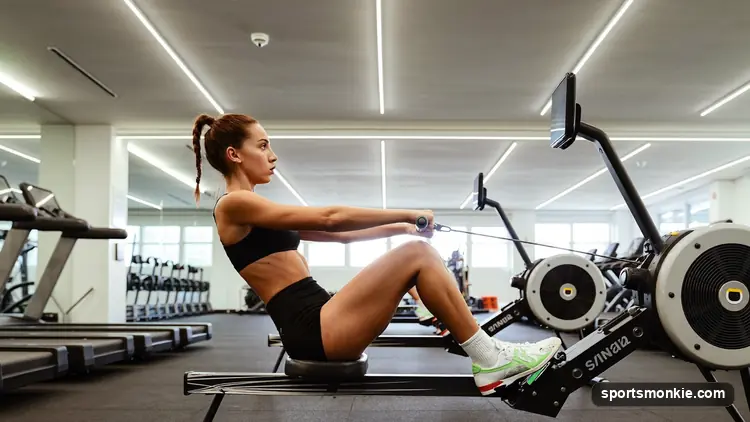
At the catch, you sit with knees bent, shins close to vertical, and arms straight out in front, torso hinged slightly forward from the hips with a flat back. This is the compressed starting position, not a place to relax.
The drive is where beginners go wrong. Concept2’s technique guide describes it plainly: “start the drive by pressing with your legs, and then swing the back through the vertical position before finally adding the arm pull.” Legs, then body, then arms — in that order, every time. Pull with your arms first and you lose most of the power your legs could have generated, plus you load your lower back and shoulders with work they aren’t built to do alone.
At the finish, legs are fully extended, torso leaning back slightly, elbows bent with the handle held lightly just below the ribs. Then the recovery reverses the sequence — arms extend first, torso hinges forward, and only once your hands clear your knees do you bend your legs and slide back to the catch. Recovery should take roughly twice as long as the drive; rushing it is the single most common reason beginners feel rowing in their arms and back instead of their legs.
What muscles does a rowing machine actually work?
Nearly all of them, in a way few other machines manage. Rowing combines a leg press, a hip hinge, and a pulling row into one motion, which is why Concept2 puts total engagement at around 80% of the body’s muscle mass across the stroke.
| Stroke phase | Primary muscles worked | What they’re doing |
|---|---|---|
| Catch | Quads, hip flexors, tibialis anterior | Holding compressed leg position |
| Drive (legs) | Quadriceps, glutes, hamstrings, calves | Generating most of the stroke’s power |
| Drive (body/arms) | Erector spinae, lats, rhomboids, biceps | Transferring power through the torso and pulling the handle |
| Finish | Rear delts, traps, core (abs + obliques) | Stabilizing the extended, slightly leaned-back position |
| Recovery | Core, forearms, grip muscles | Controlling the slide and resetting posture |
That spread is why rowing reads as both a “push” and a “pull” exercise. The leg drive is a pushing motion, similar to a leg press, while the finish is a pulling motion through the back and arms, similar to a seated row. Few cardio machines load both directions of movement in the same session.
Does a rowing machine actually help you lose weight?
It can burn calories at a genuinely high rate, but the machine alone does not create weight loss — your overall calorie balance does. Per Harvard Health’s reference table, 30 minutes of stationary rowing burns:
| Body weight | Moderate effort (30 min) | Vigorous effort (30 min) |
|---|---|---|
| 125 lb (57 kg) | 210 calories | 255 calories |
| 155 lb (70 kg) | 252 calories | 369 calories |
| 185 lb (84 kg) | 294 calories | 440 calories |
Scale that to an hour and moderate rowing lands around 420-590 calories, vigorous effort 510-880, which is competitive with or better than running at a comparable perceived effort for most people, because the added upper-body work raises the total energy cost. But calorie burn during a workout is only one side of the ledger. If you burn 400 calories rowing and then eat back 600 in a post-workout smoothie and snack, you have added weight, not lost it. Rowing is an excellent tool for creating a calorie deficit; it is not a substitute for tracking what you eat.
Where rowing has a real edge over running or cycling for weight loss is adherence: it is low-impact enough on the knees and hips that most people can do it four to five days a week without the joint soreness that derails a running plan, and low-impact consistency beats a harder workout you quit after two weeks.
How should a beginner structure a rowing machine workout?
Start with technique before intensity. Rowing hard with bad sequencing just grooves the wrong pattern faster and is the most common cause of the lower-back and forearm soreness beginners report after their first few sessions. Set the damper (the resistance dial, usually 1-10) to 3-5; it changes how heavy each stroke feels, not how hard the workout is, and a lower setting keeps your stroke rate consistent while you learn.
A simple 4-week beginner progression:
| Week | Session structure | Focus |
|---|---|---|
| 1 | 3x 15-20 min steady, easy pace | Learn legs-body-arms sequencing, low stroke rate (18-20 spm) |
| 2 | 3x 20-25 min steady, moderate pace | Build stroke consistency, stroke rate 20-22 spm |
| 3 | 2x steady + 1x intervals (8x 1 min hard/1 min easy) | Introduce intensity without abandoning form |
| 4 | 2x steady 25-30 min + 1x intervals (6x 2 min hard/1 min easy) | Extend aerobic base and interval tolerance |
By week 4 you’re rowing 3-4 times a week for 25-30 minutes, which lines up with the volume British Rowing’s own beginner indoor plans recommend before progressing to structured pace targets.
What’s the best rowing machine workout: intervals or steady state?
Neither wins outright; they train different things and the best plan uses both.
Steady-state rows — 20-40 minutes at a pace where you could hold a conversation — build the aerobic base that everything else depends on. They’re also the lowest-risk session for a beginner still grooving technique, because there’s no pressure to rush the stroke.
Interval rows — short hard efforts (30 seconds to 2 minutes) with equal or longer recovery — build power and raise your ceiling faster than steady rowing alone, and they’re more time-efficient once your technique holds up under fatigue. A classic beginner-friendly interval set is 8x 500m with 90 seconds rest, or simple 1-minute-on/1-minute-off blocks if you’re not yet tracking distance.
The mistake is doing only one. Steady state without intervals plateaus your fitness; intervals without a steady-state base tend to break technique down under fatigue, which is exactly when rowing-related back and shoulder strain shows up. Two steady sessions and one interval session a week is a sound split for anyone past their first month.
Rowing pairs naturally with running as a cross-training combination — see our breakdown of rowing vs. running for how to split volume between the two without overtraining. If you’re shopping for your first machine, our Concept2 rowing machine guide covers the models worth buying and what separates them from budget alternatives.
The bottom line
Fix your sequencing before you chase intensity. Legs, then body, then arms on the drive; arms, then body, then legs on the recovery. That order alone works nearly every major muscle group, protects your lower back, and turns a 25-minute session into one of the highest calorie-burn, lowest-impact workouts available on a single machine. Pair it with an honest look at what you eat, and rowing earns its reputation as a genuine weight-loss tool rather than just another cardio option.
If you’re getting bored on the erg, our guide to beginner ski conditioning and other cross-training pieces on SportsMonkie can round out a week that doesn’t live entirely on one machine.
Frequently asked questions
Is 30 minutes of rowing a day enough to lose weight? Yes, for most people. Thirty minutes of moderate rowing burns roughly 210-294 calories depending on body weight, and vigorous effort pushes that to 255-440 calories. That is a meaningful daily deficit, but weight loss only happens if total calories eaten stay below what you burn across the whole day, not just during the workout.
Does rowing build muscle or just burn fat? Both, to a point. Rowing loads the legs, back, and arms against resistance on every stroke, which is enough to build noticeable muscle tone and strength in an untrained beginner. It will not replace a squat or deadlift program for maximum size, but it is one of the few cardio machines that also trains pulling strength.
Why does my lower back hurt after rowing? Almost always technique, not the machine. Rounding your spine at the catch or yanking the handle with your arms before your legs finish driving loads the lumbar spine instead of the hips and legs. Keep your back flat with a slight forward hinge, drive with your legs first, and stop if pain continues past a few sessions.
How many times a week should a beginner use a rowing machine? Three to four sessions a week is a realistic start, with at least one rest or light day between harder efforts. That is enough to build the aerobic base and stroke consistency you need before adding volume, and it gives your forearms, grip, and lower back time to adapt to a new movement pattern.
What should my rowing machine damper setting be as a beginner? Somewhere between 3 and 5 on a Concept2-style damper, not the highest setting. The damper controls how much air resistance you feel, not the actual difficulty of the workout, and a lower setting lets you keep a faster, more consistent stroke rate while you learn technique. Save higher settings for once your form is solid.
Is rowing better than the treadmill for weight loss? Neither wins outright. Running at a hard pace can out-burn moderate rowing calorie for calorie, but rowing recruits far more upper-body and back muscle and is far easier on the knees and hips. For most beginners, the machine you will actually use four times a week for weight loss is the better choice.
Frequently asked questions
Is 30 minutes of rowing a day enough to lose weight?+
Yes, for most people. Thirty minutes of moderate rowing burns roughly 210-294 calories depending on body weight, and vigorous effort pushes that to 255-440 calories. That is a meaningful daily deficit, but weight loss only happens if total calories eaten stay below what you burn across the whole day, not just during the workout.
Does rowing build muscle or just burn fat?+
Both, to a point. Rowing loads the legs, back, and arms against resistance on every stroke, which is enough to build noticeable muscle tone and strength in an untrained beginner. It will not replace a squat or deadlift program for maximum size, but it is one of the few cardio machines that also trains pulling strength.
Why does my lower back hurt after rowing?+
Almost always technique, not the machine. Rounding your spine at the catch or yanking the handle with your arms before your legs finish driving loads the lumbar spine instead of the hips and legs. Keep your back flat with a slight forward hinge, drive with your legs first, and stop if pain continues past a few sessions.
How many times a week should a beginner use a rowing machine?+
Three to four sessions a week is a realistic start, with at least one rest or light day between harder efforts. That is enough to build the aerobic base and stroke consistency you need before adding volume, and it gives your forearms, grip, and lower back time to adapt to a new movement pattern.
What should my rowing machine damper setting be as a beginner?+
Somewhere between 3 and 5 on a Concept2-style damper, not the highest setting. The damper controls how much air resistance you feel, not the actual difficulty of the workout, and a lower setting lets you keep a faster, more consistent stroke rate while you learn technique. Save higher settings for once your form is solid.
Is rowing better than the treadmill for weight loss?+
Neither wins outright. Running at a hard pace can out-burn moderate rowing calorie for calorie, but rowing recruits far more upper-body and back muscle and is far easier on the knees and hips. For most beginners, the machine you will actually use four times a week for weight loss is the better choice.
Sources
Play & tools
Free browser games and tools — no account, no download.
- Play today's Sports Connections — Today's Sports Connections — daily hints, answers, and play the grid.
- Play Guess the NFL Player — A new mystery NFL player every day. Eight guesses, with a clue on each — plus free unlimited mode.
- Explore all our games →
Related guides
Rowing Machine to Lose Weight: Does It Work?
Can a rowing machine help you lose weight? How rowing burns calories, why it's full-body, realistic results, and how to train for fat loss.

Heptathlon Training Guide: Beginner and High School Plan
A practical heptathlon training guide for beginners and high school athletes, with weekly structure, event priorities, recovery and common mistakes.

8-Week 5K Training Plan (Beginner to Intermediate)
This 8-week 5K training plan runs three to four days a week, mixing easy runs, intervals, one tempo run, and a weekly long run to get you to the finish line faster. Full week-by-week schedule and target-time paces.

12-Week Half Marathon Training Plan (Beginner to Sub-2:00)
A 12-week half marathon training plan that builds from a 3-mile base to race day: easy runs, one long run per week to 11-12 miles, weekly tempo and interval work, then a 2-week taper and a paced race strategy.

Beginner Running Plan: 8-Week Run-Walk Schedule
Start running with an adaptable 8-week run-walk plan: three sessions a week, rest days, pacing guidance and clear rules for repeating a week.
10K Training Plan: A 10-Week Schedule to Race Day
This 10K training plan builds from a 5K base over 10 weeks with easy runs, weekly tempo and interval sessions, a long run to 7-8 miles, and a taper.