
Silver's Smart Ball Puts a One-Gram Chip Inside the NBA's Ball, and Fans Smell a Magnet
On this page5
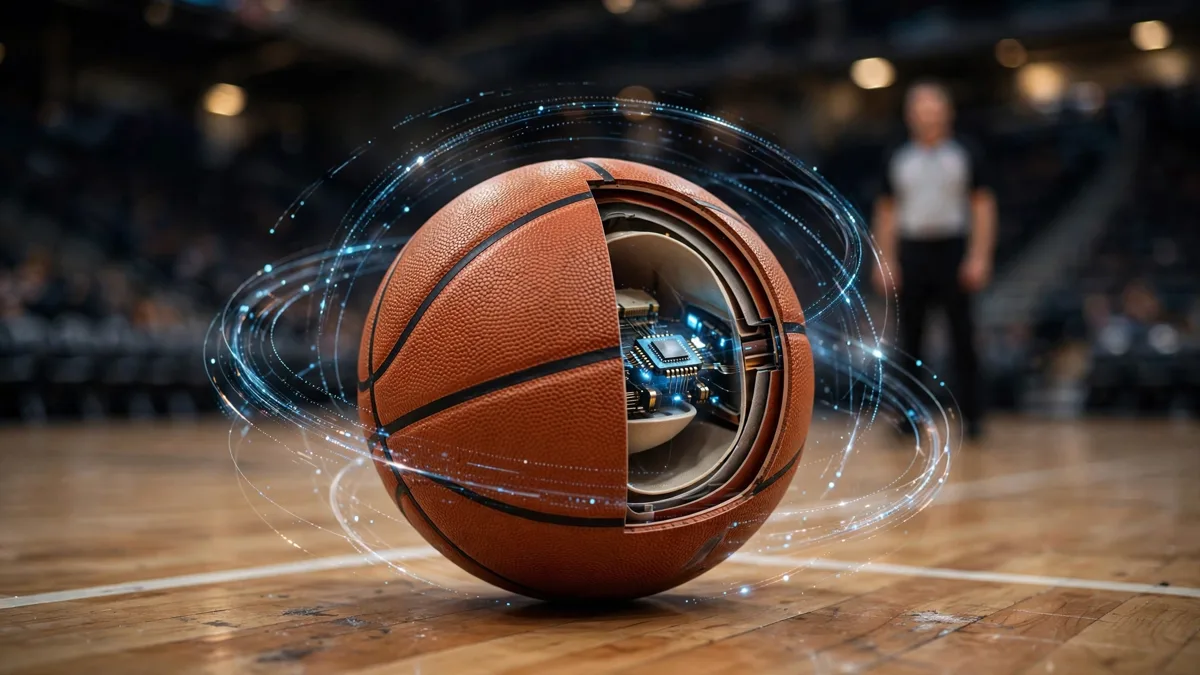
The NBA wants to put a witness inside the basketball. Commissioner Adam Silver said on Sunday that the league is experimenting with a Wilson smart ball containing a chip that weighs roughly one gram, and that the technology could be used for officiating in NBA games as soon as next year, OpenCourt Basketball reports. The announcement landed in a league already arguing about what it measures, the same weekend NBA players’ fears about wearable data being used against them in contract talks became a story of their own. The ball, unlike the players, cannot object to being tracked.
What can a one-gram chip actually tell an official?
More than a camera can, on two specific calls. Silver explained that any change in the ball’s spin can reveal whether a finger touched it as it went out of bounds, which is the last-touch question that replay reviews routinely fail to settle, Basketball Network reports. The same principle applies to a shot’s arc: if the trajectory changes in flight, something touched it, which speaks directly to goaltending. Those are measurement questions dressed up as judgement questions, and a sensor answers the measurement half instantly. The league has been moving this way for a while, through Hawk-Eye camera decisions in the playoffs, Basketball Network reports, and the chipped balls long used in the NFL and in leading soccer tournaments, Fadeaway World reports. A chipped ball is the logical end of that road: instead of watching the play from twelve angles, ask the ball what happened to it.
Why does the one gram matter so much?
Because players would reject anything heavier, and Silver knows it. A standard NBA ball weighs roughly 620 grams, so the chip adds about a sixth of one percent, OpenCourt Basketball reports. The league tested chipped and ordinary balls alternately in the G League, Summer League and preseason settings, and Silver’s headline finding was that nobody could tell the difference. That blind test is the whole ballgame for adoption. Basketball players are famously sensitive to the ball, its grip, its seams and its bounce, and a technology that altered any of them would be dead before the first review it settled. One gram is not a compromise; it is the design brief.
Why did fans reach for the magnet-ball joke?
Because a chip inside the ball sounds, to a suspicious ear, like a mechanism rather than a measuring device. Pro Football Network collected the reaction, fans calling the plan magnet ball 2.0 and joking that the league was not even trying to hide it. The joke deserves a straight answer, because the physics is not close. The device Silver described is a passive sensor: it records spin and trajectory and transmits data. It has no motor, no magnet and no way to push against anything, and at one gram it is roughly one six-hundred-and-twentieth of the object it would supposedly be steering. Compare the calls this league actually argues about, the first push-off call under the NBA’s new emphasis this preseason or a flagrant-versus-technical split decided on review in a preseason scuffle: those are human judgements. The chip addresses the other category, the fingertip on the ball that no camera angle caught, and it is telling that the conspiracy version travelled faster than the officiating one.
How does this fit the league’s wider data argument?
It routes around it. In the same round of comments, Silver conceded that wearable trackers in games remain blocked because the players’ association will not agree how the data may be used, with players worried that evidence of slowing down could surface in bargaining, Basketball Network reports. That dispute is about data generated by a player’s body, which is why a contract standoff like Karl-Anthony Towns’ with the Knicks makes it so sensitive: anything measurable becomes negotiable. The ball’s data belongs to no one’s body. It describes the game, not the athlete, so the league can adopt it without a bargaining fight, and Silver’s as-soon-as-next-year timeline, against the wearables’ indefinite delay, shows the difference. The NBA is not short of technology it wants to use. It is short of technology nobody has a contractual reason to refuse.
What happens next?
A decision on whether next season’s games use the chipped ball for officiating, which Silver framed as a live possibility rather than a distant one, OpenCourt Basketball reports. The consumer version, which would let a young player graph hundreds of shots and compare the flight of makes and misses, is a few years away on his account. Between now and any rollout sit the ordinary questions of accuracy, failure rates and who sees the data first, the officials or the broadcast. But the direction is set, and it started with a gram of electronics that the players who tested it could not feel. The most consequential piece of equipment in next season’s reviews may be the one nobody noticed was different.
Frequently asked questions
What is the NBA's smart ball?+
A Wilson basketball with a small sensor embedded in it. Silver said the chip weighs roughly one gram, while a standard NBA ball weighs around 620 grams, OpenCourt Basketball and Basketball Network report. It records the ball's movement, spin and changes in trajectory, and the data is aimed first at officiating rather than at fans.
How would a chip in the ball help referees?+
By registering touches that replay can miss. Silver explained that a change in the ball's spin can show whether a finger brushed it before it went out of bounds, settling last-touch calls, and a change in a shot's arc can speak to goaltending, Basketball Network reports. Those are two of the most argued-over judgement calls in the game.
When could the smart ball be used in NBA games?+
As soon as next year, for officiating, on Silver's own timeline, OpenCourt Basketball reports. The league has already alternated chipped and ordinary balls in the G League, Summer League and some preseason settings, and Silver said the most encouraging finding is that nobody could tell the difference between them.
Why are fans calling it a magnet ball?+
As a joke with a suspicious edge. Pro Football Network collected the reaction, including fans labelling the plan magnet ball 2.0 and saying the league was not even trying to hide it. There is no evidence behind the gag: the device Silver described is a passive one-gram sensor that measures the ball, inside a ball roughly 620 times heavier, with no mechanism to move it.
Has basketball technology like this been used before?+
Chipped balls are established elsewhere and camera systems are already in the NBA. The NFL and leading soccer tournaments use chips in their balls, Fadeaway World reports, and the NBA's Hawk-Eye camera system was used to overturn a call against LeBron James in the 2025 playoffs, Basketball Network reports. The smart ball extends that logic from the arena's cameras into the ball itself.
What else could the chip be used for?+
Coaching, eventually, and a consumer product a few years away. Silver said a user could graph hundreds of their own shots and compare the characteristics of makes and misses to adjust their shooting, OpenCourt Basketball reports. He was clear that version is years off; the officiating use comes first.
How does the smart ball sit with the players' data concerns?+
Awkwardly, in the same week. Silver's smart-ball comments came alongside his admission that the league has not agreed with the players' association on using wearable data in games, because players fear a measured decline could be used against them in bargaining. A sensor in the ball generates league-owned data about the game rather than about a player's body, which may be exactly why it is moving faster.
Sources
- OpenCourt Basketball: NBA could introduce smart ball technology as soon as 2027 (the one-gram chip, the spin and trajectory tracking, the G League and Summer League tests and the consumer version being years away)
- Basketball Network: Adam Silver explains how Wilson's smart ball could change NBA (the finger-touch and goaltending explanations, the 620-gram comparison, the Hawk-Eye precedent and the wearable-data answer in the same appearance)
- Pro Football Network: NBA fans raise red flags over Adam Silver's plan to test microchip-embedded basketballs (the magnet-ball reaction, the SleeperHoops summary of the plan and the as-soon-as-next-year timeline)
- Fadeaway World: Adam Silver's plan to test microchip-embedded basketballs has NBA fans worried about the future of the game (the CNBC interview setting and the NFL and soccer chip precedents)
Play & tools
Free browser games and tools — no account, no download.
- Play 82-0 — Draft five, one per position, and see if your lineup can go a flawless NBA season.
- Play Era Ball — Draft an all-time NBA roster from a single era, then simulate a season and chase a perfect run.
- Play 32-0 — Draft five college basketball legends, one per position, and chase a perfect 32-0 national title.
- Explore all our games →
- Get the printable bracket — Download and print a blank tournament bracket to fill out by hand.
- Open the TS% calculator — Calculate TS% from points, field goal attempts and free throw attempts — scoring efficiency in one number.
- Explore all our free sports tools →
Related basketball guides
View all →
NBA Players Fear Wearable Tech Data Could Be Used Against Them in Contract Talks
Adam Silver says the NBA and the Players Association have no agreement on wearable tech in games, because players fear their own data could be used in bargaining.
Scottie Barnes Gets First Push-Off Call as NBA's New Emphasis Debuts in Preseason Opener
Scottie Barnes was whistled for an off-arm push-off inside two minutes of the Raptors' preseason opener, the first call under the NBA's new point of emphasis.
Jaylen Brown Watches His Boston Return From the Locker Room as Fans Call Him Dramatic
Jaylen Brown's first game back at TD Garden as a 76er ended with him resting, off the bench and watching from the locker room while Celtics fans mocked the absence.
Caleb Wilson Drops a Defender and Scores 20 in the Second Half After One in the First
Bulls rookie Caleb Wilson had one point at half-time in Memphis, then 20 after it, a viral ankle-breaker three in the last minute and the final shot.
Liberty Say They Were Told No Reset Timeout, Officials Say No One Asked in 101-98 Loss
New York say officials told them no reset timeout remained in overtime, the pool report says the opposite, and the Liberty have filed an inquiry down 2-0 to Atlanta.
The Warriors Say They Don't Know Where Kristaps Porzingis Is
Golden State says it does not know where Kristaps Porzingis is, what he is dealing with health-wise, or when he might return to the court.