
10 Most Popular Football Jersey Numbers and the Legends Who Wore Them
On this page13
- 01A Brief History of Football Numbering
- 02The Most Popular Football Jersey Numbers at a Glance
- 03No. 10 — Still the Most Coveted Number in the Game
- 04No. 7 — The Number That Became a Brand
- 05No. 9 — Built for Strikers
- 06No. 1 — The Goalkeeper’s Number, Non-Negotiable
- 07No. 11 — The Left Winger’s Shirt
- 08No. 8 — The Box-to-Box Playmaker
- 09No. 3 — Attacking Full-Back Royalty
- 10No. 6 — Leadership at the Back
- 11No. 5 — Reinvented by Zidane and Puyol
- 12No. 4 — The Modern Defensive General
- 13How We Ranked Them
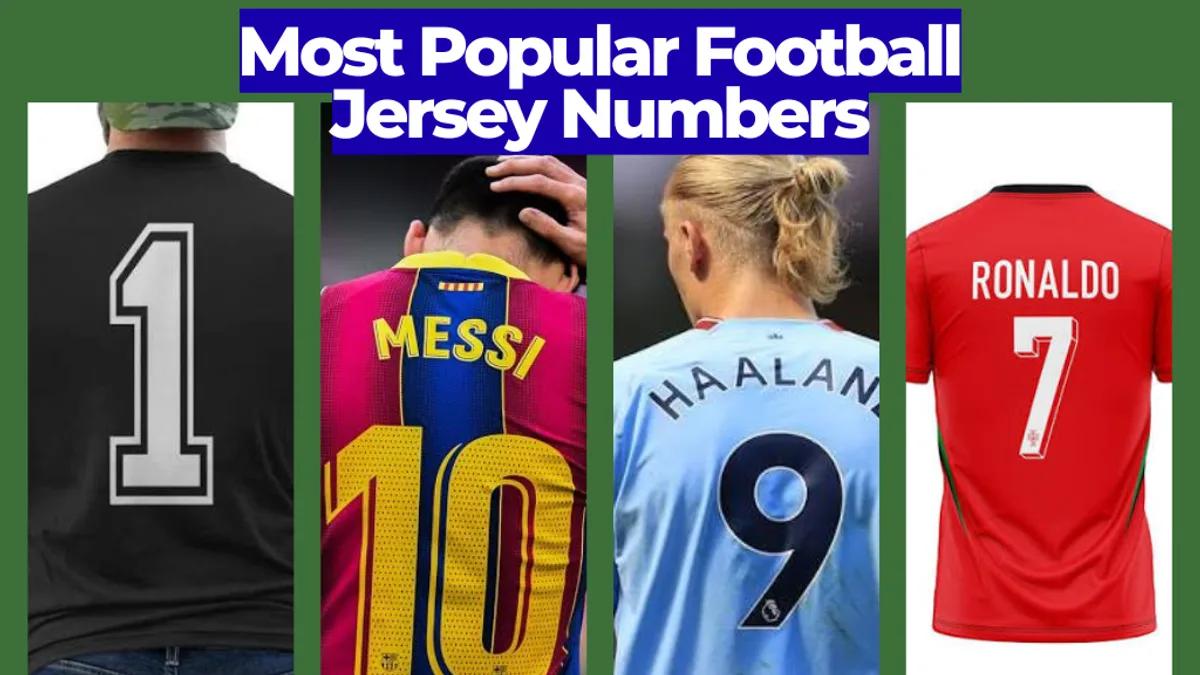
When Cristiano Ronaldo signed for Juventus in 2018, he reportedly paid a teammate to give up the No. 7 shirt. That’s what these numbers are worth to the players who wear them. No. 10 means creative genius, No. 9 means goals, No. 1 means the last line of defence before the net. Decades of specific players wearing specific numbers built those meanings, and even now, with squad numbering loosening the old positional rules, the associations haven’t gone anywhere. Here are the 10 most popular football jersey numbers, ranked, and the legends behind each one.
A Brief History of Football Numbering
Before the 1990s, most leagues used fixed positional numbers: the goalkeeper wore 1, the right-back wore 2, the striker wore 9, and the creative midfielder behind the forwards wore 10. Anyone in the stands could read a team’s shape just from the numbers on their backs. Squad numbering, where a player keeps one number for a season regardless of position, became standard in England starting in 1993 and spread from there. Players grew more attached to specific numbers as personal brands, even as the old positional logic faded across world football.
The Most Popular Football Jersey Numbers at a Glance
| Rank | Number | Defining Wearer(s) | Why It’s Iconic |
|---|---|---|---|
| 1 | No. 10 | Pelé, Maradona, Zidane, Messi | Football’s ultimate playmaker number |
| 2 | No. 7 | Cristiano Ronaldo, Beckham, Best | Flair, pace and commercial superstardom |
| 3 | No. 9 | Ronaldo Nazário, Haaland, Benzema | The pure goalscorer’s number |
| 4 | No. 1 | Buffon, Schmeichel, Neuer | Non-negotiable goalkeeper’s shirt |
| 5 | No. 11 | Giggs, Bale, Neymar | Left wing pace and dribbling |
| 6 | No. 8 | Gerrard, Iniesta | Box-to-box leadership and big-game goals |
| 7 | No. 3 | Roberto Carlos, Ashley Cole | Attacking full-back royalty |
| 8 | No. 6 | Bobby Moore, Beckenbauer, Baresi | Defensive leadership and captaincy |
| 9 | No. 5 | Zidane, Puyol | Reinvented as a creator’s or leader’s number |
| 10 | No. 4 | Vieira, Sergio Ramos, Van Dijk | The modern defensive general |
No. 10 — Still the Most Coveted Number in the Game
No shirt number carries more weight than the 10. It traces back to Pelé at the 1958 World Cup, where Brazil’s alphabetical squad list happened to hand the 17-year-old the number; he made it legendary on his own. Diego Maradona wore it for Argentina through the 1986 World Cup win, and Zinedine Zidane carried it for France. Lionel Messi has worn 10 for Argentina and now Inter Miami, taking the number to Major League Soccer after his 2023 move and winning the 2024 Copa América wearing it. At club level, the No. 10 usually goes to the most technically gifted player in the squad, and wearing it comes with an expectation attached.
No. 7 — The Number That Became a Brand
At Manchester United, the No. 7 passed from George Best to Bryan Robson, then Eric Cantona, then David Beckham, then Cristiano Ronaldo, whose run with the number turned it into one of the most commercially valuable shirts in world football. At Real Madrid, Raúl wore it before Ronaldo arrived and took over. Ronaldo has kept the No. 7 at every stop since, including Al-Nassr in the Saudi Pro League, where he has continued breaking scoring records into his 40s. Each handoff added another layer to what the number now means.
No. 9 — Built for Strikers
A true No. 9 scores goals for a living. Brazilian striker Ronaldo defined the role for a generation, and his performances at the 1998 and 2002 World Cups tied the number permanently to explosive, physical finishing. Karim Benzema wore it through his Real Madrid prime and now wears it at Al-Hilal in Saudi Arabia, Robert Lewandowski wears it at Barcelona, and Harry Kane wears it at Bayern Munich, where he became one of the most prolific strikers in Bundesliga history. Erling Haaland took the No. 9 at Manchester City in 2022, succeeding Gabriel Jesus, and has scored at a rate few of his predecessors matched.
No. 1 — The Goalkeeper’s Number, Non-Negotiable
No. 1 is the one number squad numbering never really touched — it still means starting goalkeeper almost everywhere. Gianluigi Buffon wore it for Italy and Juventus across two decades at the top of the position. Peter Schmeichel wore it during Manchester United’s 1999 treble season, and Manuel Neuer has worn it for Bayern Munich and Germany while redefining the “sweeper-keeper” style of play. Petr Cech, who wore it through Chelsea’s most successful era, is another name permanently tied to the shirt.
No. 11 — The Left Winger’s Shirt
Ryan Giggs wore No. 11 for virtually his entire Manchester United career, retiring with the club’s all-time appearance record. Gareth Bale wore it at Real Madrid, scoring winning goals in multiple Champions League finals. Neymar wore 11 at Barcelona as part of the “MSN” attacking trio alongside Messi and Luis Suárez before switching to 10 at Paris Saint-Germain and Al-Hilal. Across all three, the number has stayed tied to pace, dribbling and wide attacking threat, echoing the best strikers in world football who share the frontline with them.
No. 8 — The Box-to-Box Playmaker
Steven Gerrard captained Liverpool wearing No. 8 through the club’s most dramatic modern moment, the 2005 “Miracle of Istanbul” Champions League final comeback. Andrés Iniesta wore it for Barcelona and Spain, scoring the winning goal in the 2010 World Cup final. Both built the number’s reputation around late goals, leadership and covering every blade of grass — the archetype of a true box-to-box midfielder.
No. 3 — Attacking Full-Back Royalty
Roberto Carlos turned No. 3 into a statement at Real Madrid, combining defensive pace with a free-kick technique that made him one of the most feared set-piece takers of his era. Ashley Cole wore it for Arsenal, Chelsea and England, regarded by many as the finest defensive left-back of his generation. Both proved a full-back’s shirt could carry as much prestige as an attacker’s.
No. 6 — Leadership at the Back
Bobby Moore wore No. 6 as England’s captain when they won the 1966 World Cup, lifting the trophy at Wembley. Franz Beckenbauer, nicknamed “Der Kaiser,” wore it for West Germany while pioneering the attacking libero role from central defence. Franco Baresi wore it through AC Milan’s dominant era in the late 1980s and early 1990s. All three built the number’s reputation as the shirt for a team’s calmest leader.
No. 5 — Reinvented by Zidane and Puyol
No. 5 traditionally belonged to a stopping centre-back, but Zinedine Zidane changed that at Real Madrid. When he joined in 2001, club convention reserved numbers 1 through 10 for the biggest arrivals, and Zidane chose 5, wearing it through his volleyed winner in the 2002 Champions League final. Carles Puyol wore 5 at Barcelona and scored the winning header in Spain’s 2010 World Cup semi-final against Germany, adding a defender’s edge back to the number.
No. 4 — The Modern Defensive General
Patrick Vieira wore No. 4 through Arsenal’s unbeaten 2003-04 “Invincibles” season, anchoring midfield rather than defence. Sergio Ramos made the number synonymous with late, dramatic goals at Real Madrid, including a stoppage-time equaliser in the 2014 Champions League final. Virgil van Dijk wears No. 4 for both Liverpool and the Netherlands today, captaining club and country from centre-back as one of the sport’s most complete modern defenders.
How We Ranked Them
This list weighs three things together: how many genuine legends wore each number, how consistently the number’s meaning has held across clubs and eras, and how visible the number remains in the current game — from Messi’s 10 at Inter Miami to Haaland’s 9 at Manchester City. Numbers with a deep, unbroken chain of iconic wearers rank above numbers tied to just one or two great players, which is why 10, 7 and 9 sit at the top and why full-back and midfield numbers like 3, 5 and 8 still make the cut. For the players carrying these numbers into the current era, see our rankings of the best football strikers right now and the greatest soccer players of all time.
Frequently asked questions
What is the most popular jersey number in football?+
No. 10 is the most popular and prestigious jersey number in football. Pelé, Diego Maradona, Zinedine Zidane and now Lionel Messi have all worn it during defining stretches of their careers, cementing it as the number for a team's chief creator and best player.
Who wears No. 7 in football and why is it iconic?+
No. 7 has been worn by George Best, Bryan Robson, Eric Cantona, David Beckham and Cristiano Ronaldo, most famously as a Manchester United lineage. Ronaldo carried the number to Real Madrid, Juventus and Al-Nassr, turning it into one of the most commercially valuable shirts in world football.
Which players wear No. 9 and what does it mean?+
No. 9 belongs to the team's main striker. Ronaldo Nazário, Karim Benzema, Robert Lewandowski, Harry Kane and Erling Haaland have all worn it, and it remains shorthand for a pure, prolific goalscorer.
What number do goalkeepers wear in football?+
Goalkeepers traditionally wear No. 1, a tradition upheld by Gianluigi Buffon, Peter Schmeichel and Manuel Neuer. In modern squad-numbering systems a backup keeper may wear a different number, but the No. 1 shirt still signals a club's first-choice goalkeeper.
Why did Zinedine Zidane wear No. 5 instead of No. 10 at Real Madrid?+
Real Madrid president Florentino Pérez asked incoming stars to pick from numbers 1 to 10 when Zidane joined in 2001, reserving 1 for the goalkeeper. Zidane chose 5, and wore it through his entire Bernabéu career, including his volleyed winner in the 2002 Champions League final.
Can football players choose any squad number they want?+
Within league rules, yes — squad numbering lets players request any available number, which is why unusual choices like high numbers or a birth year show up. Clubs sometimes retire a number to honour a legendary player, and it can no longer be issued.
What jersey number does Lionel Messi wear now?+
Messi wears No. 10 at Inter Miami, the number he took to Major League Soccer after his 2023 move and wore again while winning the 2024 Copa América with Argentina.
Sources
Play & tools
Free browser games and tools — no account, no download.
- Play 38-0 — Sign a 4-4-2 of all-time football legends and chase a perfect 38-0 league season — perfect, not just unbeaten.
- Explore all our games →
Related football guides
View all →
Offensive Positions in Football Explained: Every Role on the Unit
Offensive positions in football explained: QB, RB/FB, WR, TE, and the five offensive line spots (LT, LG, C, RG, RT) with duties and alignment.
Football Positions Explained: Every Offense, Defense & Special Teams Role
Football positions explained: every offense, defense, and special teams role in American football, what each one does, and how they fit together.
Inverted Fullback Explained: What It Means in Soccer Tactics
What is an inverted fullback in soccer? Learn how the role works, why Pep Guardiola popularized it, and which players do it best.
Quarterback Position in Football: Role, Skills, and Responsibilities Explained
The quarterback position leads the offense, calling plays, taking the snap, and throwing or handing off the ball. Learn the QB's full job in football.
What Is a Cornerback in Football? Position, Role & Skills Explained
A cornerback in football is the defensive back who covers wide receivers in man or zone coverage. Learn the role, skills, and famous CBs.
What Is a Linebacker in Football? Position, Roles & Types Explained
A linebacker (LB) is a defensive player who lines up behind the line to stop the run, cover receivers, and blitz the quarterback. Full breakdown here.