
How Many Acres Is a Golf Course? Size by Course Type
On this page8
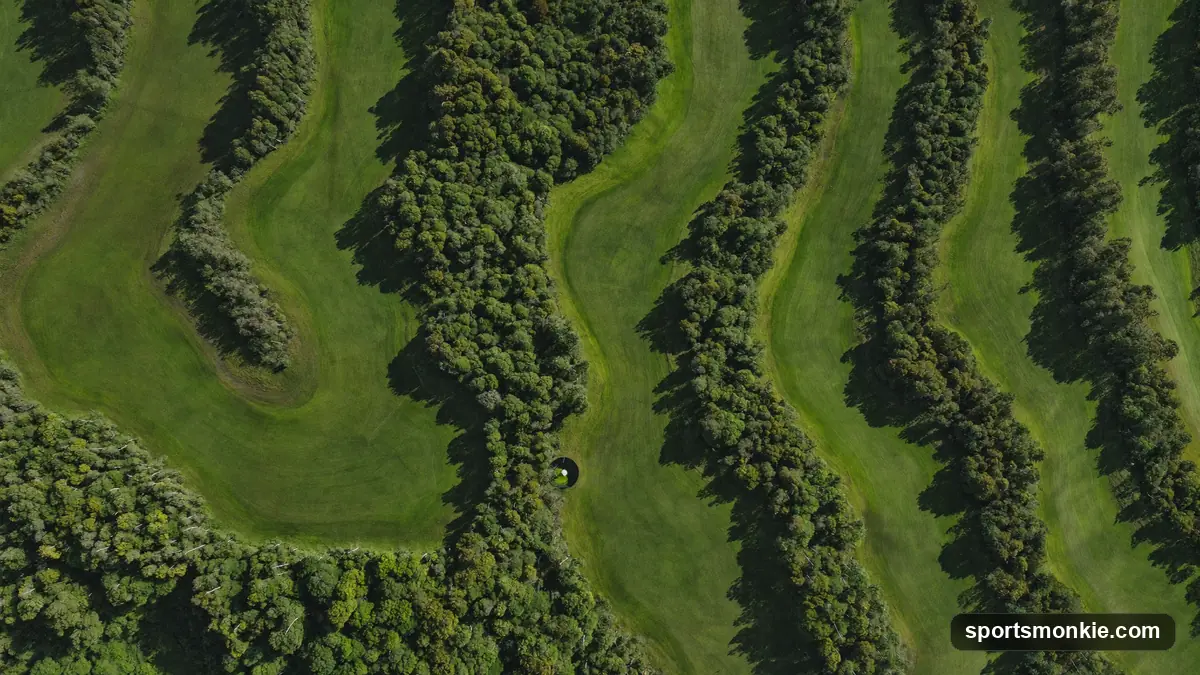
A regulation 18-hole golf course covers about 110 to 190 acres, with the U.S. average close to 150 acres, according to land-use surveys from the Golf Course Superintendents Association of America (GCSAA). Around 100 of those acres are maintained turfgrass; the rest is rough, water, native areas, and buildings. Course type moves the number a lot, so the honest answer is a range, not a single figure.
Here is how the acreage breaks down by course type, what eats up the land, and how much of the country golf actually occupies.
Acreage by course type
Not every “golf course” needs the same footprint. A short par-3 track and a championship resort layout can differ by a factor of five or more. This table sets the working numbers.
| Course type | Typical acreage |
|---|---|
| Pitch-and-putt / short par-3 (18 holes) | 30–60 acres |
| Executive course (par 3s and short 4s) | 75–100 acres |
| Regulation 18-hole, tight urban site | 110–120 acres |
| Regulation 18-hole, U.S. average | ~150 acres |
| Resort / championship, wide corridors | 170–200 acres |
The American Society of Golf Course Architects (ASGCA) frames it the same way: a course of all short par-3s can be built on as little as 30 acres, an intermediate or executive 18 needs 75 to 100 acres, and a full-size par-72 layout wants 120 to 200 acres depending on the site.
What actually uses the land
The playable turf is a smaller share of the total than most golfers assume. GCSAA’s land-use survey puts the average maintained turfgrass on an 18-hole facility near 100 acres, split roughly into fairways of about 32 acres and rough of about 67 acres, with greens and tees making up only a few acres combined.
The remaining 40 to 90 acres on a typical property go to features that never get mown to fairway height: water hazards, wetlands and drainage, native and out-of-play zones, cart paths, practice areas, the clubhouse, and parking. Courses on rolling or wooded land use more total acreage because the corridors between holes have to be wider for safety and the routing has to work around terrain.
Why length and routing move the number
Two courses can both be regulation 18-hole layouts and still differ by 50 acres, because total yardage and routing drive the footprint. A longer par-72 with several 500-plus-yard par-5s needs more land end to end than a shorter one, and every extra yard of hole also needs width on both sides for safety and errant shots. A course stretched to 7,200 yards for tournament play simply occupies more ground than a 6,200-yard members’ course.
Routing style matters as much as length. A “core” course, where holes loop back on themselves in a compact block, packs into less land than a “housing” or “real estate” course, where each hole is separated by homes and roads and the whole layout sprawls across the property. The same 18 holes can sit on 130 acres as a tight core or 200-plus acres threaded through a subdivision.
Why urban and resort courses differ so much
Location is the single biggest swing factor. A course squeezed into a city or suburb is built to a tight budget of land, often 110 to 120 acres, with holes running close together and narrow buffers between them. Resort and destination courses do the opposite: generous corridors, large landing areas, and scenic buffer land push them toward 170 to 200 acres, sometimes more when the developer wraps housing or open space around the golf.
Climate matters too. Desert courses in the U.S. Southwest maintain far less turf, because unirrigated desert fills the space between holes, which is one reason water use varies as widely as it does. Our how much water does a golf course use guide covers that side of the equation.
What about a 9-hole course?
A 9-hole regulation course is not simply half an 18. It typically covers 50 to 100 acres, because the fixed elements, a practice range, clubhouse, parking, and maintenance yard, do not shrink with the hole count. A par-3 or executive 9 can fit on 20 to 45 acres, which is why short 9-hole layouts are the format of choice for tight suburban sites and community courses. The land savings come from fewer and shorter holes, not from proportionally less support land.
Is 20 acres ever enough?
For a regulation course, no. Twenty acres cannot hold 18 holes long enough to test a full set of clubs. What 20 acres can support is a short-game facility: a pitch-and-putt, a par-3 loop of a few holes, or a driving range with a small practice course attached. If the goal is a genuine 18-hole round, the floor is roughly 30 acres for an all-par-3 layout and well over 100 acres for anything at regulation length.
How much of the U.S. is golf?
Golf occupies far less land than the debate around it suggests. GCSAA survey work projected U.S. golf facilities at roughly 2.3 million acres in total. Set against a national land area of about 2.43 billion acres, that is under 0.1% of the country, less than one-tenth of one percent. Put differently, every golf course in America combined would fit inside a single small state.
Course supply has also been shrinking. The National Golf Foundation has tracked more closures than openings for well over a decade, as weaker operators shut and the total number of U.S. courses drifts down from its mid-2000s peak.
Planning around the number
If you are sizing up a site or just settling a clubhouse argument, start from the type of course, not a single average. A regulation 18 needs 120-plus acres to be built properly; anything less means a shorter, tighter layout. Owners weighing the economics should look past the land to the rounds and revenue, since acreage is a fixed cost and profitability lives on the number of golfers who show up. For the player’s side of that math, our average cost of a round of golf breakdown shows where the green fee actually goes.
Frequently asked questions
Is 20 acres enough for a golf course?+
Not for a regulation course. Twenty acres suits a short par-3 layout, a pitch-and-putt, or a practice range with a few holes. A full 18-hole par-3 course needs roughly 30 to 60 acres, and a regulation 18 needs well over 100, so 20 acres only supports a compact, short-game facility.
How many acres do most 18-hole courses use?+
A regulation 18-hole course typically covers 110 to 190 acres, with the U.S. average close to 150 acres, per GCSAA land-use data. Tight urban courses sit near 110 to 120 acres, while resort and championship layouts with wide corridors reach 170 to 200 acres.
How profitable is owning a golf course?+
Margins are thin and depend on rounds played, membership, and food-and-beverage income. Many U.S. courses run close to break-even, and the National Golf Foundation notes course supply has fallen for years as weaker operators close. Profitability leans on location, private versus public model, and non-golf revenue.
What percent of US land is golf courses?+
Very little. U.S. golf facilities cover roughly 2.3 million acres, based on GCSAA survey projections, against a national land area of about 2.43 billion acres. That is under 0.1%, or less than one-tenth of one percent, of all land in the United States.
Sources
Play & tools
Free browser games and tools — no account, no download.
- Play today's Sports Connections — Today's Sports Connections — daily hints, answers, and play the grid.
- Play Guess the NFL Player — A new mystery NFL player every day. Eight guesses, with a clue on each — plus free unlimited mode.
- Explore all our games →
Related golf guides
View all →
What Is a Municipal Golf Course?
A municipal golf course is a public course owned by a local government. What 'muni' means, how it differs from other public courses, and who runs it.

How Long Does 9 Holes of Golf Take? Times by Group Size
Nine holes of golf takes about 2 to 2.5 hours for a foursome, and closer to an hour on your own. See how long 9 holes take by group size and cart use.

How Many Dimples on a Golf Ball? Why They Exist
Most golf balls have 300 to 500 dimples. A Titleist Pro V1 has 388. Here is why the count varies and how dimples cut drag and add distance.

How Much Water Does a Golf Course Use? The Real Numbers
A typical 18-hole golf course uses roughly 90–130 million gallons of water a year, but desert courses use far more and rainy ones far less. The real figures, by region.
The Longest Golf Courses in the World
The longest golf course in the world is Australia's Nullarbor Links at 1,365 km. The longest conventional 18-hole course is Jade Dragon in China at 8,548 yards.
What Is an Executive Golf Course? Length and Par Explained
An executive golf course is a shorter, lower-par layout with more par 3s and a quicker round. Here is the typical length, par and how it compares.