
Why Could VAR Not Send Off Morgan Rogers at Everton?
On this page6
Chelsea won 2-0 at Everton on Saturday with a second-half brace from Pedro Neto, and by Monday the result had a referee attached to it. Three former Premier League officials, Mark Clattenburg, Mike Dean and Dermot Gallagher, each said Morgan Rogers should have been punished for his sliding challenge on James Garner just before half-time. Rogers was already on a yellow card. He stayed on the pitch anyway, because the one route that might have removed him is a route the rules close off.
What happened between Rogers and Garner just before half-time?
Rogers had been booked in the 33rd minute, after a tussle with Everton captain James Tarkowski that ended with the two holding each other’s shirts and being separated, and both cautioned, football.london reports. Minutes later, just before the break, Rogers and Garner went into a sliding 50/50 challenge and both ended in a heap, with Garner particularly unhappy about how Rogers arrived. Referee Paul Tierney played on. No free kick, no foul, no card. Both players needed a moment, and the game reached half-time at 0-0 with Everton’s players and crowd convinced a second yellow had been missed.
What did the three former referees say?
They agreed on the destination and argued about the route. Clattenburg called the challenge a clear foul and a clear reckless challenge, because of the speed, the force and a clear contact on the knee, and said it was a yellow card if identified by the referee, which for a player already booked means a sending-off, football.london reports. Dean went further on Soccer Saturday: a minimum yellow, and his own call was a straight red straight away, because Rogers did not get the ball and caught Garner with his stud on the inside of the knee. Gallagher, on Sky Sports’ Ref Watch on Monday, placed the challenge on the threshold of a straight red and said Rogers was lucky the referee did not even give a free kick, BritBrief reports. Three officials, three calibrations, one shared conclusion: play should not simply have continued.
Why could VAR not give Rogers a second yellow?
Because a second yellow is the one sending-off the system is forbidden to manufacture. VAR can intervene for a straight red card. It cannot upgrade a non-decision into a booking, and it cannot hand out a yellow card of any kind, first or second. Clattenburg spelled out the consequence: VAR does not have the power to issue a second yellow card where the referee has not given one, football.london reports. Gallagher explained the trap Tierney’s decision created: once the referee plays on and gives no foul, the VAR’s only remaining question is whether the challenge clears the far higher straight-red bar, and a challenge three experienced officials place somewhere between a yellow and a red sits exactly in the gap the protocol leaves open. The desk has seen the two neighbouring cases this season: Gravenberch’s red card at Anfield, where the verdicts split over a harsh first yellow and a clear second, was a dismissal the on-field referee actually gave, and Yarmolyuk’s headbutt red card at Brentford sat in violent conduct, a category the review system can always reach.
Is there a case for the defence?
Yes, and it was made on television. Joleon Lescott, the former Everton and Manchester City defender working for TNT Sports, said he liked the challenge, that both players were committed, that nobody was malicious and that the right decision was made with no yellow cards at all, the Chelsea Chronicle reports. The Chronicle’s account of the mechanics gives that view something to stand on: Rogers went in side-footed with his studs down, his foot rolled over the top of the ball and into Garner’s shin, and Garner appeared to tread on Rogers’s sliding leg as he missed the ball, which is why fans of both clubs spent Saturday arguing the other man should have gone. That split is the honest shape of the incident. The former referees saw a reckless arrival on a knee. A former defender saw a 50/50 that two midfielders are paid to contest, closer to the Soucek challenge at West Ham that won the ball and still produced a penalty in how sharply reasonable officials divided over one frame of contact.
Why did the decision matter so much to Everton?
Because of what happened 44 seconds after half-time. Rogers drove forward and helped create the chance that Neto finished for the opening goal, according to the match reporting, and Neto added the second in the 90th minute. The win was Chelsea’s first Premier League clean sheet in nine months and it ended Everton’s unbeaten start to the season, their first defeat, at the Hill Dickinson Stadium. David Moyes held the two halves of his grievance together: he said he had looked again at the Rogers tackle and that some might have seen a second yellow in it, and he was disappointed that Harrison Armstrong had been booked for a challenge on Josh Acheampong that he thought looked a half-decent tackle, football.london reports. For a club that had a goal taken away by a subjective offside call at Hull a week earlier, a second weekend shaped by a judgment call, this time one the technology was barred from correcting, lands as a pattern rather than an incident.
What happens next in the Rogers case?
Probably nothing official, which is the point of the story. There is no retrospective route to a second yellow, and nobody in the coverage expects a charge for a challenge of this kind. What remains is the policy question the three verdicts keep circling: whether a system built to correct clear errors should stay out of the most consequential yellow card in a match, the one that sends a player off. BritBrief notes the same game gave Chelsea a second escape, with Cole Palmer at the centre of two flashpoints of his own, so the debate about what Tierney let go at Everton has more than one exhibit. For now the rule stands as Gallagher described it, and Everton are left with the grievance, the ended unbeaten run and the 2-0 scoreline.
Frequently asked questions
Why was Morgan Rogers already on a yellow card?+
He was booked in the 33rd minute after a heated confrontation with Everton captain James Tarkowski, in which the two grabbed each other's shirts and had to be separated after Tarkowski barged Moises Caicedo off the ball, football.london reports. Both players were cautioned.
What did Mark Clattenburg say about the Rogers tackle?+
That it was a yellow card if the referee identified it, and that Rogers was very lucky not to receive a second yellow. Clattenburg called the challenge a clear foul and a clear reckless challenge, with speed, force and clear contact on the knee, football.london reports.
What did Mike Dean say about the tackle?+
That it was a minimum yellow, and that his own call was a straight red straight away. Dean said Rogers did not get the ball and caught Garner with his stud just on the inside of the knee, football.london reports. He gave the verdict on Sky Sports' Soccer Saturday.
What did Dermot Gallagher say on Ref Watch?+
That Rogers was lucky the referee did not give a free kick. Gallagher told Sky Sports the challenge sat on the threshold of a straight red card, and explained that once the referee played on, the VAR's only question was whether it reached the straight-red bar, because a second yellow was outside his powers, BritBrief reports.
Why can VAR not award a second yellow card?+
Because the VAR protocol only covers straight red cards, goals, penalties and mistaken identity. A yellow card, including a second yellow that would send a player off, is not a reviewable category. Clattenburg explained that VAR does not have the power to issue a second yellow card where the referee has not given one, football.london reports.
Did everyone agree the tackle was a foul?+
No. Former Everton defender Joleon Lescott, on TNT Sports, called it a firm but fair tackle between two committed players and said the right decision was made with no yellow cards, the Chelsea Chronicle reports. The Chronicle also notes Rogers went in side-footed with his studs down and his foot rolled over the ball into Garner's shin.
Did Rogers have a hand in Chelsea's opening goal?+
Yes. Less than a minute after the restart, Rogers drove forward and helped create the chance Pedro Neto finished, 44 seconds into the second half, according to match reporting of the incident. Neto scored again in the 90th minute to complete Chelsea's 2-0 win.
What did David Moyes say after the match?+
He questioned both decisions side by side. Moyes said he had looked again at the Rogers tackle on Garner and that some might have seen it as a second yellow, and he was disappointed Harrison Armstrong had been booked for a challenge on Josh Acheampong that he thought looked a half-decent tackle, football.london reports.
Sources
- football.london: Chelsea handed red card punishment verdict after Everton footage as player is very lucky (the full Monday roundup: Clattenburg, Dean and Gallagher verdicts in their own words, the Tarkowski booking sequence and Moyes's quotes)
- BritBrief: Chelsea told why two key players should have been sent off at Everton (the Sky Sports Ref Watch panel on Monday, Gallagher's threshold verdict and the Cole Palmer flashpoints in the same game)
- BritBrief: Clattenburg and Dean agree Rogers should have been sent off for Everton clash (the two verdicts side by side, the booking in the Tarkowski clash and Tierney's handling of the Armstrong caution)
- The Chelsea Chronicle via Yardbarker: It is a straight red, Mike Dean insists Chelsea star should have been sent off (the challenge mechanics, Rogers side-footed with studs down, and Joleon Lescott's firm-but-fair counter-view on TNT Sports)
Play & tools
Free browser games and tools — no account, no download.
- Play 38-0 — Sign a 4-4-2 of all-time football legends and chase a perfect 38-0 league season — perfect, not just unbeaten.
- Explore all our games →
Related football guides
View all →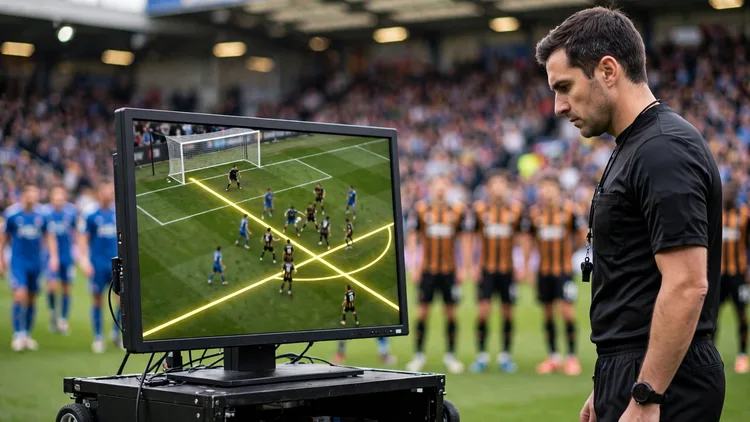
Brennan Johnson's Goal at Hull Is Ruled Out by a Subjective Offside Everton Have Seen Before
Brennan Johnson's goal for Everton at Hull was disallowed after a VAR review for a subjective offside, his second disallowed-goal controversy in two games.
Botman Escapes a Red Card at Newcastle as Jackson Says He Nearly Broke His Leg
Sven Botman stayed on after a VAR check for serious foul play against Aston Villa, with the referee's own published words calling the challenge reckless.
Yarmolyuk's Headbutt Earns a Red Card but No Penalty as Liverpool Beat Brentford 2-1
Yehor Yarmolyuk was sent off for a headbutting action on Jeremy Jacquet before a corner at Brentford, and Liverpool got no penalty because the ball was dead.
Gravenberch's Red Card Splits the Verdicts: Harsh First Yellow, Clear Second
Ryan Gravenberch was sent off at Anfield after two yellows in 15 minutes. Former referees call the first harsh and the second correct, and the pundits split.
Soucek Wins the Ball Outside the Box, QPR Get a Penalty, and West Ham Want Answers
Tomas Soucek's tackle on Paul Smyth won the ball outside the box, but QPR got a penalty in Friday's 1-1 draw, reigniting the Championship VAR debate.
Abu Farchi Is Sent Off Eight Minutes After Coming On as the Rapids Blow Another Lead
Saied Abu Farchi came on in the 60th minute and was sent off in the 68th for a hand to Michael Boxall's face as Colorado drew 2-2 with Minnesota.